



 Chat with AI
Exam 13: Perfect Competition

Exam 1: Economics and Economic Reasoning158 Questions
Exam 2: The Production Possibility Model, Trade, and Globalization133 Questions
Exam 3: Economic Institutions163 Questions
Exam 4: Supply and Demand182 Questions
Exam 5: Using Supply and Demand163 Questions
Exam 6: Describing Supply and Demand: Elasticities216 Questions
Exam 7: Taxation and Government Intervention201 Questions
Exam 8: Market Failure Versus Government Failure197 Questions
Exam 9: Comparative Advantage, Exchange Rates, and Globalization118 Questions
Exam 10: International Trade Policy99 Questions
Exam 11: Production and Cost Analysis I194 Questions
Exam 12: Production and Cost Analysis II152 Questions
Exam 13: Perfect Competition170 Questions
Exam 14: Monopoly and Monopolistic Competition274 Questions
Exam 15: Oligopoly and Antitrust Policy142 Questions
Exam 16: Real-World Competition and Technology108 Questions
Exam 17: Work and the Labor Market150 Questions
Exam 18: Who Gets What the Distribution of Income131 Questions
Exam 19: The Logic of Individual Choice: the Foundation of Supply and Demand170 Questions
Exam 20: Game Theory, Strategic Decision Making, and Behavioral Economics103 Questions
Exam 21: Thinking Like a Modern Economist97 Questions
Exam 22: Behavioral Economics and Modern Economic Policy126 Questions
Exam 23: Microeconomic Policy, Economic Reasoning, and Beyond134 Questions
Exam 24: Economic Growth, Business Cycles, and Unemployment124 Questions
Exam 25: Measuring and Describing the Aggregate Economy229 Questions
Exam 26: The Keynesian Short-Run Policy Model: Demand-Side Policies220 Questions
Exam 27: The Classical Long-Run Policy Model: Growth and Supply-Side Policies133 Questions
Exam 28: The Financial Sector and the Economy214 Questions
Exam 29: Monetary Policy243 Questions
Exam 30: Financial Crises, Panics, and Unconventional Monetary Policy109 Questions
Exam 31: Deficits and Debt: the Austerity Debate150 Questions
Exam 32: The Fiscal Policy Dilemma119 Questions
Exam 33: Jobs and Unemployment78 Questions
Exam 34: Inflation, Deflation, and Macro Policy175 Questions
Exam 35: International Financial Policy211 Questions
Exam 36: Macro Policy in a Global Setting134 Questions
Exam 37: Structural Stagnation and Globalization125 Questions
Exam 38: Macro Policy in Developing Countries142 Questions
Select questions type


A firm will continue to operate in the long run as long as price exceeds long-run average variable cost.
(True/False)
5.0/5  (69)
(69) Refer to the graph shown. What area represents total economic profits? 
(Multiple Choice)
4.8/5 (84)
(84) Refer to the graphs shown, which depict a perfectly competitive market and firm. If market demand decreases from D0 to D1, the firm will: 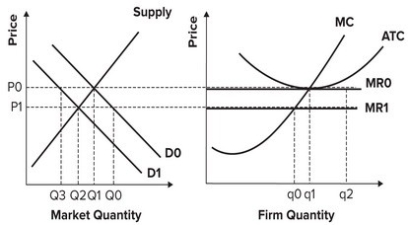
(Multiple Choice)
4.7/5 (85)
(85) Refer to the graph shown. To maximize profit, this perfectly competitive firm should produce: 
(Multiple Choice)
4.9/5 (96)
(96) Refer to the graph shown. Suppose that the market price is $5. At this price, a perfectly competitive firm should: 
(Multiple Choice)
4.9/5 (76)
(76) Retail stores generally set a fixed price and let people buy all they want at that price.Does that mean that the supply curve of those goods is perfectly elastic?
(Essay)
4.8/5 (76)
(76) Using the following diagram,demonstrate graphically and explain verbally why Q0 is not a profit maximizing output level. 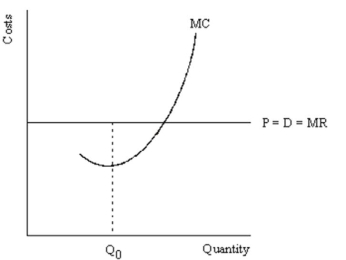
(Essay)
4.9/5 (83)
(83) The existence of positive economic profits in an industry attracts new entrants into the industry.
(True/False)
4.7/5 (73)
(73) Refer to the graph shown. Assuming that the industry continues to operate under conditions of perfect competition and that the cost curves do not shift, in the long run this firm will produce: 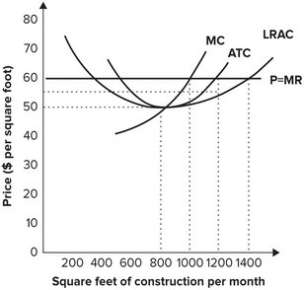
(Multiple Choice)
4.9/5 (73)
(73) Refer to the graph shown. What level of output should the perfectly competitive firm produce to maximize profits? 
(Multiple Choice)
4.9/5 (85)
(85) Refer to the graph shown, which depicts a perfectly competitive firm. When maximizing profit, the firm represented will earn per-unit profit roughly equal to: 
(Multiple Choice)
4.9/5 (76)
(76) Suppose a perfectly competitive firm can increase its profits by reducing its output. Then it must be the case that the firm's:
(Multiple Choice)
4.8/5 (79)
(79) Refer to the graph shown. Assuming that the industry operates under conditions of perfect competition and that the cost curves do not shift, the price of construction in a long-run competitive equilibrium will be: 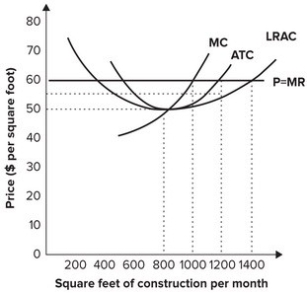
(Multiple Choice)
4.9/5 (82)
(82) Refer to the graphs shown, which depict a perfectly competitive market and firm. If market demand is D0, the: 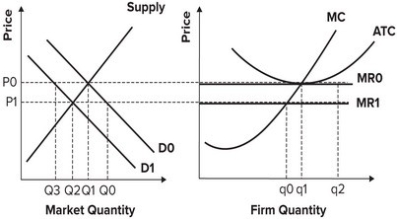
(Multiple Choice)
4.8/5 (78)
(78) Define a perfectly competitive market,and list the six conditions necessary for a market to be perfectly competitive.
(Essay)
4.9/5 (81)
(81) Refer to the graph shown. Other things equal, an increase in the market price of this product will cause: 
(Multiple Choice)
4.7/5 (65)
(65) Refer to the graph shown, which depicts a perfectly competitive firm. To maximize profit, the firm represented will produce: 
(Multiple Choice)
4.9/5 (89)
(89) Demonstrate graphically and explain verbally where the level of output should be when a perfectly competitive firm is earning a positive economic profit.Be sure to label the profit maximizing level of output and shade in the area that represents profit.
(Essay)
4.9/5 (77)
(77) Firms continue to produce (illegally)counterfeit computer software and documentation. Some of the illegal copies are Microsoft products, though Microsoft still has a large share of the market for its products. The presence of enforced copyright protection laws indicates that the market for Microsoft software cannot be considered a competitive market because:
(Multiple Choice)
4.8/5 (88)
(88) The market demand curve for a product produced in a perfectly competitive industry is normally:
(Multiple Choice)
4.8/5 (94)
(94) 
Filters
- Essay(0)
- Multiple Choice(0)
- Short Answer(0)
- True False(0)
- Matching(0)