



 Chat with AI
Exam 37: Vital Signs and Measurements

Exam 1: Introduction to Medical Assisting76 Questions
Exam 2: Healthcare and the Healthcare Team80 Questions
Exam 3: Professionalism and Success75 Questions
Exam 4: Interpersonal Communication97 Questions
Exam 5: Legal and Ethical Issues85 Questions
Exam 6: Infection Control Fundamentals74 Questions
Exam 7: Safety and Patient Reception73 Questions
Exam 8: Office Equipment and Supplies155 Questions
Exam 9: Examination and Treatment Areas97 Questions
Exam 10: Written and Electronic Communication84 Questions
Exam 11: Medical Records and Documentation75 Questions
Exam 12: Electronic Health Records72 Questions
Exam 13: Managing Medical Records74 Questions
Exam 14: Telephone Techniques89 Questions
Exam 15: Patient Education75 Questions
Exam 16: Schedule Management80 Questions
Exam 17: Insurance Billing80 Questions
Exam 18: Diagnostic Coding74 Questions
Exam 19: Procedure Coding75 Questions
Exam 20: Patient Collections and Financial Management142 Questions
Exam 21: Organization of the Body145 Questions
Exam 22: The Integumentary System100 Questions
Exam 23: The Skeletal System154 Questions
Exam 24: The Muscular System100 Questions
Exam 25: The Cardiovascular System89 Questions
Exam 26: The Blood74 Questions
Exam 27: The Lymphatic and Immune Systems78 Questions
Exam 28: The Respiratory System91 Questions
Exam 29: The Nervous System130 Questions
Exam 30: The Urinary System91 Questions
Exam 31: The Reproductive Systems124 Questions
Exam 32: The Digestive System112 Questions
Exam 33: The Endocrine System80 Questions
Exam 34: Special Senses92 Questions
Exam 35: Infection Control Practices105 Questions
Exam 36: Patient Interview and History96 Questions
Exam 37: Vital Signs and Measurements93 Questions
Exam 38: Assisting With a General Physical Exam75 Questions
Exam 39: Assisting in Reproductive and Urinary Specialties74 Questions
Exam 40: Assisting in Pediatrics75 Questions
Exam 41: Assisting in Geriatrics75 Questions
Exam 42: Assisting in Other Medical Specialties75 Questions
Exam 43: Assisting in Eye and Ear Care75 Questions
Exam 44: Assisting in Minor Surgery92 Questions
Exam 45: Orientation to the Lab85 Questions
Exam 46: Microbiology and Disease117 Questions
Exam 47: Processing and Testing Urine and Stool Samples95 Questions
Exam 48: Collecting, Processing, and Testing Blood Specimens75 Questions
Exam 49: Electrocardiography and Pulmonary Function Testing94 Questions
Exam 50: Diagnostic Imaging79 Questions
Exam 51: Principles of Pharmacology104 Questions
Exam 52: Math and Dosage Calculations74 Questions
Exam 53: Medication Administration76 Questions
Exam 54: Physical Therapy and Rehabilitation78 Questions
Exam 55: Nutrition and Health90 Questions
Exam 56: Practice Management76 Questions
Exam 57: Emergency Preparedness105 Questions
Exam 58: Preparing for the World of Work76 Questions
Select questions type


A systolic reading between 120 and 139 mm Hg and a diastolic reading between 80 and 89 mm Hg is considered ________.
(Short Answer)
4.8/5  (73)
(73) The measurement on this sphygmomanometer gauge is ________ mm Hg. 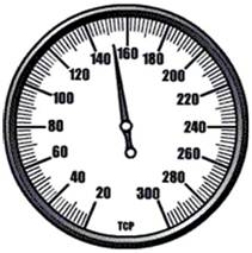
(Short Answer)
4.8/5 (90)
(90) A(n) _______ amplifies body sounds, making them louder, and consists of earpieces, binaurals, rubber or plastic tubing, and a chestpiece.
(Short Answer)
4.9/5 (71)
(71) A patient with a pulse rate of 45 beats per minute is said to have ________.
(Multiple Choice)
4.7/5 (83)
(83) Which of the following is an accurate statement about a stethoscope?
(Multiple Choice)
4.8/5 (86)
(86) The measurement on this sphygmomanometer gauge is ________ mm Hg. 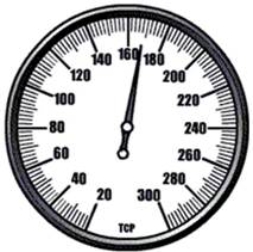
(Short Answer)
4.8/5 (96)
(96) The normal adult range for respirations per minute is ____.
(Multiple Choice)
4.8/5 (82)
(82) The vital signs are taken in different positions to assess for orthostatic, or ________, hypotension.
(Short Answer)
4.8/5 (87)
(87) The measurement on this sphygmomanometer gauge is ________ mm Hg. 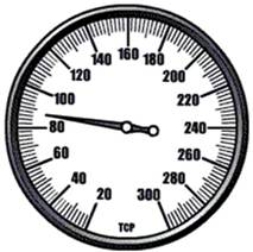
(Short Answer)
4.8/5 (81)
(81) Quint Gardner, a 35-year-old established patient, is in the office for his annual checkup. He says he feels great, and he appears to be in good physical condition. According to office policy, you check his blood pressure using the aneroid sphygmomanometer and his temperature using an axillary thermometer. His vital signs are: BP: 118/88, R: 16, T: 102.4, P: 62. Given these vitals what would the medical assistant's next step be?
(Multiple Choice)
4.8/5 (74)
(74) When taking an infant's pulse, if the brachial artery cannot be felt, which pulse site would be checked?
(Multiple Choice)
4.9/5 (82)
(82) A patient's blood pressure is checked standing and sitting. There is an increase in the pulse rate of more than 10 bpm, and the blood pressure drops more than 20 points, so this patient is considered to have orthostatic hypotension. This is sometimes documented as a positive ________ test.
(Short Answer)
4.7/5 (76)
(76) Which of the following is important when taking a rectal temperature?
(Multiple Choice)
4.7/5 (73)
(73) A patient with a body mass index (BMI) of 30 or more is considered to be ______.
(Short Answer)
4.8/5 (89)
(89) Convert 101.2ºF to Celsius: ________ºC. (round to the nearest tenth)
(Short Answer)
4.8/5 (77)
(77) Pulse is measured as the number of times the heart beats in ____.
(Multiple Choice)
4.8/5 (70)
(70) The pulse point that is located in the bend of the elbow is called the ____ pulse.
(Multiple Choice)
4.7/5 (84)
(84) The measurement on this sphygmomanometer gauge is ________ mm Hg. 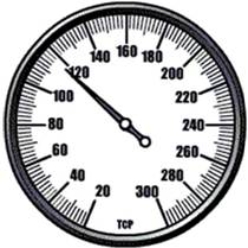
(Short Answer)
4.8/5 (83)
(83) Which of the following is the most accurate measurement of body temperature?
(Multiple Choice)
4.8/5 (92)
(92) 
Filters
- Essay(0)
- Multiple Choice(0)
- Short Answer(0)
- True False(0)
- Matching(0)