



 Chat with AI
Exam 37: Vital Signs and Measurements

Exam 1: Introduction to Medical Assisting76 Questions
Exam 2: Healthcare and the Healthcare Team80 Questions
Exam 3: Professionalism and Success75 Questions
Exam 4: Interpersonal Communication97 Questions
Exam 5: Legal and Ethical Issues85 Questions
Exam 6: Infection Control Fundamentals74 Questions
Exam 7: Safety and Patient Reception73 Questions
Exam 8: Office Equipment and Supplies155 Questions
Exam 9: Examination and Treatment Areas97 Questions
Exam 10: Written and Electronic Communication84 Questions
Exam 11: Medical Records and Documentation75 Questions
Exam 12: Electronic Health Records72 Questions
Exam 13: Managing Medical Records74 Questions
Exam 14: Telephone Techniques89 Questions
Exam 15: Patient Education75 Questions
Exam 16: Schedule Management80 Questions
Exam 17: Insurance Billing80 Questions
Exam 18: Diagnostic Coding74 Questions
Exam 19: Procedure Coding75 Questions
Exam 20: Patient Collections and Financial Management142 Questions
Exam 21: Organization of the Body145 Questions
Exam 22: The Integumentary System100 Questions
Exam 23: The Skeletal System154 Questions
Exam 24: The Muscular System100 Questions
Exam 25: The Cardiovascular System89 Questions
Exam 26: The Blood74 Questions
Exam 27: The Lymphatic and Immune Systems78 Questions
Exam 28: The Respiratory System91 Questions
Exam 29: The Nervous System130 Questions
Exam 30: The Urinary System91 Questions
Exam 31: The Reproductive Systems124 Questions
Exam 32: The Digestive System112 Questions
Exam 33: The Endocrine System80 Questions
Exam 34: Special Senses92 Questions
Exam 35: Infection Control Practices105 Questions
Exam 36: Patient Interview and History96 Questions
Exam 37: Vital Signs and Measurements93 Questions
Exam 38: Assisting With a General Physical Exam75 Questions
Exam 39: Assisting in Reproductive and Urinary Specialties74 Questions
Exam 40: Assisting in Pediatrics75 Questions
Exam 41: Assisting in Geriatrics75 Questions
Exam 42: Assisting in Other Medical Specialties75 Questions
Exam 43: Assisting in Eye and Ear Care75 Questions
Exam 44: Assisting in Minor Surgery92 Questions
Exam 45: Orientation to the Lab85 Questions
Exam 46: Microbiology and Disease117 Questions
Exam 47: Processing and Testing Urine and Stool Samples95 Questions
Exam 48: Collecting, Processing, and Testing Blood Specimens75 Questions
Exam 49: Electrocardiography and Pulmonary Function Testing94 Questions
Exam 50: Diagnostic Imaging79 Questions
Exam 51: Principles of Pharmacology104 Questions
Exam 52: Math and Dosage Calculations74 Questions
Exam 53: Medication Administration76 Questions
Exam 54: Physical Therapy and Rehabilitation78 Questions
Exam 55: Nutrition and Health90 Questions
Exam 56: Practice Management76 Questions
Exam 57: Emergency Preparedness105 Questions
Exam 58: Preparing for the World of Work76 Questions
Select questions type


Nina Trevez is a 32-year-old patient who is new to your medical office. During the initial patient interview, Ms. Trevez says her appendix was removed when she was 10 years old, she had a complete mastectomy of the left breast 5 years ago, and she has a severe allergy to penicillin. Which of the following actions would you be careful to take while taking Ms. Trevez's vital signs?
(Multiple Choice)
4.9/5  (86)
(86) Respiration is the number of times a patient breathes in ____ seconds.
(Multiple Choice)
4.8/5 (77)
(77) Convert 100.8ºF to Celsius: ________ºC. (round to the nearest tenth)
(Short Answer)
4.9/5 (86)
(86) In the figure, the pulse is being taken over the ________ artery. 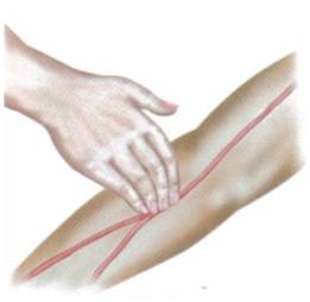
(Short Answer)
4.9/5 (90)
(90) The procedure called the ________ method provides an approximation of the systolic blood pressure to ensure an adequate level of cuff inflation when the actual measurement is made.
(Short Answer)
4.8/5 (75)
(75) To calculate a patient's ________ (BMI), a chart from the CDC or a handheld BMI calculator can be used.
(Short Answer)
4.7/5 (86)
(86) Electronic digital _______ are used frequently in medical offices and provide a fast and accurate digital readout of the patient's temperature.
(Short Answer)
4.9/5 (71)
(71) A blood pressure over 140 to 159 mm Hg systolic and 90 to 99 mm Hg diastolic is considered _________ hypertension.
(Short Answer)
4.8/5 (71)
(71) When taking a blood pressure, there are five phases that are heard after the cuff is deflated. These phases are called ____.
(Multiple Choice)
4.8/5 (76)
(76) Which of the following is not an internal factor that affects the blood pressure?
(Multiple Choice)
4.7/5 (81)
(81) 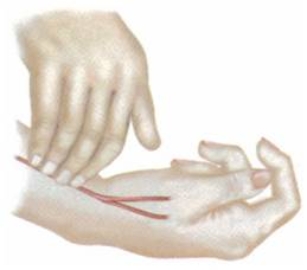
Which of the following thermometers provides the least accurate temperature reading?
(Multiple Choice)
4.9/5 (94)
(94) A(n) ________ consists of an inflatable cuff, a pressure bulb or automatic device for inflating the cuff, and a manometer to read the blood pressure.
(Short Answer)
4.9/5 (74)
(74) The vital signs are taken in different positions to assess for ________, or postural, hypotension.
(Short Answer)
4.9/5 (66)
(66) Mrs. Young called the medical office because her 6-year-old daughter Mary says she feels ill. Mrs. Young used a disposable thermometer to measure the child's temperature and found it to be 102.3° Fahrenheit. Which of the following would be the best response to Mrs. Young?
(Multiple Choice)
4.9/5 (90)
(90) The pressure measured when the left ventricle of the heart contracts is the ________ pressure, and it is the first heartbeat you hear when taking a blood pressure.
(Short Answer)
4.9/5 (78)
(78) Abnormally rapid, deep, and labored breathing is called ________.
(Short Answer)
4.9/5 (79)
(79) The brachial artery pulse point is located in the bend of the elbow, or the ________ space.
(Short Answer)
4.8/5 (86)
(86) Which of the following is a special consideration when taking blood pressure in adults?
(Multiple Choice)
4.9/5 (87)
(87) 
Filters
- Essay(0)
- Multiple Choice(0)
- Short Answer(0)
- True False(0)
- Matching(0)