



 Chat with AI
Exam 6: Energy Flow in the Life of a Cell

Exam 1: An Introduction to Life on Earth91 Questions
Exam 2: Atoms, Molecules, and Life90 Questions
Exam 3: Biological Molecules98 Questions
Exam 4: Cell Structure and Function90 Questions
Exam 5: Cell Membrane Structure and Function96 Questions
Exam 6: Energy Flow in the Life of a Cell90 Questions
Exam 7: Capturing Solar Energy: Photosynthesis101 Questions
Exam 8: Harvesting Energy: Glycolysis and Cellular Respiration91 Questions
Exam 9: The Continuity of Life: Cellular Reproduction90 Questions
Exam 10: Patterns of Inheritance93 Questions
Exam 11: Dna: the Molecule of Heredity90 Questions
Exam 12: Gene Expression and Regulation90 Questions
Exam 13: Biotechnology90 Questions
Exam 14: Principles of Evolution98 Questions
Exam 15: How Populations Evolve110 Questions
Exam 16: The Origin of Species92 Questions
Exam 17: The History of Life119 Questions
Exam 18: Systematics: Seeking Order Amidst Diversity91 Questions
Exam 19: The Diversity of Prokaryotes and Viruses97 Questions
Exam 20: The Diversity of Protists102 Questions
Exam 21: The Diversity of Plants103 Questions
Exam 22: The Diversity of Fungi105 Questions
Exam 23: Animal Diversity I: Invertebrates101 Questions
Exam 24: Animal Diversity Ii: Vertebrates118 Questions
Exam 25: Animal Behavior119 Questions
Exam 26: Population Growth and Regulation116 Questions
Exam 27: Community Interactions124 Questions
Exam 28: How Do Ecosystems Work124 Questions
Exam 29: Earths Diverse Ecosystems126 Questions
Exam 30: Conserving Earths Biodiversity110 Questions
Exam 31: Homeostasis and the Organization of the Animal Body95 Questions
Exam 32: Circulation89 Questions
Exam 33: Respiration92 Questions
Exam 34: Nutrition and Digestion91 Questions
Exam 35: The Urinary System90 Questions
Exam 36: Defenses Against Disease89 Questions
Exam 37: Chemical Control of the Animal Body: the Endocrine System129 Questions
Exam 38: The Nervous System111 Questions
Exam 39: The Senses90 Questions
Exam 40: Action and Support: the Muscles and Skeleton90 Questions
Exam 41: Animal Reproduction117 Questions
Exam 42: Animal Development123 Questions
Exam 43: Plant Anatomy and Nutrient Transport95 Questions
Exam 44: Plant Reproduction and Development90 Questions
Exam 45: Plant Responses to the Environment87 Questions
Select questions type


Preservatives such as citric acid are added to foods to interfere with bacterial growth. This creates an acidic pH in the food. Why does this affect the bacteria that are present?
(Multiple Choice)
4.8/5  (71)
(71) Imagine you are conducting an experiment on a yeast enzyme known as sucrase. This enzyme is used by yeast cells to break down sucrose into glucose and fructose. What type of reaction is this?
(Multiple Choice)
4.8/5 (79)
(79) Kinetic energy is like sitting at the top of a hill, and potential energy is like coasting down that hill on your bike. True or False?
(True/False)
4.9/5 (81)
(81) A "high-energy" bond in an ATP molecule is located between:
(Multiple Choice)
4.8/5 (70)
(70) What is a simple definition of energy, from a biological perspective? Give some examples of how energy is used in a cell.
(Essay)
4.8/5 (81)
(81) The burning of sugar is an example of an endergonic reaction, and photosynthesis is an example of an exergonic reaction. True or False?
(True/False)
4.8/5 (82)
(82) Most reactions in the body occur too slowly to sustain life. This is because:
(Multiple Choice)
4.8/5 (73)
(73) The photosynthetic reaction is considered to be an endergonic reaction. True or False?
(True/False)
4.8/5 (83)
(83) Sulfa antibiotics damage bacteria by affecting a certain bacterial enzyme. The sulfa antibiotic looks similar to a substrate normally required by the bacterial cells to live. The sulfa antibiotic occupies the active site of the required enzyme and blocks entry of its normal substrate. This prevents the bacteria from making nucleotides that are required for their reproduction and survival. Based on this information, the action of sulfa antibiotics is an example of:
(Multiple Choice)
4.9/5 (88)
(88) In cells, endergonic reactions are often coupled with enzymatic reactions that store energy. True or False?
(True/False)
4.8/5 (82)
(82) Animals have enzymes that break apart starch molecules but not cellulose, despite the fact that both are made up of glucose subunits. Which enzyme characteristic BEST explains this?
(Multiple Choice)
4.9/5 (80)
(80) Which of the following has the greatest amount of kinetic energy?
(Multiple Choice)
4.7/5 (81)
(81) ADP stores energy in its chemical bonds and is able to use that energy for work in the cell. True or False?
(True/False)
4.8/5 (74)
(74) Which of the enzymes shown must occur in the gastric region (stomach)of the gastrointestinal tract? 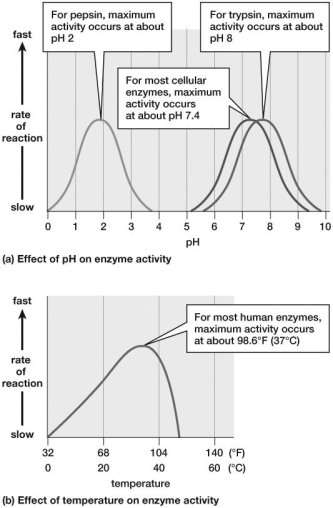
(Essay)
4.7/5 (92)
(92) In chemical reactions, ________ reactions release energy and ________ reactions require an input of energy.
(Essay)
4.9/5 (79)
(79) How is it possible for living organisms to comply with the second law of thermodynamics?
(Multiple Choice)
4.8/5 (87)
(87) 
Filters
- Essay(0)
- Multiple Choice(0)
- Short Answer(0)
- True False(0)
- Matching(0)