



 Chat with AI
Exam 6: Energy Flow in the Life of a Cell

Exam 1: An Introduction to Life on Earth91 Questions
Exam 2: Atoms, Molecules, and Life90 Questions
Exam 3: Biological Molecules98 Questions
Exam 4: Cell Structure and Function90 Questions
Exam 5: Cell Membrane Structure and Function96 Questions
Exam 6: Energy Flow in the Life of a Cell90 Questions
Exam 7: Capturing Solar Energy: Photosynthesis101 Questions
Exam 8: Harvesting Energy: Glycolysis and Cellular Respiration91 Questions
Exam 9: The Continuity of Life: Cellular Reproduction90 Questions
Exam 10: Patterns of Inheritance93 Questions
Exam 11: Dna: the Molecule of Heredity90 Questions
Exam 12: Gene Expression and Regulation90 Questions
Exam 13: Biotechnology90 Questions
Exam 14: Principles of Evolution98 Questions
Exam 15: How Populations Evolve110 Questions
Exam 16: The Origin of Species92 Questions
Exam 17: The History of Life119 Questions
Exam 18: Systematics: Seeking Order Amidst Diversity91 Questions
Exam 19: The Diversity of Prokaryotes and Viruses97 Questions
Exam 20: The Diversity of Protists102 Questions
Exam 21: The Diversity of Plants103 Questions
Exam 22: The Diversity of Fungi105 Questions
Exam 23: Animal Diversity I: Invertebrates101 Questions
Exam 24: Animal Diversity Ii: Vertebrates118 Questions
Exam 25: Animal Behavior119 Questions
Exam 26: Population Growth and Regulation116 Questions
Exam 27: Community Interactions124 Questions
Exam 28: How Do Ecosystems Work124 Questions
Exam 29: Earths Diverse Ecosystems126 Questions
Exam 30: Conserving Earths Biodiversity110 Questions
Exam 31: Homeostasis and the Organization of the Animal Body95 Questions
Exam 32: Circulation89 Questions
Exam 33: Respiration92 Questions
Exam 34: Nutrition and Digestion91 Questions
Exam 35: The Urinary System90 Questions
Exam 36: Defenses Against Disease89 Questions
Exam 37: Chemical Control of the Animal Body: the Endocrine System129 Questions
Exam 38: The Nervous System111 Questions
Exam 39: The Senses90 Questions
Exam 40: Action and Support: the Muscles and Skeleton90 Questions
Exam 41: Animal Reproduction117 Questions
Exam 42: Animal Development123 Questions
Exam 43: Plant Anatomy and Nutrient Transport95 Questions
Exam 44: Plant Reproduction and Development90 Questions
Exam 45: Plant Responses to the Environment87 Questions
Select questions type


Coupled reactions are important components of human physiology. Describe an example of a coupled reaction in the human body.
(Essay)
5.0/5  (88)
(88) When certain molecules are pumped across biological membranes against a concentration gradient via active transport, ATP is used. In our body cells, for example, sugars are actively transported and metabolized within the membrane-enclosed mitochondria. Prokaryotes, in contrast, lack mitochondria but are nonetheless able to metabolize the same sugars. Based on the details provided in this scenario, which of the following statements is expected to be TRUE?
(Multiple Choice)
4.9/5 (66)
(66) If this figure shows the metabolism of glucose and oxygen to CO2 and H2O, where do the carbon in CO2 and the hydrogen in H2O come from? 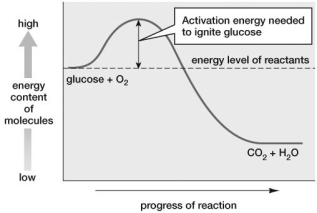
(Multiple Choice)
4.9/5 (69)
(69) The second law of thermodynamics states that the ________, or disorder, of the universe is constantly increasing.
(Essay)
4.9/5 (78)
(78) During photosynthesis, plants convert light energy to chemical energy. This is an example of:
(Multiple Choice)
5.0/5 (100)
(100) Which molecule functions in the short-term storage of energy?
(Multiple Choice)
4.9/5 (84)
(84) The end product of a biosynthetic pathway often acts to block the initial step in that pathway. This phenomenon is called:
(Multiple Choice)
4.7/5 (101)
(101) The burning of sugars as fuels for runners is an example of an ________ chemical reaction, whereas the production of sugars during photosynthesis is an example of an ________ chemical reaction.
(Essay)
4.9/5 (87)
(87) Imagine you are conducting an experiment on an enzyme known as sucrase. This enzyme is synthesized and used by yeast cells to break down the disaccharide sucrose (table sugar)into the monosaccharides glucose and fructose. You decide to conduct an experiment to test whether the sucrase enzyme can break down the artificial sweetener sucralose. Sucralose (a "chlorinated" carbohydrate)has some chemical similarity to sucrose, but is different in that three of its hydroxyl groups are missing and replaced with chlorine atoms instead. Based on the details provided in this scenario, do you think the sucrase enzyme will be able to interact with sucralose?
(Multiple Choice)
4.9/5 (88)
(88) Compare endergonic and exergonic chemical reactions using an analogy from everyday life.
(Essay)
4.9/5 (93)
(93) In an isolated system, all of the following are true of the second law of thermodynamics EXCEPT:
(Multiple Choice)
4.8/5 (84)
(84) Triclosan is a broad-spectrum antibacterial agent used in many household products. It is structurally similar to polychlorobiphenylol, a substrate that binds to the active site of the enzyme sulfotransferase. Based on these facts, you can conclude that triclosan most likely:
(Multiple Choice)
4.7/5 (77)
(77) An ________ chemical reaction releases energy, whereas an ________ reaction requires an input of energy.
(Multiple Choice)
4.8/5 (69)
(69) The addition of the competitive inhibitor slows down a particular reaction. How could you overcome the effects of the inhibitor and increase the rate of the reaction?
(Multiple Choice)
4.7/5 (75)
(75) Explain how enzymes decrease the activation energy required for biological processes in our bodies.
(Essay)
4.9/5 (84)
(84) 
Filters
- Essay(0)
- Multiple Choice(0)
- Short Answer(0)
- True False(0)
- Matching(0)