



 Chat with AI
Exam 11: Dna: the Molecule of Heredity

Exam 1: An Introduction to Life on Earth91 Questions
Exam 2: Atoms, Molecules, and Life90 Questions
Exam 3: Biological Molecules98 Questions
Exam 4: Cell Structure and Function90 Questions
Exam 5: Cell Membrane Structure and Function96 Questions
Exam 6: Energy Flow in the Life of a Cell90 Questions
Exam 7: Capturing Solar Energy: Photosynthesis101 Questions
Exam 8: Harvesting Energy: Glycolysis and Cellular Respiration91 Questions
Exam 9: The Continuity of Life: Cellular Reproduction90 Questions
Exam 10: Patterns of Inheritance93 Questions
Exam 11: Dna: the Molecule of Heredity90 Questions
Exam 12: Gene Expression and Regulation90 Questions
Exam 13: Biotechnology90 Questions
Exam 14: Principles of Evolution98 Questions
Exam 15: How Populations Evolve110 Questions
Exam 16: The Origin of Species92 Questions
Exam 17: The History of Life119 Questions
Exam 18: Systematics: Seeking Order Amidst Diversity91 Questions
Exam 19: The Diversity of Prokaryotes and Viruses97 Questions
Exam 20: The Diversity of Protists102 Questions
Exam 21: The Diversity of Plants103 Questions
Exam 22: The Diversity of Fungi105 Questions
Exam 23: Animal Diversity I: Invertebrates101 Questions
Exam 24: Animal Diversity Ii: Vertebrates118 Questions
Exam 25: Animal Behavior119 Questions
Exam 26: Population Growth and Regulation116 Questions
Exam 27: Community Interactions124 Questions
Exam 28: How Do Ecosystems Work124 Questions
Exam 29: Earths Diverse Ecosystems126 Questions
Exam 30: Conserving Earths Biodiversity110 Questions
Exam 31: Homeostasis and the Organization of the Animal Body95 Questions
Exam 32: Circulation89 Questions
Exam 33: Respiration92 Questions
Exam 34: Nutrition and Digestion91 Questions
Exam 35: The Urinary System90 Questions
Exam 36: Defenses Against Disease89 Questions
Exam 37: Chemical Control of the Animal Body: the Endocrine System129 Questions
Exam 38: The Nervous System111 Questions
Exam 39: The Senses90 Questions
Exam 40: Action and Support: the Muscles and Skeleton90 Questions
Exam 41: Animal Reproduction117 Questions
Exam 42: Animal Development123 Questions
Exam 43: Plant Anatomy and Nutrient Transport95 Questions
Exam 44: Plant Reproduction and Development90 Questions
Exam 45: Plant Responses to the Environment87 Questions
Select questions type


What is the relationship among DNA, a gene, and a chromosome?
(Multiple Choice)
4.8/5  (78)
(78) In Griffith's experiments, what happened when heat-killed S-strain bacteria were injected into a mouse along with live R-strain bacteria?
(Multiple Choice)
4.8/5 (76)
(76) The molecule ________ carries the genetic "blueprints" for all forms of life on Earth.
(Essay)
4.9/5 (80)
(80) It became apparent to Watson and Crick after completing their model that a DNA molecule could carry a vast amount of hereditary information in its:
(Multiple Choice)
4.9/5 (84)
(84) By the early 1950s, many biologists realized that the key to understanding inheritance lay in the structure of:
(Multiple Choice)
4.9/5 (85)
(85) Newly replicated DNA strands contain (on average)one mistake for every:
(Multiple Choice)
4.7/5 (79)
(79) Watson and Crick are credited with the discovery and description of the DNA:
(Multiple Choice)
4.8/5 (82)
(82) Based on this figure, which type(s)of bacteria would you expect to be isolated from the dead mouse in the final experiment (involving the mixture of bacterial strains)? 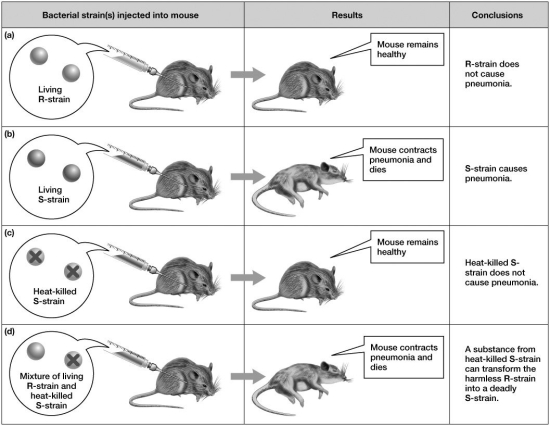
(Multiple Choice)
4.8/5 (96)
(96) Segments of DNA that are made during replication are joined together by ________.
(Essay)
4.8/5 (96)
(96) The number of subunits in a DNA molecule is more important to its function than the sequence of these subunits. True or False?
(True/False)
4.8/5 (76)
(76) Most mutations are harmful, although some can be beneficial. True or False?
(True/False)
4.8/5 (71)
(71) Bacterial cells have only one DNA molecule, which is double stranded and is replicated in essentially the same fashion as in eukaryotes. Imagine that, following the techniques of other scientists studying DNA, you created a bacterial cell that contains only radioactive nitrogen in its DNA. You then place the cell in a culture medium containing only "regular" (nonradioactive)nitrogen, Based on this scenario and your knowledge of DNA structure and replication, how many cells will contain some DNA with radioactive nitrogen after four rounds of cell replication?
(Multiple Choice)
4.7/5 (77)
(77) DNA replication occurs without errors due to the complementary base pairing used in the copying process. True or False?
(True/False)
4.8/5 (78)
(78) Which component of a DNA nucleotide could be removed without breaking the polynucleotide chain?
(Multiple Choice)
4.9/5 (88)
(88) The two polynucleotide chains in a DNA molecule are attached to each other by:
(Multiple Choice)
4.9/5 (96)
(96) 
Filters
- Essay(0)
- Multiple Choice(0)
- Short Answer(0)
- True False(0)
- Matching(0)