



 Chat with AI
Exam 17: The History of Life

Exam 1: An Introduction to Life on Earth91 Questions
Exam 2: Atoms, Molecules, and Life90 Questions
Exam 3: Biological Molecules98 Questions
Exam 4: Cell Structure and Function90 Questions
Exam 5: Cell Membrane Structure and Function96 Questions
Exam 6: Energy Flow in the Life of a Cell90 Questions
Exam 7: Capturing Solar Energy: Photosynthesis101 Questions
Exam 8: Harvesting Energy: Glycolysis and Cellular Respiration91 Questions
Exam 9: The Continuity of Life: Cellular Reproduction90 Questions
Exam 10: Patterns of Inheritance93 Questions
Exam 11: Dna: the Molecule of Heredity90 Questions
Exam 12: Gene Expression and Regulation90 Questions
Exam 13: Biotechnology90 Questions
Exam 14: Principles of Evolution98 Questions
Exam 15: How Populations Evolve110 Questions
Exam 16: The Origin of Species92 Questions
Exam 17: The History of Life119 Questions
Exam 18: Systematics: Seeking Order Amidst Diversity91 Questions
Exam 19: The Diversity of Prokaryotes and Viruses97 Questions
Exam 20: The Diversity of Protists102 Questions
Exam 21: The Diversity of Plants103 Questions
Exam 22: The Diversity of Fungi105 Questions
Exam 23: Animal Diversity I: Invertebrates101 Questions
Exam 24: Animal Diversity Ii: Vertebrates118 Questions
Exam 25: Animal Behavior119 Questions
Exam 26: Population Growth and Regulation116 Questions
Exam 27: Community Interactions124 Questions
Exam 28: How Do Ecosystems Work124 Questions
Exam 29: Earths Diverse Ecosystems126 Questions
Exam 30: Conserving Earths Biodiversity110 Questions
Exam 31: Homeostasis and the Organization of the Animal Body95 Questions
Exam 32: Circulation89 Questions
Exam 33: Respiration92 Questions
Exam 34: Nutrition and Digestion91 Questions
Exam 35: The Urinary System90 Questions
Exam 36: Defenses Against Disease89 Questions
Exam 37: Chemical Control of the Animal Body: the Endocrine System129 Questions
Exam 38: The Nervous System111 Questions
Exam 39: The Senses90 Questions
Exam 40: Action and Support: the Muscles and Skeleton90 Questions
Exam 41: Animal Reproduction117 Questions
Exam 42: Animal Development123 Questions
Exam 43: Plant Anatomy and Nutrient Transport95 Questions
Exam 44: Plant Reproduction and Development90 Questions
Exam 45: Plant Responses to the Environment87 Questions
Select questions type


The idea that river mud left in the sun will turn into frogs illustrates:
(Multiple Choice)
4.8/5  (76)
(76) 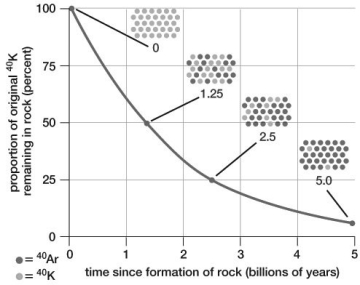 -Based on the graph, if 60% of the original 40K remains in a sample of basalt, what is the approximate age of the rock?
 (Multiple Choice)
4.8/5 (69)
(69) Which of the following is assumed to be more primitive than a dinosaur and more complex than a shark?
(Multiple Choice)
4.9/5 (75)
(75) The theory that life began in the distant past from nonliving molecules that became able to reproduce themselves is called:
(Multiple Choice)
4.7/5 (84)
(84) The extinction of the dinosaurs is thought to be due to a massive meteorite impact. True or False?
(True/False)
4.9/5 (82)
(82) Which arthropod characteristic "pre-adapted" them to life on land?
(Multiple Choice)
4.8/5 (85)
(85) The fossil evidence indicates that amphibians evolved from ________.
(Essay)
4.8/5 (73)
(73) The hobbit-sized hominin whose fossilized remains were recently discovered on a remote oceanic island belonged to the species:
(Multiple Choice)
4.8/5 (81)
(81) Which group of vertebrates was the first to evolve a waterproof egg, which allowed the group to move away from water, deeper onto dry land?
(Multiple Choice)
4.8/5 (74)
(74) Most scientists attribute the mass extinction of the dinosaurs to:
(Multiple Choice)
4.7/5 (68)
(68) Modern invertebrates first appear in the fossil record during the:
(Multiple Choice)
4.9/5 (86)
(86) Explain why an organism that carries on aerobic metabolism has an advantage over an organism that uses anaerobic metabolism.
(Essay)
4.7/5 (96)
(96) Eggs and scales enabled reptiles to dominate land during the Permian period. True or False?
(True/False)
4.8/5 (84)
(84) While exploring a sulfur spring, a scientist finds a new organism. It is single-celled, lacks a cell wall, has a few internal membranes, and appears to have set up a symbiotic relationship with a species of free-living purple sulfur bacteria that are common in the spring. There are no other organisms within it. This new organism would be considered a(n):
(Multiple Choice)
4.8/5 (82)
(82) The first land plants were restricted to moist, marshy environments because of:
(Multiple Choice)
4.8/5 (77)
(77) 
Filters
- Essay(0)
- Multiple Choice(0)
- Short Answer(0)
- True False(0)
- Matching(0)