



 Chat with AI
Exam 17: The History of Life

Exam 1: An Introduction to Life on Earth91 Questions
Exam 2: Atoms, Molecules, and Life90 Questions
Exam 3: Biological Molecules98 Questions
Exam 4: Cell Structure and Function90 Questions
Exam 5: Cell Membrane Structure and Function96 Questions
Exam 6: Energy Flow in the Life of a Cell90 Questions
Exam 7: Capturing Solar Energy: Photosynthesis101 Questions
Exam 8: Harvesting Energy: Glycolysis and Cellular Respiration91 Questions
Exam 9: The Continuity of Life: Cellular Reproduction90 Questions
Exam 10: Patterns of Inheritance93 Questions
Exam 11: Dna: the Molecule of Heredity90 Questions
Exam 12: Gene Expression and Regulation90 Questions
Exam 13: Biotechnology90 Questions
Exam 14: Principles of Evolution98 Questions
Exam 15: How Populations Evolve110 Questions
Exam 16: The Origin of Species92 Questions
Exam 17: The History of Life119 Questions
Exam 18: Systematics: Seeking Order Amidst Diversity91 Questions
Exam 19: The Diversity of Prokaryotes and Viruses97 Questions
Exam 20: The Diversity of Protists102 Questions
Exam 21: The Diversity of Plants103 Questions
Exam 22: The Diversity of Fungi105 Questions
Exam 23: Animal Diversity I: Invertebrates101 Questions
Exam 24: Animal Diversity Ii: Vertebrates118 Questions
Exam 25: Animal Behavior119 Questions
Exam 26: Population Growth and Regulation116 Questions
Exam 27: Community Interactions124 Questions
Exam 28: How Do Ecosystems Work124 Questions
Exam 29: Earths Diverse Ecosystems126 Questions
Exam 30: Conserving Earths Biodiversity110 Questions
Exam 31: Homeostasis and the Organization of the Animal Body95 Questions
Exam 32: Circulation89 Questions
Exam 33: Respiration92 Questions
Exam 34: Nutrition and Digestion91 Questions
Exam 35: The Urinary System90 Questions
Exam 36: Defenses Against Disease89 Questions
Exam 37: Chemical Control of the Animal Body: the Endocrine System129 Questions
Exam 38: The Nervous System111 Questions
Exam 39: The Senses90 Questions
Exam 40: Action and Support: the Muscles and Skeleton90 Questions
Exam 41: Animal Reproduction117 Questions
Exam 42: Animal Development123 Questions
Exam 43: Plant Anatomy and Nutrient Transport95 Questions
Exam 44: Plant Reproduction and Development90 Questions
Exam 45: Plant Responses to the Environment87 Questions
Select questions type


Miller and Urey's experiments attempting to recreate the prebiotic environment produced a rich mixture of complex organic chemicals from simple chemicals. True or False?
(True/False)
4.9/5  (92)
(92) All the life forms found in the Silurian fossil record are still alive today. True or False?
(True/False)
4.9/5 (72)
(72) The generally slow and steady succession of species on Earth has been interrupted by:
(Multiple Choice)
4.8/5 (83)
(83) The experiments that demonstrated that meat does not spontaneously generate maggots were conducted by:
(Multiple Choice)
4.7/5 (78)
(78) Miller and Urey's experiments to simulate prebiotic evolution produced:
(Multiple Choice)
4.9/5 (79)
(79) Theories on the atmosphere of early Earth indicate that it lacked:
(Multiple Choice)
4.8/5 (75)
(75) Laboratory research has shown that if a solution containing lipids and proteins is agitated for a long time, then hollow, membrane-bound structures called ________ are produced.
(Essay)
4.8/5 (73)
(73) 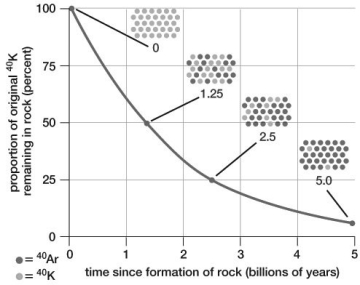 -Based on the graph, if 35% of the original 40K remains in a sample of basalt, what is the approximate age of the rock?
 (Multiple Choice)
4.9/5 (80)
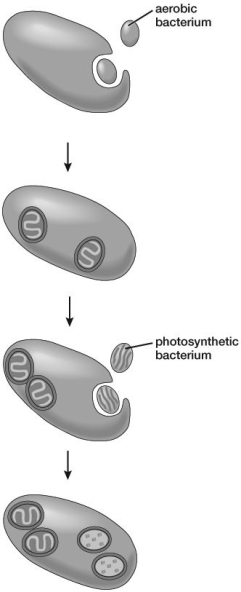
(80) 
Climate change has been linked to mass extinctions. True or False?
(True/False)
4.9/5 (75)
(75) The organisms originally responsible for putting oxygen in Earth's atmosphere lived around:
(Multiple Choice)
4.9/5 (86)
(86) Mitochondria contain their own DNA, separate from that of the rest of the cell. True or False?
(True/False)
4.9/5 (86)
(86) Homo heidelbergensis is believed to be the ancestor species of:
(Multiple Choice)
4.9/5 (71)
(71) The oxygen that arose in early Earth's atmosphere was likely produced by organisms that were very similar to modern:
(Multiple Choice)
4.9/5 (72)
(72) 
Filters
- Essay(0)
- Multiple Choice(0)
- Short Answer(0)
- True False(0)
- Matching(0)