



 Chat with AI
Exam 38: The Nervous System

Exam 1: An Introduction to Life on Earth91 Questions
Exam 2: Atoms, Molecules, and Life90 Questions
Exam 3: Biological Molecules98 Questions
Exam 4: Cell Structure and Function90 Questions
Exam 5: Cell Membrane Structure and Function96 Questions
Exam 6: Energy Flow in the Life of a Cell90 Questions
Exam 7: Capturing Solar Energy: Photosynthesis101 Questions
Exam 8: Harvesting Energy: Glycolysis and Cellular Respiration91 Questions
Exam 9: The Continuity of Life: Cellular Reproduction90 Questions
Exam 10: Patterns of Inheritance93 Questions
Exam 11: Dna: the Molecule of Heredity90 Questions
Exam 12: Gene Expression and Regulation90 Questions
Exam 13: Biotechnology90 Questions
Exam 14: Principles of Evolution98 Questions
Exam 15: How Populations Evolve110 Questions
Exam 16: The Origin of Species92 Questions
Exam 17: The History of Life119 Questions
Exam 18: Systematics: Seeking Order Amidst Diversity91 Questions
Exam 19: The Diversity of Prokaryotes and Viruses97 Questions
Exam 20: The Diversity of Protists102 Questions
Exam 21: The Diversity of Plants103 Questions
Exam 22: The Diversity of Fungi105 Questions
Exam 23: Animal Diversity I: Invertebrates101 Questions
Exam 24: Animal Diversity Ii: Vertebrates118 Questions
Exam 25: Animal Behavior119 Questions
Exam 26: Population Growth and Regulation116 Questions
Exam 27: Community Interactions124 Questions
Exam 28: How Do Ecosystems Work124 Questions
Exam 29: Earths Diverse Ecosystems126 Questions
Exam 30: Conserving Earths Biodiversity110 Questions
Exam 31: Homeostasis and the Organization of the Animal Body95 Questions
Exam 32: Circulation89 Questions
Exam 33: Respiration92 Questions
Exam 34: Nutrition and Digestion91 Questions
Exam 35: The Urinary System90 Questions
Exam 36: Defenses Against Disease89 Questions
Exam 37: Chemical Control of the Animal Body: the Endocrine System129 Questions
Exam 38: The Nervous System111 Questions
Exam 39: The Senses90 Questions
Exam 40: Action and Support: the Muscles and Skeleton90 Questions
Exam 41: Animal Reproduction117 Questions
Exam 42: Animal Development123 Questions
Exam 43: Plant Anatomy and Nutrient Transport95 Questions
Exam 44: Plant Reproduction and Development90 Questions
Exam 45: Plant Responses to the Environment87 Questions
Select questions type


Memory, sensory processing, motor responses, creativity, and higher intellectual functions are carried out by the:
(Multiple Choice)
4.9/5  (77)
(77) The control centers for breathing, blood pressure, and heart rate are located in the medulla. True or False?
(True/False)
4.9/5 (75)
(75) The intensity of a stimulus is indicated by the ________ of action potentials.
(Multiple Choice)
4.9/5 (79)
(79) Why do negative charges tend to remain inside the cell during both the resting potential and the action potential?
(Essay)
4.8/5 (80)
(80) The part of the brain that controls involuntary actions, such as breathing, is the:
(Multiple Choice)
4.7/5 (85)
(85) The hippocampus is responsible for processing visual stimuli. True or False?
(True/False)
4.7/5 (83)
(83) Neurotransmitters are released from the dendrite side of the synapse. True or False?
(True/False)
4.8/5 (80)
(80) 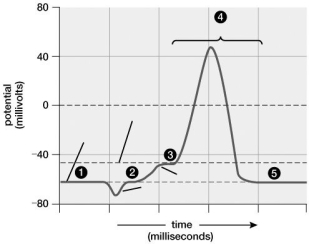 -In the graph, ________ indicates the action potential.
The repeated use of drugs such as cocaine results in a decrease in the response of the neurons to the drug. Why?
(Essay)
4.9/5 (81)
(81) A person responds to touching a pan taken from the hot oven by pulling his hand away before he realizes that the pan is cold. Why does he respond before he can think?
(Essay)
4.9/5 (82)
(82) Cells maintain a resting membrane potential, with a higher K+ concentration on the inside of the cell membrane. True or False?
(True/False)
4.9/5 (93)
(93) In a nerve cell at its resting potential, ________ are closed.
(Multiple Choice)
4.8/5 (63)
(63) Which portion of the neuron typically receives information?
(Multiple Choice)
4.9/5 (100)
(100) You just finished watching a scary movie. Now, while taking out the trash, you notice that the street light is out and it is very dark. You hear something rattling the trash cans, just like in the movie before the monster attacked. Suddenly the neighbor's cat jumps up onto the top of the trash can and you shriek. Your heart is pounding. Your reaction is caused by the neurotransmitter:
(Multiple Choice)
4.9/5 (89)
(89) The ________ is a cluster of neurons that plays a role in wakesleep cycles, muscle tone, emotions, and some reflexes.
(Essay)
4.9/5 (79)
(79) 
Filters
- Essay(0)
- Multiple Choice(0)
- Short Answer(0)
- True False(0)
- Matching(0)