



 Chat with AI
Exam 38: The Nervous System

Exam 1: An Introduction to Life on Earth91 Questions
Exam 2: Atoms, Molecules, and Life90 Questions
Exam 3: Biological Molecules98 Questions
Exam 4: Cell Structure and Function90 Questions
Exam 5: Cell Membrane Structure and Function96 Questions
Exam 6: Energy Flow in the Life of a Cell90 Questions
Exam 7: Capturing Solar Energy: Photosynthesis101 Questions
Exam 8: Harvesting Energy: Glycolysis and Cellular Respiration91 Questions
Exam 9: The Continuity of Life: Cellular Reproduction90 Questions
Exam 10: Patterns of Inheritance93 Questions
Exam 11: Dna: the Molecule of Heredity90 Questions
Exam 12: Gene Expression and Regulation90 Questions
Exam 13: Biotechnology90 Questions
Exam 14: Principles of Evolution98 Questions
Exam 15: How Populations Evolve110 Questions
Exam 16: The Origin of Species92 Questions
Exam 17: The History of Life119 Questions
Exam 18: Systematics: Seeking Order Amidst Diversity91 Questions
Exam 19: The Diversity of Prokaryotes and Viruses97 Questions
Exam 20: The Diversity of Protists102 Questions
Exam 21: The Diversity of Plants103 Questions
Exam 22: The Diversity of Fungi105 Questions
Exam 23: Animal Diversity I: Invertebrates101 Questions
Exam 24: Animal Diversity Ii: Vertebrates118 Questions
Exam 25: Animal Behavior119 Questions
Exam 26: Population Growth and Regulation116 Questions
Exam 27: Community Interactions124 Questions
Exam 28: How Do Ecosystems Work124 Questions
Exam 29: Earths Diverse Ecosystems126 Questions
Exam 30: Conserving Earths Biodiversity110 Questions
Exam 31: Homeostasis and the Organization of the Animal Body95 Questions
Exam 32: Circulation89 Questions
Exam 33: Respiration92 Questions
Exam 34: Nutrition and Digestion91 Questions
Exam 35: The Urinary System90 Questions
Exam 36: Defenses Against Disease89 Questions
Exam 37: Chemical Control of the Animal Body: the Endocrine System129 Questions
Exam 38: The Nervous System111 Questions
Exam 39: The Senses90 Questions
Exam 40: Action and Support: the Muscles and Skeleton90 Questions
Exam 41: Animal Reproduction117 Questions
Exam 42: Animal Development123 Questions
Exam 43: Plant Anatomy and Nutrient Transport95 Questions
Exam 44: Plant Reproduction and Development90 Questions
Exam 45: Plant Responses to the Environment87 Questions
Select questions type


Myelin slows the transmission of action potentials along their length. True or False?
(True/False)
4.9/5  (69)
(69) The resting potential of neurons is between ________ millivolts.
(Multiple Choice)
4.8/5 (77)
(77) The stronger the stimulus, the larger the action potential. True or False?
(True/False)
4.8/5 (87)
(87) The neurosecretory cells that control the release of hormones from the pituitary are located in the ________.
(Essay)
4.9/5 (85)
(85) A stimulus that is strong enough to change a resting potential into an action potential is said to be above a ________.
(Essay)
4.8/5 (86)
(86) 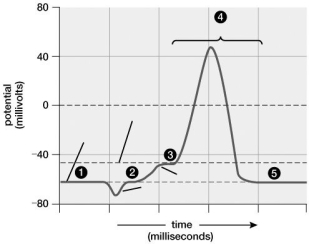 -In the graph, ________ indicates the resting membrane potential.
 (Multiple Choice)
4.9/5 (73)
(73) People with damage to the hippocampus seem to be unable to remember recent events even though their memory of events before the damage remains intact. This seems to indicate that the hippocampus is involved in:
(Multiple Choice)
4.8/5 (64)
(64) ________ carry signals from the central nervous system to the effector organs.
(Essay)
4.9/5 (81)
(81) Which of these neurotransmitters is released by neurons of the sympathetic nervous system?
(Multiple Choice)
4.9/5 (78)
(78) Nerve cells release compounds known as ________ into a synapse with adjacent cells.
(Essay)
5.0/5 (73)
(73) Taking a nap after meals is probably a good idea because it allows the body to digest the food as a result of the activities of the ________ nervous system.
(Multiple Choice)
4.8/5 (72)
(72) The brain is able to take sensory inputs from many neurons and integrate them into a few association areas. True or False?
(True/False)
4.8/5 (74)
(74) The effects of the sympathetic and parasympathetic nervous systems usually oppose each other. True or False?
(True/False)
4.9/5 (80)
(80) You walk in to take this test and feel that your food is sitting undigested in your stomach, your heart is beating rapidly, and you can't sit still. What part of your nervous system is primarily involved?
(Essay)
4.8/5 (87)
(87) GABA is a major inhibitory neurotransmitter in the brain. True or False?
(True/False)
4.9/5 (80)
(80) With one of the hemorrhagic fevers, a viral infection, the body loses the ability to adjust K+ levels. Why does this create neurological problems?
(Essay)
4.9/5 (71)
(71) 
Filters
- Essay(0)
- Multiple Choice(0)
- Short Answer(0)
- True False(0)
- Matching(0)