



 Chat with AI
Exam 2: B: The Market System and the Circular Flow

Exam 1: B: Limits, Alternatives, and Choices265 Questions
Exam 1: A: - Limits, Alternatives, and Choices60 Questions
Exam 2: B: The Market System and the Circular Flow119 Questions
Exam 2: A: - The Market System and the Circular Flow42 Questions
Exam 3: B: Demand, Supply, and Market Equilibrium291 Questions
Exam 3: A: - Demand, Supply, and Market Equilibrium51 Questions
Exam 4: B: Market Failures: Public Goods and Externalities133 Questions
Exam 4: A: - Market Failures: Public Goods and Externalities36 Questions
Exam 5: B: Governments Role and Government Failure121 Questions
Exam 5: A: Governments Role and Government Failure1 Questions
Exam 6: B: an Introduction to Macroeconomics65 Questions
Exam 6: A: an Introduction to Macroeconomics31 Questions
Exam 7: B: Measuring the Economys Output191 Questions
Exam 7: A: Measuring the Economys Output30 Questions
Exam 8: B: Economic Growth122 Questions
Exam 8: A: Economic Growth35 Questions
Exam 9: B: Business Cycles, Unemployment, and Inflation193 Questions
Exam 9: A: Business Cycles, Unemployment, and Inflation40 Questions
Exam 10: B: Basic Macroeconomic Relationships200 Questions
Exam 10: A: Basic Macroeconomic Relationships26 Questions
Exam 11: B: The Aggregate Expenditures Model238 Questions
Exam 11: A: The Aggregate Expenditures Model47 Questions
Exam 12: B: Aggregate Demand and Aggregate Supply203 Questions
Exam 12: A: Aggregate Demand and Aggregate Supply35 Questions
Exam 13: B: Fiscal Policy, Deficits, Surpluses, and Debt234 Questions
Exam 13: A: Fiscal Policy, Deficits, Surpluses, and Debt53 Questions
Exam 14: B: Money, Banking, and Money Creation206 Questions
Exam 14: A: Money, Banking, and Money Creation56 Questions
Exam 15: B: Interest Rates and Monetary Policy239 Questions
Exam 15: A: Interest Rates and Monetary Policy47 Questions
Exam 17: C: Financial Economics323 Questions
Exam 16: A: Long-Run Macroeconomic Adjustments28 Questions
Exam 16: B: Long-Run Macroeconomic Adjustments122 Questions
Exam 17: A: International Trade40 Questions
Exam 17: B: International Trade188 Questions
Exam 18: A: The Balance of Payments and Exchange Rates30 Questions
Exam 18: B: The Balance of Payments and Exchange Rates133 Questions
Exam 22: The Economics of Developing Countries254 Questions
Select questions type


The division of labour enhances productivity and efficiency by:
(Multiple Choice)
5.0/5  (69)
(69) "The 'dollar votes' of consumers ultimately determine the composition of output and the allocation of resources in a market economy." This statement best describes the concept of:
(Multiple Choice)
4.8/5 (92)
(92) The guiding function of prices indicates that, at equilibrium prices, neither product surpluses nor shortages can occur.
(True/False)
4.9/5 (82)
(82) 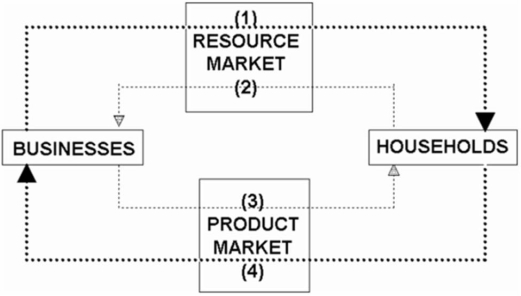 Refer to the circular flow model of the economy.In the diagram flow (4) represents:
 (Multiple Choice)
4.7/5 (71)
(71) Which is assumed to be most limited in scope under a market system?
(Multiple Choice)
4.9/5 (78)
(78) In market economies, profit primarily depends on consumer demand, production efficiency, and product quality.In contrast, in command economies, profit depends on:
(Multiple Choice)
4.9/5 (83)
(83) 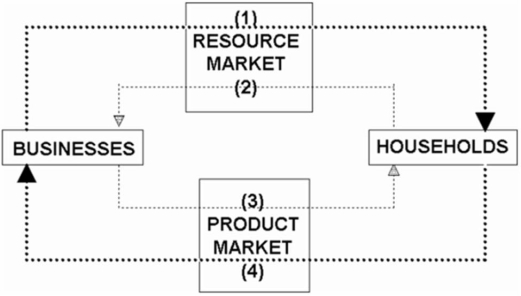 Refer to the circular flow model of the economy.In the diagram flow (1) represents:
 (Multiple Choice)
4.9/5 (75)
(75) Consumer sovereignty means that legislation now protects the rights of consumers to dispose of their incomes as they see fit.
(True/False)
4.8/5 (84)
(84) In the simple circular flow model businesses are suppliers of final products.
(True/False)
4.8/5 (80)
(80) Specialization in production is important primarily because it:
(Multiple Choice)
4.8/5 (65)
(65) The idea that the desires of resource suppliers and producers to further their own self-interest will automatically further the public interest is known as:
(Multiple Choice)
4.7/5 (72)
(72) 
Filters
- Essay(0)
- Multiple Choice(0)
- Short Answer(0)
- True False(0)
- Matching(0)