



 Chat with AI
Exam 2: B: The Market System and the Circular Flow

Exam 1: B: Limits, Alternatives, and Choices265 Questions
Exam 1: A: - Limits, Alternatives, and Choices60 Questions
Exam 2: B: The Market System and the Circular Flow119 Questions
Exam 2: A: - The Market System and the Circular Flow42 Questions
Exam 3: B: Demand, Supply, and Market Equilibrium291 Questions
Exam 3: A: - Demand, Supply, and Market Equilibrium51 Questions
Exam 4: B: Market Failures: Public Goods and Externalities133 Questions
Exam 4: A: - Market Failures: Public Goods and Externalities36 Questions
Exam 5: B: Governments Role and Government Failure121 Questions
Exam 5: A: Governments Role and Government Failure1 Questions
Exam 6: B: an Introduction to Macroeconomics65 Questions
Exam 6: A: an Introduction to Macroeconomics31 Questions
Exam 7: B: Measuring the Economys Output191 Questions
Exam 7: A: Measuring the Economys Output30 Questions
Exam 8: B: Economic Growth122 Questions
Exam 8: A: Economic Growth35 Questions
Exam 9: B: Business Cycles, Unemployment, and Inflation193 Questions
Exam 9: A: Business Cycles, Unemployment, and Inflation40 Questions
Exam 10: B: Basic Macroeconomic Relationships200 Questions
Exam 10: A: Basic Macroeconomic Relationships26 Questions
Exam 11: B: The Aggregate Expenditures Model238 Questions
Exam 11: A: The Aggregate Expenditures Model47 Questions
Exam 12: B: Aggregate Demand and Aggregate Supply203 Questions
Exam 12: A: Aggregate Demand and Aggregate Supply35 Questions
Exam 13: B: Fiscal Policy, Deficits, Surpluses, and Debt234 Questions
Exam 13: A: Fiscal Policy, Deficits, Surpluses, and Debt53 Questions
Exam 14: B: Money, Banking, and Money Creation206 Questions
Exam 14: A: Money, Banking, and Money Creation56 Questions
Exam 15: B: Interest Rates and Monetary Policy239 Questions
Exam 15: A: Interest Rates and Monetary Policy47 Questions
Exam 17: C: Financial Economics323 Questions
Exam 16: A: Long-Run Macroeconomic Adjustments28 Questions
Exam 16: B: Long-Run Macroeconomic Adjustments122 Questions
Exam 17: A: International Trade40 Questions
Exam 17: B: International Trade188 Questions
Exam 18: A: The Balance of Payments and Exchange Rates30 Questions
Exam 18: B: The Balance of Payments and Exchange Rates133 Questions
Exam 22: The Economics of Developing Countries254 Questions
Select questions type


In the market system, the statement of "Wages, interest, rent, and profit are crucial determinants of the size of each person's income." is an indication of:
(Multiple Choice)
4.8/5  (75)
(75) Consumer sovereignty and "dollar votes" are most related to which fundamental question about a competitive market system?
(Multiple Choice)
4.8/5 (74)
(74) The issues of distribution of goods and services and incomes in a competitive market system are the primary topic of which fundamental question?
(Multiple Choice)
5.0/5 (73)
(73) If competitive industry Y is incurring substantial losses, we can expect that output will:
(Multiple Choice)
4.8/5 (83)
(83) In a market system, well-defined property rights are important because they:
(Multiple Choice)
4.8/5 (87)
(87) Which fundamental question about a competitive market system primarily focuses on technological progress and capital accumulation?
(Multiple Choice)
4.9/5 (79)
(79) 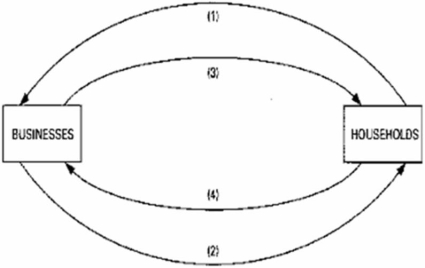 Refer to the diagram.Arrows (1) and (2) represent:
In a market economy the distribution of income would be determined primarily by
(Multiple Choice)
4.8/5 (78)
(78) Which of the following is unique to a market economy system?
(Multiple Choice)
4.9/5 (77)
(77) The basic reason for the production of capital goods is to:
(Multiple Choice)
4.9/5 (82)
(82) 
Filters
- Essay(0)
- Multiple Choice(0)
- Short Answer(0)
- True False(0)
- Matching(0)