



 Chat with AI
Exam 2: B: The Market System and the Circular Flow

Exam 1: B: Limits, Alternatives, and Choices265 Questions
Exam 1: A: - Limits, Alternatives, and Choices60 Questions
Exam 2: B: The Market System and the Circular Flow119 Questions
Exam 2: A: - The Market System and the Circular Flow42 Questions
Exam 3: B: Demand, Supply, and Market Equilibrium291 Questions
Exam 3: A: - Demand, Supply, and Market Equilibrium51 Questions
Exam 4: B: Market Failures: Public Goods and Externalities133 Questions
Exam 4: A: - Market Failures: Public Goods and Externalities36 Questions
Exam 5: B: Governments Role and Government Failure121 Questions
Exam 5: A: Governments Role and Government Failure1 Questions
Exam 6: B: an Introduction to Macroeconomics65 Questions
Exam 6: A: an Introduction to Macroeconomics31 Questions
Exam 7: B: Measuring the Economys Output191 Questions
Exam 7: A: Measuring the Economys Output30 Questions
Exam 8: B: Economic Growth122 Questions
Exam 8: A: Economic Growth35 Questions
Exam 9: B: Business Cycles, Unemployment, and Inflation193 Questions
Exam 9: A: Business Cycles, Unemployment, and Inflation40 Questions
Exam 10: B: Basic Macroeconomic Relationships200 Questions
Exam 10: A: Basic Macroeconomic Relationships26 Questions
Exam 11: B: The Aggregate Expenditures Model238 Questions
Exam 11: A: The Aggregate Expenditures Model47 Questions
Exam 12: B: Aggregate Demand and Aggregate Supply203 Questions
Exam 12: A: Aggregate Demand and Aggregate Supply35 Questions
Exam 13: B: Fiscal Policy, Deficits, Surpluses, and Debt234 Questions
Exam 13: A: Fiscal Policy, Deficits, Surpluses, and Debt53 Questions
Exam 14: B: Money, Banking, and Money Creation206 Questions
Exam 14: A: Money, Banking, and Money Creation56 Questions
Exam 15: B: Interest Rates and Monetary Policy239 Questions
Exam 15: A: Interest Rates and Monetary Policy47 Questions
Exam 17: C: Financial Economics323 Questions
Exam 16: A: Long-Run Macroeconomic Adjustments28 Questions
Exam 16: B: Long-Run Macroeconomic Adjustments122 Questions
Exam 17: A: International Trade40 Questions
Exam 17: B: International Trade188 Questions
Exam 18: A: The Balance of Payments and Exchange Rates30 Questions
Exam 18: B: The Balance of Payments and Exchange Rates133 Questions
Exam 22: The Economics of Developing Countries254 Questions
Select questions type


Specialization and trade are beneficial to society because:
(Multiple Choice)
4.7/5  (65)
(65) Which of the following economic systems are polar opposites of each other?
(Multiple Choice)
4.9/5 (81)
(81) In the circular flow diagram, revenues and goods and services flow:
(Multiple Choice)
4.8/5 (74)
(74) Which of the following best describes the "guiding function" of competitive prices?
(Multiple Choice)
4.8/5 (81)
(81) The development of new technology and capital goods are essential elements for the market system.This is because:
(Multiple Choice)
4.8/5 (82)
(82) Assume the demand for product Y increases and the subsequent market system responses result in the production of more Y.This illustrates:
(Multiple Choice)
4.8/5 (77)
(77) In terms of the circular flow diagram households make expenditures in the _____ market and receive income through the _____ market.
(Multiple Choice)
4.9/5 (81)
(81) 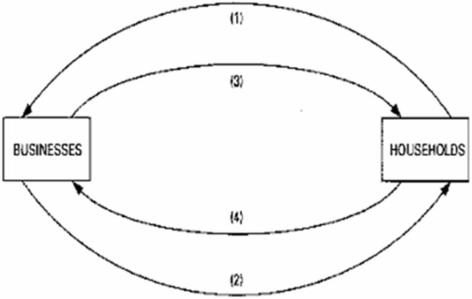 Refer to the diagram.Arrows (3) and (4) represent:
Which statement accurately summarizes the relationship between the prices of goods and their relative scarcity?
(Multiple Choice)
4.7/5 (96)
(96) For whom is a given mix of goods and services to be produced? How, in other words, is the product to be distributed among people when such commodities and services are available? In a market economy, this problem is resolved primarily in the:
(Multiple Choice)
4.9/5 (65)
(65) A division of labour enhances society's output by permitting people to take advantage of existing differences in their abilities and skills.
(True/False)
4.8/5 (95)
(95) Suppose industry A is realizing substantial economic profits.Which of the following best describes the adjustment process which would bring about a new equilibrium?
(Multiple Choice)
4.7/5 (75)
(75) In terms of the circular flow diagram businesses obtain revenue through the _____ market and make expenditures in the _____ market.
(Multiple Choice)
4.9/5 (85)
(85)  Given the information provided and assuming trade does occur between the provinces, we can expect:
 (Multiple Choice)
4.9/5 (79)
(79) 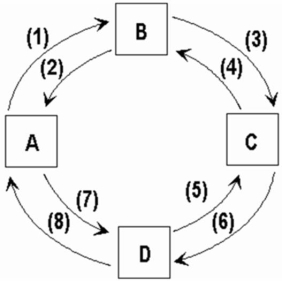 Refer to the figure.If box B represents the factor market and flow (3) represents money income, then:
 (Multiple Choice)
4.7/5 (84)
(84) 
Filters
- Essay(0)
- Multiple Choice(0)
- Short Answer(0)
- True False(0)
- Matching(0)