



 Chat with AI
Exam 8: B: Economic Growth

Exam 1: B: Limits, Alternatives, and Choices265 Questions
Exam 1: A: - Limits, Alternatives, and Choices60 Questions
Exam 2: B: The Market System and the Circular Flow119 Questions
Exam 2: A: - The Market System and the Circular Flow42 Questions
Exam 3: B: Demand, Supply, and Market Equilibrium291 Questions
Exam 3: A: - Demand, Supply, and Market Equilibrium51 Questions
Exam 4: B: Market Failures: Public Goods and Externalities133 Questions
Exam 4: A: - Market Failures: Public Goods and Externalities36 Questions
Exam 5: B: Governments Role and Government Failure121 Questions
Exam 5: A: Governments Role and Government Failure1 Questions
Exam 6: B: an Introduction to Macroeconomics65 Questions
Exam 6: A: an Introduction to Macroeconomics31 Questions
Exam 7: B: Measuring the Economys Output191 Questions
Exam 7: A: Measuring the Economys Output30 Questions
Exam 8: B: Economic Growth122 Questions
Exam 8: A: Economic Growth35 Questions
Exam 9: B: Business Cycles, Unemployment, and Inflation193 Questions
Exam 9: A: Business Cycles, Unemployment, and Inflation40 Questions
Exam 10: B: Basic Macroeconomic Relationships200 Questions
Exam 10: A: Basic Macroeconomic Relationships26 Questions
Exam 11: B: The Aggregate Expenditures Model238 Questions
Exam 11: A: The Aggregate Expenditures Model47 Questions
Exam 12: B: Aggregate Demand and Aggregate Supply203 Questions
Exam 12: A: Aggregate Demand and Aggregate Supply35 Questions
Exam 13: B: Fiscal Policy, Deficits, Surpluses, and Debt234 Questions
Exam 13: A: Fiscal Policy, Deficits, Surpluses, and Debt53 Questions
Exam 14: B: Money, Banking, and Money Creation206 Questions
Exam 14: A: Money, Banking, and Money Creation56 Questions
Exam 15: B: Interest Rates and Monetary Policy239 Questions
Exam 15: A: Interest Rates and Monetary Policy47 Questions
Exam 17: C: Financial Economics323 Questions
Exam 16: A: Long-Run Macroeconomic Adjustments28 Questions
Exam 16: B: Long-Run Macroeconomic Adjustments122 Questions
Exam 17: A: International Trade40 Questions
Exam 17: B: International Trade188 Questions
Exam 18: A: The Balance of Payments and Exchange Rates30 Questions
Exam 18: B: The Balance of Payments and Exchange Rates133 Questions
Exam 22: The Economics of Developing Countries254 Questions
Select questions type


If a nation's real GDP is growing by 3 percent per year, its real domestic output will double in approximately:
(Multiple Choice)
4.7/5  (76)
(76) Critics of economic growth say that it will deplete economic resources.
(True/False)
4.8/5 (74)
(74) An anti-growth view would be that there may be a significant trade-off between productivity and:
(Multiple Choice)
4.7/5 (65)
(65) Productivity growth is a minor source of improvements in real wage rates and the standard of living.
(True/False)
4.9/5 (76)
(76) 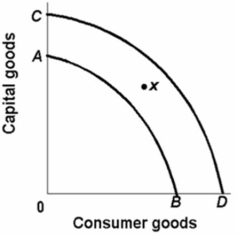 Refer to the above graph.If the production possibilities curve of an economy shifts from AB to CD, it is most likely caused by:
 (Multiple Choice)
4.9/5 (74)
(74) During the last decade, the innovations in computers and telecommunications, together with global competition, have resulted in:
(Multiple Choice)
4.8/5 (77)
(77) Increases in the value of the product to each user, including existing users, as the total number of users rises is called:
(Multiple Choice)
4.7/5 (78)
(78) An increase in the quantity and quality of natural resources is a demand factor for economic growth.
(True/False)
4.9/5 (81)
(81) An outward shift in the production possibilities curve is the direct result of improvements in the efficiency factor for economic growth.
(True/False)
4.9/5 (81)
(81) One of the distinguishing features of the recent productivity growth is:
(Multiple Choice)
4.9/5 (97)
(97) Which is best considered an efficiency factor in economic growth?
(Multiple Choice)
4.8/5 (69)
(69) Real GDP was $4,719 billion in Year 1 and $4,848 billion in Year 2.In contrast, real GDP per capita in Year 1 was $19,261, but in Year 2 it was only $19,162.Why did one measure increase while the other measure decreased?
(Multiple Choice)
4.8/5 (71)
(71) The slowdown of a nation's rate of productivity growth may:
(Multiple Choice)
4.9/5 (82)
(82) 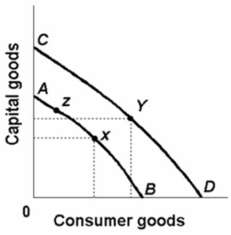 Refer to the above diagram.Realized economic growth is best represented by a:
 (Multiple Choice)
4.8/5 (74)
(74) The case against economic growth is often made using which of the following arguments?
(Multiple Choice)
4.8/5 (75)
(75) One of the main arguments against further growth for industrialized nations focuses on the problem of:
(Multiple Choice)
4.9/5 (90)
(90) What economic concept would be most closely associated with a situation where an aluminum plant uses extensive computerization on the production line to reduce per-unit costs of production?
(Multiple Choice)
4.9/5 (69)
(69) 
Filters
- Essay(0)
- Multiple Choice(0)
- Short Answer(0)
- True False(0)
- Matching(0)