



 Chat with AI
Exam 8: B: Economic Growth

Exam 1: B: Limits, Alternatives, and Choices265 Questions
Exam 1: A: - Limits, Alternatives, and Choices60 Questions
Exam 2: B: The Market System and the Circular Flow119 Questions
Exam 2: A: - The Market System and the Circular Flow42 Questions
Exam 3: B: Demand, Supply, and Market Equilibrium291 Questions
Exam 3: A: - Demand, Supply, and Market Equilibrium51 Questions
Exam 4: B: Market Failures: Public Goods and Externalities133 Questions
Exam 4: A: - Market Failures: Public Goods and Externalities36 Questions
Exam 5: B: Governments Role and Government Failure121 Questions
Exam 5: A: Governments Role and Government Failure1 Questions
Exam 6: B: an Introduction to Macroeconomics65 Questions
Exam 6: A: an Introduction to Macroeconomics31 Questions
Exam 7: B: Measuring the Economys Output191 Questions
Exam 7: A: Measuring the Economys Output30 Questions
Exam 8: B: Economic Growth122 Questions
Exam 8: A: Economic Growth35 Questions
Exam 9: B: Business Cycles, Unemployment, and Inflation193 Questions
Exam 9: A: Business Cycles, Unemployment, and Inflation40 Questions
Exam 10: B: Basic Macroeconomic Relationships200 Questions
Exam 10: A: Basic Macroeconomic Relationships26 Questions
Exam 11: B: The Aggregate Expenditures Model238 Questions
Exam 11: A: The Aggregate Expenditures Model47 Questions
Exam 12: B: Aggregate Demand and Aggregate Supply203 Questions
Exam 12: A: Aggregate Demand and Aggregate Supply35 Questions
Exam 13: B: Fiscal Policy, Deficits, Surpluses, and Debt234 Questions
Exam 13: A: Fiscal Policy, Deficits, Surpluses, and Debt53 Questions
Exam 14: B: Money, Banking, and Money Creation206 Questions
Exam 14: A: Money, Banking, and Money Creation56 Questions
Exam 15: B: Interest Rates and Monetary Policy239 Questions
Exam 15: A: Interest Rates and Monetary Policy47 Questions
Exam 17: C: Financial Economics323 Questions
Exam 16: A: Long-Run Macroeconomic Adjustments28 Questions
Exam 16: B: Long-Run Macroeconomic Adjustments122 Questions
Exam 17: A: International Trade40 Questions
Exam 17: B: International Trade188 Questions
Exam 18: A: The Balance of Payments and Exchange Rates30 Questions
Exam 18: B: The Balance of Payments and Exchange Rates133 Questions
Exam 22: The Economics of Developing Countries254 Questions
Select questions type


Suppose the nominal GDP of an economy was $100 billion in 2016 and $260 billion in 2017.The general price index was 100 in 2016 and 180 in 2017.During 2016-2017, the economy's real GDP rose by:
(Multiple Choice)
4.8/5  (87)
(87) 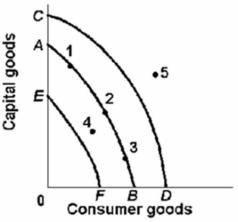 Refer to the above diagram.If there is a movement away from the full employment of resources in an economy with production possibilities curve AB, this can be shown by:
 (Multiple Choice)
4.8/5 (85)
(85) Economies of scale are increases in per-unit cost that result in a decrease in the size of markets and firms.
(True/False)
4.9/5 (89)
(89) Economic well-being in Canada is overstated by growth rates because they don't account for:
(Multiple Choice)
4.8/5 (80)
(80) The knowledge and skill that make for a productive worker are referred to by economists as:
(Multiple Choice)
4.9/5 (81)
(81) By how many times was the richest area in the world richer than the poorest area in the world in 1820?
(Multiple Choice)
5.0/5 (74)
(74) 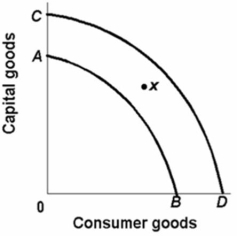 Refer to the above graph.If the production possibilities curve for an economy is at CD but the economy is operating at point X, the reasons are most likely to be:
 (Multiple Choice)
4.9/5 (88)
(88) Critics of the recent rapid advances in new technology say that:
(Multiple Choice)
5.0/5 (76)
(76) Which is best considered a supply factor for long-run economic growth?
(Multiple Choice)
4.9/5 (79)
(79) According to some studies in Canada, the productivity advance related to the information technology:
(Multiple Choice)
4.9/5 (73)
(73) 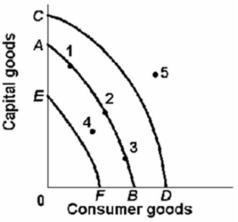 Refer to the above diagram.If the production possibilities curve for an economy is at AB but the economy is operating at point 4, the reasons are most likely to be because of:
 (Multiple Choice)
4.9/5 (78)
(78) Which of the following would not be expected to increase labour productivity?
(Multiple Choice)
4.8/5 (84)
(84) Other things equal, in which of the following instances would the increase in labour productivity be the greatest?
(Multiple Choice)
4.9/5 (94)
(94) Between 1946 - 2011, the annual Canadian multifactor productivity has increased by about:
(Multiple Choice)
4.9/5 (82)
(82) There are several institutional structures that promote and sustain economic growth.These factors include:
(Multiple Choice)
5.0/5 (85)
(85) Increasing returns would be a situation where a firm increases its workforce and other inputs by:
(Multiple Choice)
4.9/5 (82)
(82) 
Filters
- Essay(0)
- Multiple Choice(0)
- Short Answer(0)
- True False(0)
- Matching(0)