



 Chat with AI
Exam 8: B: Economic Growth

Exam 1: B: Limits, Alternatives, and Choices265 Questions
Exam 1: A: - Limits, Alternatives, and Choices60 Questions
Exam 2: B: The Market System and the Circular Flow119 Questions
Exam 2: A: - The Market System and the Circular Flow42 Questions
Exam 3: B: Demand, Supply, and Market Equilibrium291 Questions
Exam 3: A: - Demand, Supply, and Market Equilibrium51 Questions
Exam 4: B: Market Failures: Public Goods and Externalities133 Questions
Exam 4: A: - Market Failures: Public Goods and Externalities36 Questions
Exam 5: B: Governments Role and Government Failure121 Questions
Exam 5: A: Governments Role and Government Failure1 Questions
Exam 6: B: an Introduction to Macroeconomics65 Questions
Exam 6: A: an Introduction to Macroeconomics31 Questions
Exam 7: B: Measuring the Economys Output191 Questions
Exam 7: A: Measuring the Economys Output30 Questions
Exam 8: B: Economic Growth122 Questions
Exam 8: A: Economic Growth35 Questions
Exam 9: B: Business Cycles, Unemployment, and Inflation193 Questions
Exam 9: A: Business Cycles, Unemployment, and Inflation40 Questions
Exam 10: B: Basic Macroeconomic Relationships200 Questions
Exam 10: A: Basic Macroeconomic Relationships26 Questions
Exam 11: B: The Aggregate Expenditures Model238 Questions
Exam 11: A: The Aggregate Expenditures Model47 Questions
Exam 12: B: Aggregate Demand and Aggregate Supply203 Questions
Exam 12: A: Aggregate Demand and Aggregate Supply35 Questions
Exam 13: B: Fiscal Policy, Deficits, Surpluses, and Debt234 Questions
Exam 13: A: Fiscal Policy, Deficits, Surpluses, and Debt53 Questions
Exam 14: B: Money, Banking, and Money Creation206 Questions
Exam 14: A: Money, Banking, and Money Creation56 Questions
Exam 15: B: Interest Rates and Monetary Policy239 Questions
Exam 15: A: Interest Rates and Monetary Policy47 Questions
Exam 17: C: Financial Economics323 Questions
Exam 16: A: Long-Run Macroeconomic Adjustments28 Questions
Exam 16: B: Long-Run Macroeconomic Adjustments122 Questions
Exam 17: A: International Trade40 Questions
Exam 17: B: International Trade188 Questions
Exam 18: A: The Balance of Payments and Exchange Rates30 Questions
Exam 18: B: The Balance of Payments and Exchange Rates133 Questions
Exam 22: The Economics of Developing Countries254 Questions
Select questions type


Defenders of growth say that it is the primary path to raising living standards.
(True/False)
4.9/5  (82)
(82) Using Image 8.1 Global Perspective, which of the following countries is the least competitive country in the world according to the global competitiveness index calculated for 2016-2017?
(Multiple Choice)
4.9/5 (91)
(91) How does the environment react to waste, assuming that the standard of living is increasing?
(Multiple Choice)
4.8/5 (81)
(81) Which of the following countries had the highest average annual rate of growth of real GDP from 1960 to 2010?
(Multiple Choice)
4.9/5 (83)
(83) Over the past half century the growth of real GDP in Canada has been caused primarily by:
(Multiple Choice)
4.8/5 (83)
(83) The best measure of economic growth adjusted for the population of a nation is the increase in:
(Multiple Choice)
4.8/5 (77)
(77) Other things equal, if a full-employment economy reallocates a substantial quantity of its resources to capital goods, we would expect:
(Multiple Choice)
4.8/5 (89)
(89) One of the basic economic defences of economic growth rests on the conclusion that:
(Multiple Choice)
4.9/5 (80)
(80) About two-thirds of Canada's growth rate in the last half century has been due to rising productivity and about one-third has been due to the use of more inputs.
(True/False)
4.8/5 (72)
(72) 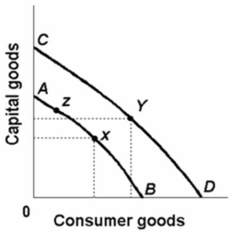 Refer to the above diagram.The most likely cause of a shift from AB to CD would be a(n):
 (Multiple Choice)
4.7/5 (83)
(83) The different starting dates for modern economic growth in different parts of the world are the main cause of:
(Multiple Choice)
4.9/5 (89)
(89) Suppose total output (real GDP) is $4000 and labour productivity is 8.We can conclude that:
(Multiple Choice)
4.9/5 (86)
(86) During 1945-2016, the labour force in Canada has increased by about:
(Multiple Choice)
4.9/5 (80)
(80) Which of the following is not a supply factor in economic growth?
(Multiple Choice)
4.9/5 (86)
(86) 
Filters
- Essay(0)
- Multiple Choice(0)
- Short Answer(0)
- True False(0)
- Matching(0)