



 Chat with AI
Exam 22: The Economics of Developing Countries

Exam 1: B: Limits, Alternatives, and Choices265 Questions
Exam 1: A: - Limits, Alternatives, and Choices60 Questions
Exam 2: B: The Market System and the Circular Flow119 Questions
Exam 2: A: - The Market System and the Circular Flow42 Questions
Exam 3: B: Demand, Supply, and Market Equilibrium291 Questions
Exam 3: A: - Demand, Supply, and Market Equilibrium51 Questions
Exam 4: B: Market Failures: Public Goods and Externalities133 Questions
Exam 4: A: - Market Failures: Public Goods and Externalities36 Questions
Exam 5: B: Governments Role and Government Failure121 Questions
Exam 5: A: Governments Role and Government Failure1 Questions
Exam 6: B: an Introduction to Macroeconomics65 Questions
Exam 6: A: an Introduction to Macroeconomics31 Questions
Exam 7: B: Measuring the Economys Output191 Questions
Exam 7: A: Measuring the Economys Output30 Questions
Exam 8: B: Economic Growth122 Questions
Exam 8: A: Economic Growth35 Questions
Exam 9: B: Business Cycles, Unemployment, and Inflation193 Questions
Exam 9: A: Business Cycles, Unemployment, and Inflation40 Questions
Exam 10: B: Basic Macroeconomic Relationships200 Questions
Exam 10: A: Basic Macroeconomic Relationships26 Questions
Exam 11: B: The Aggregate Expenditures Model238 Questions
Exam 11: A: The Aggregate Expenditures Model47 Questions
Exam 12: B: Aggregate Demand and Aggregate Supply203 Questions
Exam 12: A: Aggregate Demand and Aggregate Supply35 Questions
Exam 13: B: Fiscal Policy, Deficits, Surpluses, and Debt234 Questions
Exam 13: A: Fiscal Policy, Deficits, Surpluses, and Debt53 Questions
Exam 14: B: Money, Banking, and Money Creation206 Questions
Exam 14: A: Money, Banking, and Money Creation56 Questions
Exam 15: B: Interest Rates and Monetary Policy239 Questions
Exam 15: A: Interest Rates and Monetary Policy47 Questions
Exam 17: C: Financial Economics323 Questions
Exam 16: A: Long-Run Macroeconomic Adjustments28 Questions
Exam 16: B: Long-Run Macroeconomic Adjustments122 Questions
Exam 17: A: International Trade40 Questions
Exam 17: B: International Trade188 Questions
Exam 18: A: The Balance of Payments and Exchange Rates30 Questions
Exam 18: B: The Balance of Payments and Exchange Rates133 Questions
Exam 22: The Economics of Developing Countries254 Questions
Select questions type


The World Bank is the organization to which DVCs turn as a "last-resort" lending agency for projects that private institutions will not fund.
(True/False)
4.8/5  (87)
(87) Population expansion can impede economic development for the following reasons except
(Multiple Choice)
4.9/5 (78)
(78) A suggested policy for industrially advanced countries to adopt to encourage economic growth in developing countries would be
(Multiple Choice)
4.8/5 (84)
(84) The two paths to economic development, which are the same for both developing countries and industrially advanced economies, are
(Multiple Choice)
4.9/5 (95)
(95) The differences in the per capita incomes of the IACs and the DVCs have diminished sharply since the Second World War because of U.S.aid programs.
(True/False)
4.8/5 (87)
(87) Which of the following is considered to be a severe obstacle to economic growth for DVCs?
(Multiple Choice)
4.9/5 (93)
(93) The primary function of the International Finance Corporation (IFC) is to
(Multiple Choice)
4.9/5 (84)
(84) Surplus agricultural labor in a developing nation usually means that there is
(Multiple Choice)
4.9/5 (79)
(79) Which of the following would be an example of direct foreign investment in DVCs?
(Multiple Choice)
4.7/5 (81)
(81) Which of the following is not a characteristic of human resources in the poorest DVCs?
(Multiple Choice)
4.8/5 (75)
(75) 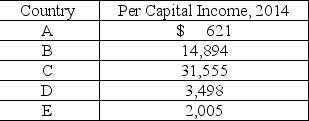 Which of the given nations would be low-income developing countries (DVCs), according to the World Bank?
 (Multiple Choice)
4.7/5 (77)
(77) One recommended policy that IACs could adopt to help DVCs is to recruit and hire skilled workers from DVCs for businesses in IACs.
(True/False)
4.9/5 (84)
(84) The industrially advanced countries (IACs) had an average per capita income in 2014 of around
(Multiple Choice)
4.9/5 (81)
(81) Saving is a larger percentage of domestic output in DVCs than in IACs, but the saving is put to poor use.
(True/False)
4.7/5 (82)
(82) One reason why foreign aid is viewed as harmful is that it promotes dependency.
(True/False)
4.8/5 (85)
(85) To be classified as a low-income developing country, annual per capita income in 2014 needed to be
(Multiple Choice)
4.9/5 (75)
(75) The demographic transition view of population growth believes that slower population growth will lead to rising incomes.
(True/False)
4.8/5 (78)
(78) Assume a DVC has a real per capita output of $1,000 as compared to $20,000 for an IAC.If both nations realize a 4 percent growth of their real per capita outputs, after one year the absolute real per capita output gap will
(Multiple Choice)
4.7/5 (88)
(88) 
Filters
- Essay(0)
- Multiple Choice(0)
- Short Answer(0)
- True False(0)
- Matching(0)