



 Chat with AI
Exam 22: The Economics of Developing Countries

Exam 1: B: Limits, Alternatives, and Choices265 Questions
Exam 1: A: - Limits, Alternatives, and Choices60 Questions
Exam 2: B: The Market System and the Circular Flow119 Questions
Exam 2: A: - The Market System and the Circular Flow42 Questions
Exam 3: B: Demand, Supply, and Market Equilibrium291 Questions
Exam 3: A: - Demand, Supply, and Market Equilibrium51 Questions
Exam 4: B: Market Failures: Public Goods and Externalities133 Questions
Exam 4: A: - Market Failures: Public Goods and Externalities36 Questions
Exam 5: B: Governments Role and Government Failure121 Questions
Exam 5: A: Governments Role and Government Failure1 Questions
Exam 6: B: an Introduction to Macroeconomics65 Questions
Exam 6: A: an Introduction to Macroeconomics31 Questions
Exam 7: B: Measuring the Economys Output191 Questions
Exam 7: A: Measuring the Economys Output30 Questions
Exam 8: B: Economic Growth122 Questions
Exam 8: A: Economic Growth35 Questions
Exam 9: B: Business Cycles, Unemployment, and Inflation193 Questions
Exam 9: A: Business Cycles, Unemployment, and Inflation40 Questions
Exam 10: B: Basic Macroeconomic Relationships200 Questions
Exam 10: A: Basic Macroeconomic Relationships26 Questions
Exam 11: B: The Aggregate Expenditures Model238 Questions
Exam 11: A: The Aggregate Expenditures Model47 Questions
Exam 12: B: Aggregate Demand and Aggregate Supply203 Questions
Exam 12: A: Aggregate Demand and Aggregate Supply35 Questions
Exam 13: B: Fiscal Policy, Deficits, Surpluses, and Debt234 Questions
Exam 13: A: Fiscal Policy, Deficits, Surpluses, and Debt53 Questions
Exam 14: B: Money, Banking, and Money Creation206 Questions
Exam 14: A: Money, Banking, and Money Creation56 Questions
Exam 15: B: Interest Rates and Monetary Policy239 Questions
Exam 15: A: Interest Rates and Monetary Policy47 Questions
Exam 17: C: Financial Economics323 Questions
Exam 16: A: Long-Run Macroeconomic Adjustments28 Questions
Exam 16: B: Long-Run Macroeconomic Adjustments122 Questions
Exam 17: A: International Trade40 Questions
Exam 17: B: International Trade188 Questions
Exam 18: A: The Balance of Payments and Exchange Rates30 Questions
Exam 18: B: The Balance of Payments and Exchange Rates133 Questions
Exam 22: The Economics of Developing Countries254 Questions
Select questions type


Studies generally show that if there is more investment in capital goods in DVCs, there will be greater
(Multiple Choice)
4.9/5  (62)
(62) Which of these sets of nations consists of low-income developing nations?
(Multiple Choice)
4.8/5 (85)
(85) According to the United Nations, approximately what percentage of the world's income is received by the richest one-fifth of the world's population?
(Multiple Choice)
4.7/5 (77)
(77) The vicious circle of poverty is based on the connections between low income, low saving, low investment, and low productivity.
(True/False)
4.9/5 (85)
(85) Which of the following countries had the best score in the Corruption Perception Index in 2015?
(Multiple Choice)
4.9/5 (79)
(79) Avenues for the government to foster economic growth and development include the following, except
(Multiple Choice)
4.7/5 (80)
(80) Most of the DVCs find it difficult to accumulate capital goods because
(Multiple Choice)
4.7/5 (76)
(76) Which of the following is typically not a problem for low-income DVCs?
(Multiple Choice)
4.9/5 (92)
(92) What is the problem with saving in DVCs, even when saving as a percentage of domestic output is the same as in industrially advanced countries?
(Multiple Choice)
4.9/5 (73)
(73) Which of these sets of nations consists of high-income economies?
(Multiple Choice)
4.8/5 (77)
(77) Rapid population growth can be an obstacle to economic development
(Multiple Choice)
4.7/5 (77)
(77) All of the following contribute to low investment spending in DVCs except
(Multiple Choice)
5.0/5 (73)
(73) An increasing share of the private capital flows to DVCs in recent years has been in the form of
(Multiple Choice)
4.9/5 (77)
(77) The corruption and poor administration that are common to the public sectors of many DVCs suggest that government may not be very effective in promoting economic growth.
(True/False)
4.9/5 (71)
(71) 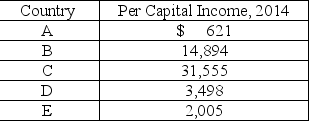 Which of the given nations would be high-income countries (IACs), according to the World Bank?
 (Multiple Choice)
4.8/5 (77)
(77) 
Filters
- Essay(0)
- Multiple Choice(0)
- Short Answer(0)
- True False(0)
- Matching(0)