



 Chat with AI
Exam 22: The Economics of Developing Countries

Exam 1: B: Limits, Alternatives, and Choices265 Questions
Exam 1: A: - Limits, Alternatives, and Choices60 Questions
Exam 2: B: The Market System and the Circular Flow119 Questions
Exam 2: A: - The Market System and the Circular Flow42 Questions
Exam 3: B: Demand, Supply, and Market Equilibrium291 Questions
Exam 3: A: - Demand, Supply, and Market Equilibrium51 Questions
Exam 4: B: Market Failures: Public Goods and Externalities133 Questions
Exam 4: A: - Market Failures: Public Goods and Externalities36 Questions
Exam 5: B: Governments Role and Government Failure121 Questions
Exam 5: A: Governments Role and Government Failure1 Questions
Exam 6: B: an Introduction to Macroeconomics65 Questions
Exam 6: A: an Introduction to Macroeconomics31 Questions
Exam 7: B: Measuring the Economys Output191 Questions
Exam 7: A: Measuring the Economys Output30 Questions
Exam 8: B: Economic Growth122 Questions
Exam 8: A: Economic Growth35 Questions
Exam 9: B: Business Cycles, Unemployment, and Inflation193 Questions
Exam 9: A: Business Cycles, Unemployment, and Inflation40 Questions
Exam 10: B: Basic Macroeconomic Relationships200 Questions
Exam 10: A: Basic Macroeconomic Relationships26 Questions
Exam 11: B: The Aggregate Expenditures Model238 Questions
Exam 11: A: The Aggregate Expenditures Model47 Questions
Exam 12: B: Aggregate Demand and Aggregate Supply203 Questions
Exam 12: A: Aggregate Demand and Aggregate Supply35 Questions
Exam 13: B: Fiscal Policy, Deficits, Surpluses, and Debt234 Questions
Exam 13: A: Fiscal Policy, Deficits, Surpluses, and Debt53 Questions
Exam 14: B: Money, Banking, and Money Creation206 Questions
Exam 14: A: Money, Banking, and Money Creation56 Questions
Exam 15: B: Interest Rates and Monetary Policy239 Questions
Exam 15: A: Interest Rates and Monetary Policy47 Questions
Exam 17: C: Financial Economics323 Questions
Exam 16: A: Long-Run Macroeconomic Adjustments28 Questions
Exam 16: B: Long-Run Macroeconomic Adjustments122 Questions
Exam 17: A: International Trade40 Questions
Exam 17: B: International Trade188 Questions
Exam 18: A: The Balance of Payments and Exchange Rates30 Questions
Exam 18: B: The Balance of Payments and Exchange Rates133 Questions
Exam 22: The Economics of Developing Countries254 Questions
Select questions type


A developing nation may not experience an increase in the average standard of living even if it increases its output of goods and services because of
(Multiple Choice)
4.8/5  (76)
(76) Which characteristic is most typical of human resources in developing nations?
(Multiple Choice)
4.8/5 (85)
(85) The building of a new factory by a corporation would be an example of increasing the infrastructure in a developing nation.
(True/False)
4.7/5 (79)
(79) The international agency that lends money to DVCs for economic development projects is the
(Multiple Choice)
4.8/5 (81)
(81) Land reform (or the reform of land ownership) is a relatively minor institutional obstacle to economic growth in many developing countries.
(True/False)
4.9/5 (90)
(90) 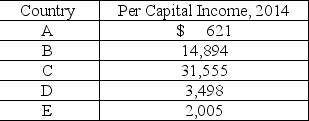 Refer to the table.If per capita income increases by 10 percent over five years in each of the nations shown, the per capita income gap between country C and country A
 (Multiple Choice)
4.9/5 (73)
(73) To stimulate economic growth, it would be best if developing countries adopted policies to
(Multiple Choice)
4.8/5 (79)
(79) Expanding the supplies of raw materials, capital equipment, effective labor, and technological knowledge will
(Multiple Choice)
4.8/5 (79)
(79) In 2014, the United States had about percent of the world's population and produced about percent of the world output.
(Multiple Choice)
4.9/5 (81)
(81) Over the next 15 years, out of every 10 people added to the world's population will be born in developing countries.
(Multiple Choice)
4.9/5 (78)
(78) The international organization, with 188 member nations, whose major objective is to help DVCs achieve economic growth is the
(Multiple Choice)
4.9/5 (80)
(80) If the per capita incomes of DVCs (developing countries) grew at the same annual rate as those of IACs (industrially advanced countries), then the absolute income gap between rich and poor nations over the years would
(Multiple Choice)
4.9/5 (88)
(88) The presence of large and fast-growing populations in developing countries contributes to lower per capita incomes.
(True/False)
4.8/5 (71)
(71) 
Filters
- Essay(0)
- Multiple Choice(0)
- Short Answer(0)
- True False(0)
- Matching(0)