



 Chat with AI
Exam 15: Parasitism and Infectious Diseases

Exam 1: Introduction: Ecology, Evolution, and the Scientific Method65 Questions
Exam 2: Adaptations to Aquatic Environments 67 Questions
Exam 3: Adaptations to Terrestrial Environments 69 Questions
Exam 4: Adaptations to Variable Environments 65 Questions
Exam 5: Climates and Soils68 Questions
Exam 6: Terrestrial and Aquatic Biomes64 Questions
Exam 7: Evolution and Adaptation 68 Questions
Exam 8: Life Histories66 Questions
Exam 9: Reproductive Strategies65 Questions
Exam 10: Social Behaviors67 Questions
Exam 11: Population Distributions70 Questions
Exam 12: Population Growth and Regulation62 Questions
Exam 13: Population Dynamics Over Space and Time69 Questions
Exam 14: Predation and Herbivory69 Questions
Exam 15: Parasitism and Infectious Diseases68 Questions
Exam 16: Competition67 Questions
Exam 17: Mutualism68 Questions
Exam 18: Community Structure 66 Questions
Exam 19: Community Succession 120 Questions
Exam 20: Movement of Energy in Ecosystems 68 Questions
Exam 21: Movement of Elements in Ecosystems71 Questions
Exam 22: Landscape Ecology and Global Biodiversity 68 Questions
Exam 23: Global Conservation of Biodiversity67 Questions
Select questions type


In S-I-R models, which of the following represents the probability of contact between susceptible and infected individuals?
(Multiple Choice)
4.8/5  (69)
(69) Which of the following strategies do schistosomes use to circumvent the host's immune system?
(Multiple Choice)
4.7/5 (82)
(82) The parasitic worm Acanthocephalus dirus has evolved an adaptation that causes its isopod host, Caecidotea intermedius, to
(Multiple Choice)
4.8/5 (53)
(53) Chimpanzees infected with intestinal worms sometimes eat Aspilia leaves. This is an example of
(Multiple Choice)
4.9/5 (71)
(71) The amphibian pathogen the chytrid fungus does not fit the S-I-R model because the
(Multiple Choice)
4.7/5 (83)
(83) The black-legged tick (or deer tick) associated with Lyme disease is
(Multiple Choice)
4.9/5 (95)
(95) Question: Anthropologists studying a tribe on an island in the South Pacific ask you to help them with an intriguing health problem: The chiefs of the tribe keep dying at a much more rapid rate than other members of the population. You travel to the island to observe the tribe, and you find that each time an animal is killed during a hunt, the body of the animal is shared communally among all of the members of the tribe. However, one part of the animal, its brain, is reserved exclusively for the tribal chief. The chief consumes the brain raw because it is believed that this allows him to assimilate the animal's knowledge of the island. What would you suggest is causing the death of the tribal chiefs, how is it killing them, and what is the mechanism of transmission?
(Essay)
4.9/5 (67)
(67) Which of the following is NOT a characteristic of an emerging infectious disease?
(Multiple Choice)
4.7/5 (75)
(75) 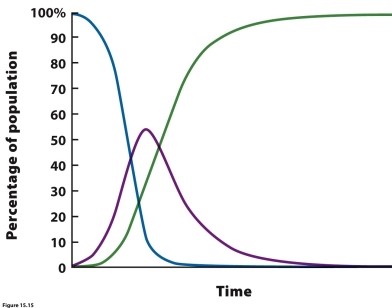 In the figure showing dynamics of an infected population over time, what do the blue, purple, and green curves represent?
 (Not Answered)
This question doesn't have any answer yet
Why does the parasitic flatworm (Leucochloridium paradoxum) of the amber snail (Succinea putris) alter the behavior of the snail so that it moves to the top of a plant stem?
(Multiple Choice)
4.7/5 (90)
(90) Two populations with sample sizes of 25 and 27 are compared with a t-test. What is the value for the degrees of freedom?
(Multiple Choice)
4.8/5 (72)
(72) Parasites can move between hosts either by horizontal or vertical transmission. Why might those parasites that employ horizontal transmission be more impacted by environmental stochasticity?
(Short Answer)
5.0/5 (75)
(75) What does the S-I-R model characterize for infectious diseases?
(Multiple Choice)
4.9/5 (82)
(82) 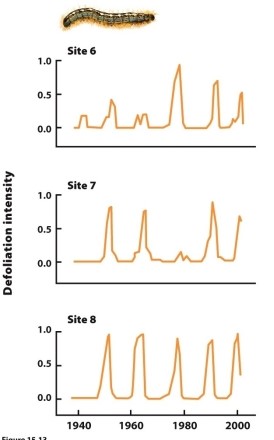 The figure shows population fluctuations in forest tent caterpillars over a 60-year period. The caterpillars were susceptible to a viral infection throughout this time. What causes the 10- to 15-year population fluctuation in the caterpillars?
 (Not Answered)
This question doesn't have any answer yet
Describe two ways a parasite can decrease the likelihood that it will run out of potential hosts.
(Essay)
4.7/5 (71)
(71) 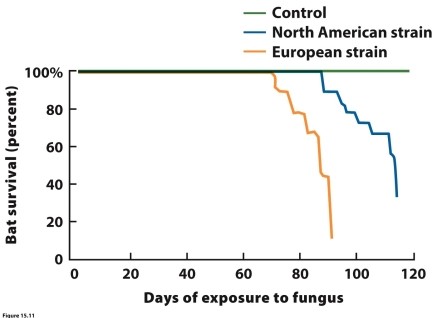 The graph shows survival rates for North American populations of the little brown bat (Myotis lucifugus) after exposure to either a North American or European strain of white-nose fungus (Geomyces destructans). What did researchers conclude about the two strains?
 (Not Answered)
This question doesn't have any answer yet

Filters
- Essay(0)
- Multiple Choice(0)
- Short Answer(0)
- True False(0)
- Matching(0)