



 Chat with AI
Exam 18: Community Structure

Exam 1: Introduction: Ecology, Evolution, and the Scientific Method65 Questions
Exam 2: Adaptations to Aquatic Environments 67 Questions
Exam 3: Adaptations to Terrestrial Environments 69 Questions
Exam 4: Adaptations to Variable Environments 65 Questions
Exam 5: Climates and Soils68 Questions
Exam 6: Terrestrial and Aquatic Biomes64 Questions
Exam 7: Evolution and Adaptation 68 Questions
Exam 8: Life Histories66 Questions
Exam 9: Reproductive Strategies65 Questions
Exam 10: Social Behaviors67 Questions
Exam 11: Population Distributions70 Questions
Exam 12: Population Growth and Regulation62 Questions
Exam 13: Population Dynamics Over Space and Time69 Questions
Exam 14: Predation and Herbivory69 Questions
Exam 15: Parasitism and Infectious Diseases68 Questions
Exam 16: Competition67 Questions
Exam 17: Mutualism68 Questions
Exam 18: Community Structure 66 Questions
Exam 19: Community Succession 120 Questions
Exam 20: Movement of Energy in Ecosystems 68 Questions
Exam 21: Movement of Elements in Ecosystems71 Questions
Exam 22: Landscape Ecology and Global Biodiversity 68 Questions
Exam 23: Global Conservation of Biodiversity67 Questions
Select questions type


How does an ecologist determine the presence of an ecotone?
(Multiple Choice)
4.8/5  (81)
(81) Which relationships in the figure indicate top-down control? Which relationships indicate bottom-up control?
(Short Answer)
4.8/5 (78)
(78) In hiking up a mountain you are likely to pass through various community types as you proceed from the low-elevation lands to the summit. As you proceed from one community type to another, a boundary between community types, created by changing environmental conditions, will be observed. This boundary area of overlap/blending is termed the _____ and has _____ level of biodiversity as compared to each of the two communities on either side of the boundary area.
(Multiple Choice)
4.7/5 (69)
(69) 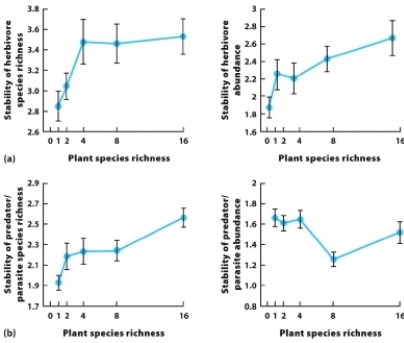 What do the data in the graphs suggest about the resistance of the community to disturbance?
 (Multiple Choice)
4.9/5 (88)
(88) Whitaker's classic study of trees in the Great Smoky Mountains provided evidence of the fact that
(Multiple Choice)
4.8/5 (75)
(75) 
Filters
- Essay(0)
- Multiple Choice(0)
- Short Answer(0)
- True False(0)
- Matching(0)