



 Chat with AI
Exam 18: Community Structure

Exam 1: Introduction: Ecology, Evolution, and the Scientific Method65 Questions
Exam 2: Adaptations to Aquatic Environments 67 Questions
Exam 3: Adaptations to Terrestrial Environments 69 Questions
Exam 4: Adaptations to Variable Environments 65 Questions
Exam 5: Climates and Soils68 Questions
Exam 6: Terrestrial and Aquatic Biomes64 Questions
Exam 7: Evolution and Adaptation 68 Questions
Exam 8: Life Histories66 Questions
Exam 9: Reproductive Strategies65 Questions
Exam 10: Social Behaviors67 Questions
Exam 11: Population Distributions70 Questions
Exam 12: Population Growth and Regulation62 Questions
Exam 13: Population Dynamics Over Space and Time69 Questions
Exam 14: Predation and Herbivory69 Questions
Exam 15: Parasitism and Infectious Diseases68 Questions
Exam 16: Competition67 Questions
Exam 17: Mutualism68 Questions
Exam 18: Community Structure 66 Questions
Exam 19: Community Succession 120 Questions
Exam 20: Movement of Energy in Ecosystems 68 Questions
Exam 21: Movement of Elements in Ecosystems71 Questions
Exam 22: Landscape Ecology and Global Biodiversity 68 Questions
Exam 23: Global Conservation of Biodiversity67 Questions
Select questions type


Explain the shape of the intermediate disturbance hypothesis (IDH) graph. Why does it have the appearance that it does?
(Essay)
4.8/5  (88)
(88) 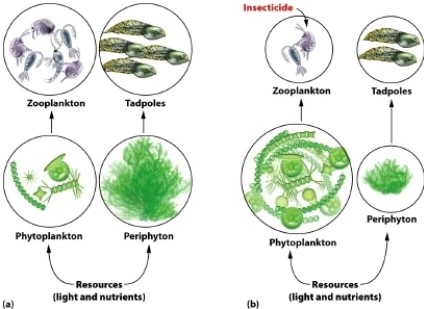 Which of the following statements would NOT be true about the species relationship in the figure?
 (Multiple Choice)
4.8/5 (90)
(90) What particular type of environmental conditions favor independent or interdependent communities?
(Short Answer)
4.8/5 (75)
(75) 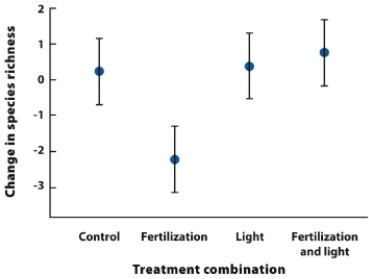 According to the experimental results shown in the figure, what factor best explains the reduction in plant species richness with addition of fertilizer?
 (Multiple Choice)
4.9/5 (70)
(70) Keystone species that are predators in a food web can increase species diversity by
(Multiple Choice)
4.9/5 (76)
(76) Briefly describe an experiment to test whether species are independent or interdependent on each other for existence.
(Essay)
4.8/5 (81)
(81) 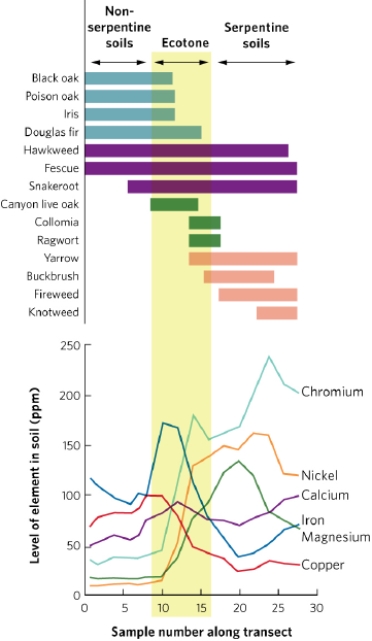 Which species is restricted to nonserpentine soils?
Shannon's index and Simpson's index are both measurements of a community's level of diversity. What does it mean when, after calculating these two indices for a given community, the results show the Simpson's index = 1, while the Shannon's index = 0?
(Multiple Choice)
4.8/5 (73)
(73) How would a relatively high proportion of omnivore species in a food web affect the connectedness of the food web?
(Short Answer)
4.7/5 (72)
(72) When Hairston, Smith, and Slobodkin suggested that Earth is green because carnivores depress the populations of herbivores that would otherwise consume most vegetation, they were focusing on _____ control of community structure.
(Multiple Choice)
4.9/5 (74)
(74) Describe the difference between what is referred to as a direct effect and an indirect effect of species in a food web.
(Essay)
5.0/5 (78)
(78) What is a major distinction between direct and indirect effects in a community?
(Multiple Choice)
4.8/5 (92)
(92) 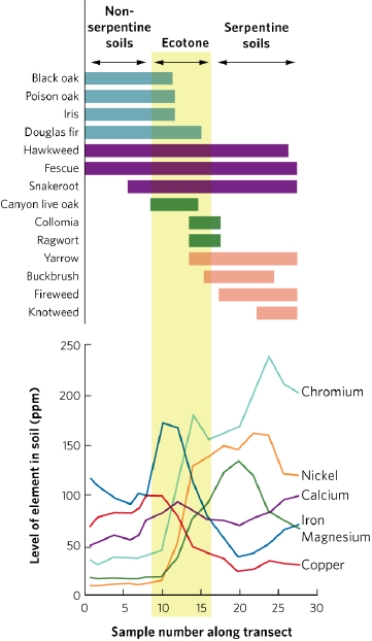 Which species is restricted to serpentine soils?
You are sampling a stream with a net, collecting 100 macroinvertebrates. You have been told the stream has high richness but low evenness. Which of the following collections would best represent the stream if what you were told is true (assume the different macroinvertebrate types noted are all the same species (e.g., 20 mayflies are all of the same species)?
(Multiple Choice)
4.8/5 (92)
(92) 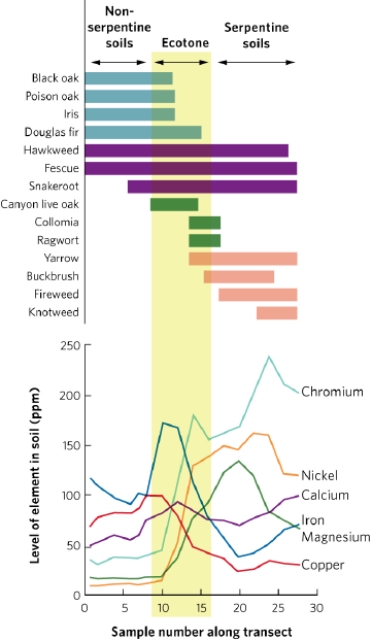 Which species is restricted to the ecotone between serpentine and nonserpentine soils?
 (Multiple Choice)
5.0/5 (72)
(72) Hairston, Smith, and Slobodkin suggested that Earth is green because carnivores depress the populations of herbivores that would otherwise consume most vegetation. Is this the only possible explanation for the greenness of Earth?
(Short Answer)
5.0/5 (66)
(66) 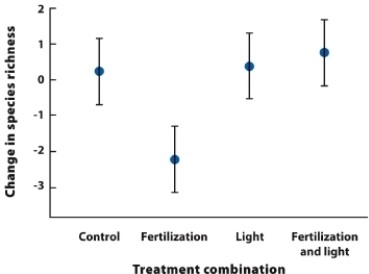 What is a reasonable explanation of the results in the figure?
 (Multiple Choice)
4.7/5 (74)
(74) 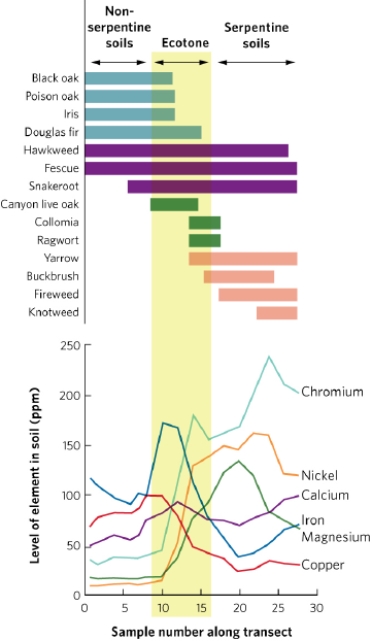 Which species would you characterize as seemingly unresponsive to changes in soil conditions across the transect?
 (Multiple Choice)
4.7/5 (81)
(81) 
Filters
- Essay(0)
- Multiple Choice(0)
- Short Answer(0)
- True False(0)
- Matching(0)