



 Chat with AI
Exam 2: Adaptations to Aquatic Environments

Exam 1: Introduction: Ecology, Evolution, and the Scientific Method65 Questions
Exam 2: Adaptations to Aquatic Environments 67 Questions
Exam 3: Adaptations to Terrestrial Environments 69 Questions
Exam 4: Adaptations to Variable Environments 65 Questions
Exam 5: Climates and Soils68 Questions
Exam 6: Terrestrial and Aquatic Biomes64 Questions
Exam 7: Evolution and Adaptation 68 Questions
Exam 8: Life Histories66 Questions
Exam 9: Reproductive Strategies65 Questions
Exam 10: Social Behaviors67 Questions
Exam 11: Population Distributions70 Questions
Exam 12: Population Growth and Regulation62 Questions
Exam 13: Population Dynamics Over Space and Time69 Questions
Exam 14: Predation and Herbivory69 Questions
Exam 15: Parasitism and Infectious Diseases68 Questions
Exam 16: Competition67 Questions
Exam 17: Mutualism68 Questions
Exam 18: Community Structure 66 Questions
Exam 19: Community Succession 120 Questions
Exam 20: Movement of Energy in Ecosystems 68 Questions
Exam 21: Movement of Elements in Ecosystems71 Questions
Exam 22: Landscape Ecology and Global Biodiversity 68 Questions
Exam 23: Global Conservation of Biodiversity67 Questions
Select questions type


In which location would you expect to find the highest levels of dissolved oxygen?
(Multiple Choice)
4.9/5  (77)
(77) What concept does the graph illustrate? Explain why it is important. 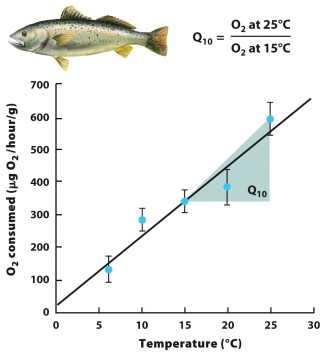
(Not Answered)
This question doesn't have any answer yet
The intricately designed shells of the algae known as diatoms are made up of which minor nutrient?
(Multiple Choice)
4.9/5 (65)
(65) You are studying a small stream and find that its pH is 4.5. What does this tell you about the stream, and what might be the cause?
(Short Answer)
4.9/5 (82)
(82) Which of the nutrients listed below is NOT required by all organisms?
(Multiple Choice)
4.9/5 (83)
(83) 
Filters
- Essay(0)
- Multiple Choice(0)
- Short Answer(0)
- True False(0)
- Matching(0)