



 Chat with AI
Exam 22: Landscape Ecology and Global Biodiversity

Exam 1: Introduction: Ecology, Evolution, and the Scientific Method65 Questions
Exam 2: Adaptations to Aquatic Environments 67 Questions
Exam 3: Adaptations to Terrestrial Environments 69 Questions
Exam 4: Adaptations to Variable Environments 65 Questions
Exam 5: Climates and Soils68 Questions
Exam 6: Terrestrial and Aquatic Biomes64 Questions
Exam 7: Evolution and Adaptation 68 Questions
Exam 8: Life Histories66 Questions
Exam 9: Reproductive Strategies65 Questions
Exam 10: Social Behaviors67 Questions
Exam 11: Population Distributions70 Questions
Exam 12: Population Growth and Regulation62 Questions
Exam 13: Population Dynamics Over Space and Time69 Questions
Exam 14: Predation and Herbivory69 Questions
Exam 15: Parasitism and Infectious Diseases68 Questions
Exam 16: Competition67 Questions
Exam 17: Mutualism68 Questions
Exam 18: Community Structure 66 Questions
Exam 19: Community Succession 120 Questions
Exam 20: Movement of Energy in Ecosystems 68 Questions
Exam 21: Movement of Elements in Ecosystems71 Questions
Exam 22: Landscape Ecology and Global Biodiversity 68 Questions
Exam 23: Global Conservation of Biodiversity67 Questions
Select questions type


MacArthur and Wilson's theory of island biogeography considers both species-area relationships and
(Multiple Choice)
4.7/5  (75)
(75) Which of the following is NOT true with regard to the species-area relationship?
(Multiple Choice)
4.9/5 (83)
(83) Why does Australia have a wide variety of unique animals and plants? Give examples.
(Essay)
4.8/5 (68)
(68) When habitat is fragmented, a(n) _____ forms along the edges.
(Multiple Choice)
4.7/5 (83)
(83) Based on the theory of island biogeography, which statement about reserve designs is TRUE?
(Multiple Choice)
4.9/5 (86)
(86) Given average temperature and humidity, potential evapotranspiration is the amount of water that could be
(Multiple Choice)
4.9/5 (70)
(70) PET is a measurement that combines the amount of solar radiation and
(Multiple Choice)
4.8/5 (84)
(84) How can we apply the theory of island biogeography to determine which characteristics might give a nature reserve the highest probable success rate in preserving a region's biodiversity? Discuss size, number, proximity, spatial arrangement, connectivity, and shape of the reserve.
(Essay)
4.7/5 (94)
(94) Based on MacArthur and Wilson's equilibrium theory of island biogeography at Ŝ,
(Multiple Choice)
4.7/5 (77)
(77) The equilibrium theory of island biogeography states that the number of species on an island reflects a balance between
(Multiple Choice)
5.0/5 (80)
(80) Which field considers the spatial arrangement of habitats at different scales?
(Multiple Choice)
4.9/5 (82)
(82) The movement of landmasses across the surface of Earth is called
(Multiple Choice)
4.8/5 (76)
(76) Discuss what MacArthur and Wilson meant by the species-area curve. What implications does this curve have for the management of nature centers/reserves?
(Essay)
4.9/5 (72)
(72) 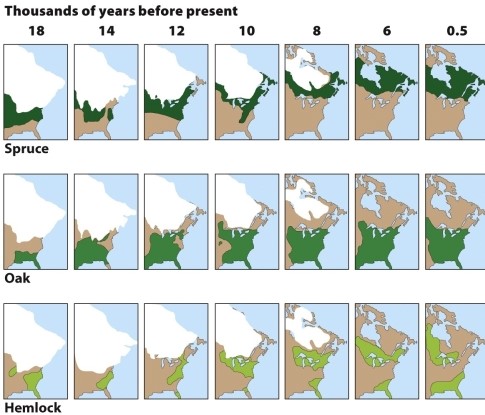 (Figure 22.27) What caused changing tree distributions seen in the figure? As global warming increases temperatures, what can be expected to happen to tree distributions of spruce, hemlock, and oak?
 (Not Answered)
This question doesn't have any answer yet
Which of the following describes the log-log form of the species area curve?
(Multiple Choice)
4.8/5 (77)
(77) A long-lasting influence of historical processes on the current ecology of an area is called a _____ effect.
(Multiple Choice)
4.7/5 (70)
(70) Arranging species in the regional pool among localities according to their adaptations and interactions is called _____ sorting.
(Multiple Choice)
4.8/5 (88)
(88) What do studies of Roman Empire settlements tell us about the legacy effects of humans on the landscape? How do human settlements cause legacy effects?
(Essay)
4.9/5 (76)
(76) 
Filters
- Essay(0)
- Multiple Choice(0)
- Short Answer(0)
- True False(0)
- Matching(0)