



 Chat with AI
Exam 22: Landscape Ecology and Global Biodiversity

Exam 1: Introduction: Ecology, Evolution, and the Scientific Method65 Questions
Exam 2: Adaptations to Aquatic Environments 67 Questions
Exam 3: Adaptations to Terrestrial Environments 69 Questions
Exam 4: Adaptations to Variable Environments 65 Questions
Exam 5: Climates and Soils68 Questions
Exam 6: Terrestrial and Aquatic Biomes64 Questions
Exam 7: Evolution and Adaptation 68 Questions
Exam 8: Life Histories66 Questions
Exam 9: Reproductive Strategies65 Questions
Exam 10: Social Behaviors67 Questions
Exam 11: Population Distributions70 Questions
Exam 12: Population Growth and Regulation62 Questions
Exam 13: Population Dynamics Over Space and Time69 Questions
Exam 14: Predation and Herbivory69 Questions
Exam 15: Parasitism and Infectious Diseases68 Questions
Exam 16: Competition67 Questions
Exam 17: Mutualism68 Questions
Exam 18: Community Structure 66 Questions
Exam 19: Community Succession 120 Questions
Exam 20: Movement of Energy in Ecosystems 68 Questions
Exam 21: Movement of Elements in Ecosystems71 Questions
Exam 22: Landscape Ecology and Global Biodiversity 68 Questions
Exam 23: Global Conservation of Biodiversity67 Questions
Select questions type


Why are nature reserves that are more circular more likely to be preferred than nature reserves that are more oval in shape?
(Multiple Choice)
4.9/5  (71)
(71) According to the _____ hypothesis, sites with higher amounts of energy are able to support more species.
(Multiple Choice)
4.9/5 (81)
(81) Eventually _____ split into South America, Africa, Antarctica, Australia, and India.
(Multiple Choice)
4.8/5 (88)
(88) Small intervening patches that dispersing organisms can use to move between large favorable habitats are called
(Multiple Choice)
4.9/5 (65)
(65) You own a small backyard lot behind your home that you have fertilized and mowed consistently over the years as a lawn. You decide you want to refocus your backyard lot and emphasize species diversity. What might you do to your backyard lot to enhance species diversity?
(Essay)
4.9/5 (87)
(87) For marine organisms, the highest diversity is seen at _____ and the lowest diversity is seen at _____.
(Multiple Choice)
4.9/5 (87)
(87) 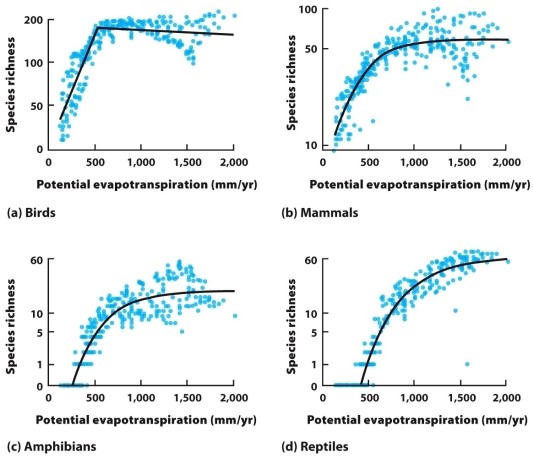 (Figure 22.24) As you can see in the figure, species richness for animals and plants increases with average potential evapotranspiration, but the curves level off at high levels of evapotranspiration. Why are high levels of evapotranspiration associated with a plateau in species richness?
 (Not Answered)
This question doesn't have any answer yet
Time since glaciation is one possible predictor of species diversity. Explain how time since glaciation leads to differences in terrestrial diversity between polar and tropical regions.
(Essay)
4.9/5 (77)
(77) Which of the following is NOT associated with low terrestrial diversity?
(Multiple Choice)
4.7/5 (69)
(69) About 150 million years ago the single landmass separated into northern and southern landmasses called
(Multiple Choice)
4.8/5 (92)
(92) A graph of the number of species observed in relation to the number of individuals sampled is called a species _____ curve.
(Multiple Choice)
4.8/5 (75)
(75) Discuss the confounding issue that areas are losing species while at the same time increasing in biodiversity.
(Essay)
5.0/5 (72)
(72) A classic study by MacArthur and Wilson demonstrated that as the size of islands increases, species
(Multiple Choice)
4.7/5 (77)
(77) The reduction in habitat size resulting from fragmentation causes a decline in species diversity for what reason?
(Multiple Choice)
4.8/5 (91)
(91) All of the species in all of the habitats that constitute a large geographic area are called
(Multiple Choice)
5.0/5 (93)
(93) According to researchers, how has forest fragmentation led to the potential higher rate of exposure to Lyme disease?
(Multiple Choice)
4.7/5 (77)
(77) 
Filters
- Essay(0)
- Multiple Choice(0)
- Short Answer(0)
- True False(0)
- Matching(0)