



 Chat with AI
Exam 14: Translation and Proteins

Exam 1: Introduction to Genetics43 Questions
Exam 2: Mitosis and Meiosis53 Questions
Exam 3: Mendelian Genetics65 Questions
Exam 4: Extensions of Mendelian Genetics65 Questions
Exam 5: Chromosome Mapping in Eukaryotes43 Questions
Exam 6: Genetic Analysis and Mapping in Bacteria and Bacteriophages49 Questions
Exam 7: Sex Determination and Sex Chromosomes45 Questions
Exam 8: Chromosome Mutations: Variation in Number and Arrangement48 Questions
Exam 9: Extranuclear Inheritance36 Questions
Exam 10: DNA Structure and Analysis48 Questions
Exam 11: DNA Replication and Recombination50 Questions
Exam 12: DNA Organization in Chromosomes37 Questions
Exam 13: The Genetic Code and Transcription45 Questions
Exam 14: Translation and Proteins44 Questions
Exam 15: Gene Mutation,dna Repair,and Transposition40 Questions
Exam 16: Regulation of Gene Expression in Bacteria41 Questions
Exam 17: Transcriptional Regulation in Eukaryotes39 Questions
Exam 18: Post-Transcriptional Regulation in Eukaryotes29 Questions
Exam 19: Epigenetic Regulation in Eukaryotes30 Questions
Exam 20: Recombinant Dna Technology52 Questions
Exam 21: Genomic Analysis44 Questions
Exam 22: Applications of Genetic Engineering and Biotechnology36 Questions
Exam 23: Developmental Genetics41 Questions
Exam 24: Cancer Genetics48 Questions
Exam 25: Quantitative Genetics and Multifactorial Traits52 Questions
Exam 26: Population and Evolutionary Genetics58 Questions
Exam 27: CRISPR and Genomic Editing20 Questions
Exam 28: DNA Forensics20 Questions
Exam 29: Genomics and Precision Medicine20 Questions
Exam 30: Genetically Modified Foods20 Questions
Exam 31: Gene Therapy20 Questions
Exam 32: Advances in Neurogenetics: The Study of Huntington Disease19 Questions
Select questions type


The diseases bovine spongiform encephalopathy and Creutzfeldt-Jakob disease are caused by what kind of protein? How does this protein cause these diseases?
(Essay)
4.9/5  (80)
(80) During initiation in bacterial translation,a particular mutation causes the premature binding of the large ribosome subunit to the small ribosome subunit.Which component of initiation is not working properly?
(Multiple Choice)
4.8/5 (71)
(71) Sickle- cell anemia is caused when one nucleotide is changed to another nucleotide in the hemoglobin gene.How does this one small change cause the life- threatening disease of sickle- cell anemia?
(Essay)
4.9/5 (83)
(83) Modular portions of a protein that fold into stable conformations with specific functional capabilities are referred to as_________ .
(Multiple Choice)
4.7/5 (84)
(84) A mutation in EF- Tu would have a DIRECT effect on which part of translation?
(Multiple Choice)
5.0/5 (70)
(70) The protein shown below provides an example of which level of protein folding? 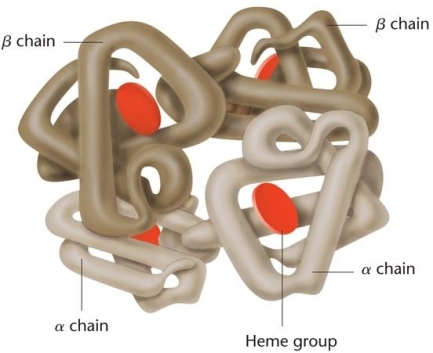
(Multiple Choice)
4.8/5 (70)
(70) Regarding the protein structure,how are fi- pleated sheets arranged and stabilized?
(Essay)
4.8/5 (62)
(62) The problem below relates to the synthesis of several intermediates in the citric acid cycle,which is essential in the production of ATP through aerobic respiration.A set of experimental results relating the growth +)of Neurospora on several media is given in the table.Based on the information provided,present the biochemical pathway for the substances oxaloacetate,fumarate,malate,and succinate,and the locations of the metabolic blocks produced by the various strains.
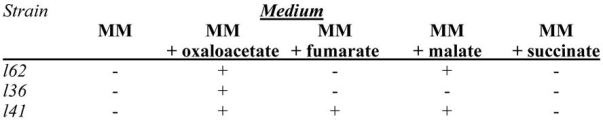
(Essay)
4.7/5 (83)
(83) Assume that a base addition occurs early in the coding region of a gene.Is the protein product of this gene expected to have MORE or FEWER altered amino acids compared with the original gene with a base deletion late in the coding region? Explain.
(Essay)
4.9/5 (83)
(83) Often point mutations can cause a protein to be made that differs in just one amino acid.Which of the following changes is most likely to cause the greatest change in protein function?
(Multiple Choice)
4.8/5 (77)
(77) Nutritional mutants in Neurospora can be "cured" by treating the medium with substances in the defective metabolic pathway.What determines whether the mutant strain auxotroph)is "cured" by a particular substance?
(Essay)
4.7/5 (64)
(64) All of the following are examples of posttranslational modifications,EXCEPT_________ .
(Multiple Choice)
4.8/5 (68)
(68) Which class of protein functions primarily by lowering the energy of activation during a reaction?
(Short Answer)
4.9/5 (89)
(89) Considering the types of side chains on amino acids and their relationship to protein structure,where are the amino acids with hydrophobic side chains most likely to be located?
(Essay)
4.9/5 (72)
(72) Which of the following is true regarding the tRNA structure?
(Multiple Choice)
4.8/5 (63)
(63) A bacterium's large subunit is 60S and its small subunit is 40S.What is the size of the ribosome containing both subunits?
(Multiple Choice)
4.9/5 (87)
(87) Below are several phenomena relating to protein structure.Clearly describe each phenomenon,the conditions u which each occurs,and the probable influence each has on protein structure.
a)hydrophobic interactions
b)hydrogen bonds
c)disulfide bridges
(Essay)
4.9/5 (72)
(72) Assuming that an amino acid sequence is 250 amino acids long,how many different molecules,each with a unique sequence,could be formed?
(Short Answer)
4.9/5 (87)
(87) The one- gene:one- enzyme hypothesis emerged from work on which two organisms?
(Multiple Choice)
4.9/5 (83)
(83) 
Filters
- Essay(0)
- Multiple Choice(0)
- Short Answer(0)
- True False(0)
- Matching(0)