



 Chat with AI
Exam 31: Immunochemistry

Exam 1: Matter, Energy, and Measurement143 Questions
Exam 2: Atoms133 Questions
Exam 3: Chemical Bonds140 Questions
Exam 4: Chemical Reactions140 Questions
Exam 5: Gases, Liquids, and Solids132 Questions
Exam 6: Solutions and Colloids153 Questions
Exam 7: Reaction Rates and Chemical Equilibrium103 Questions
Exam 8: Acids and Bases197 Questions
Exam 9: Nuclear Chemistry155 Questions
Exam 10: Organic Chemistry70 Questions
Exam 11: Alkanes142 Questions
Exam 12: Alkenes and Alkynes123 Questions
Exam 13: Benzene and Its Derivatives60 Questions
Exam 14: Alcohols, Ethers, and Thiols122 Questions
Exam 15: Chirality: the Handedness of Molecules92 Questions
Exam 16: Amines89 Questions
Exam 17: Aldehydes and Ketones101 Questions
Exam 18: Carboxylic Acids115 Questions
Exam 19: Carboxylic Anhydrides, Esters, and Amides117 Questions
Exam 20: Carbohydrates103 Questions
Exam 21: Lipids132 Questions
Exam 22: Proteins128 Questions
Exam 23: Enzymes62 Questions
Exam 24: Chemical Communications: Neurotransmitters and Hormones89 Questions
Exam 25: Nucleotides, Nucleic Acids, and Heredity121 Questions
Exam 26: Gene Expression and Protein Synthesis129 Questions
Exam 27: Bioenergetics: How the Body Converts Food to Energy140 Questions
Exam 28: Specific Catabolic Pathways: Carbohydrate, Lipid, and Protein Metabolism104 Questions
Exam 29: Biosynthetic Pathways67 Questions
Exam 30: Nutrition73 Questions
Exam 31: Immunochemistry142 Questions
Exam 32: Body Fluids72 Questions
Select questions type


Which of the following describes the specificity of NK and Tc cells?
(Multiple Choice)
4.9/5  (73)
(73) The polypeptide chains of immunoglobulins have a shape similar to which letter?
(Multiple Choice)
4.9/5 (80)
(80) Which of the following happens to T cells which, during their maturation, have not met and interacted with MHCs.
(Multiple Choice)
4.9/5 (86)
(86) T cell receptors can recognize which of the following antigens?
(Multiple Choice)
4.7/5 (74)
(74) Which of the following recognizes sugars which are unique to HIV?
(Multiple Choice)
4.8/5 (87)
(87) Dendritic cells transport protein fragments of invading viruses or bacteria to which of the following?
(Multiple Choice)
4.8/5 (66)
(66) Which of the following does not affect the variable regions of immunoglobulins?
(Multiple Choice)
4.8/5 (68)
(68) The following is a representation which shows a glycoprotein molecule, HA, found on the surface of a strain of the influenza A virus. 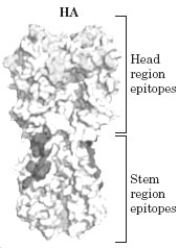 Which of the following correctly portrays the issues involved in the development of a vaccine for such a virus?
 (Multiple Choice)
4.7/5 (70)
(70) Which of the following correctly describes the interactions between antigens, class I MHC molecules and T cells?
(Multiple Choice)
4.8/5 (78)
(78) Which of the following happens when a B cell antibody interacts with its antigen?
(Multiple Choice)
4.7/5 (66)
(66) Which of the following target and perforate the surfaces of abnormal cells?
(Multiple Choice)
4.9/5 (72)
(72) In a protein antigen, how many amino acids are necessary to interact with an antibody?
(Multiple Choice)
4.8/5 (75)
(75) How many different types of immunoglobulin antibodies can a single B cell synthesize?
(Multiple Choice)
4.8/5 (75)
(75) The smallest unit of an antigen capable eliciting an immune response is called which of the following?
(Multiple Choice)
4.8/5 (88)
(88) 
Filters
- Essay(0)
- Multiple Choice(0)
- Short Answer(0)
- True False(0)
- Matching(0)