



 Chat with AI
Exam 12: Alkenes and Alkynes

Exam 1: Matter, Energy, and Measurement143 Questions
Exam 2: Atoms133 Questions
Exam 3: Chemical Bonds140 Questions
Exam 4: Chemical Reactions140 Questions
Exam 5: Gases, Liquids, and Solids132 Questions
Exam 6: Solutions and Colloids153 Questions
Exam 7: Reaction Rates and Chemical Equilibrium103 Questions
Exam 8: Acids and Bases197 Questions
Exam 9: Nuclear Chemistry155 Questions
Exam 10: Organic Chemistry70 Questions
Exam 11: Alkanes142 Questions
Exam 12: Alkenes and Alkynes123 Questions
Exam 13: Benzene and Its Derivatives60 Questions
Exam 14: Alcohols, Ethers, and Thiols122 Questions
Exam 15: Chirality: the Handedness of Molecules92 Questions
Exam 16: Amines89 Questions
Exam 17: Aldehydes and Ketones101 Questions
Exam 18: Carboxylic Acids115 Questions
Exam 19: Carboxylic Anhydrides, Esters, and Amides117 Questions
Exam 20: Carbohydrates103 Questions
Exam 21: Lipids132 Questions
Exam 22: Proteins128 Questions
Exam 23: Enzymes62 Questions
Exam 24: Chemical Communications: Neurotransmitters and Hormones89 Questions
Exam 25: Nucleotides, Nucleic Acids, and Heredity121 Questions
Exam 26: Gene Expression and Protein Synthesis129 Questions
Exam 27: Bioenergetics: How the Body Converts Food to Energy140 Questions
Exam 28: Specific Catabolic Pathways: Carbohydrate, Lipid, and Protein Metabolism104 Questions
Exam 29: Biosynthetic Pathways67 Questions
Exam 30: Nutrition73 Questions
Exam 31: Immunochemistry142 Questions
Exam 32: Body Fluids72 Questions
Select questions type


Which of the following reactions involves the addition of different groups to the two ends of a double bond?

Free
(Multiple Choice)
4.8/5  (68)
(68) Correct Answer: Verified
A
Which of the following is true of ethylene?
Free
(Multiple Choice)
4.9/5 (91)
(91) Correct Answer:Verified
VerifiedD
Which product is formed by the chlorination of 2-butene?
Free
(Multiple Choice)
4.8/5 (83)
(83) Correct Answer:Verified
VerifiedC
What type of alcohol is formed by the hydration of 1-butene?
(Multiple Choice)
4.9/5 (89)
(89) Which of the following structural features is never associated with cis-trans isomerism?
(Multiple Choice)
4.9/5 (72)
(72) Currently there is extensive recycling of which of the following polymers?
(Multiple Choice)
4.7/5 (75)
(75) Currently there is extensive recycling of which of the following polymers?
(Multiple Choice)
4.9/5 (72)
(72) Given an alkane, an alkene, and an alkyne, each of which contains two carbon atoms, which compound will contain most hydrogen atoms?
(Multiple Choice)
4.8/5 (94)
(94) Which of the following monomers can be used to prepare polystyrene?
(Multiple Choice)
4.9/5 (79)
(79) Low-density polyethylene is produced from ethylene by using which of the following?
(Multiple Choice)
4.8/5 (82)
(82) Which of the following is not a correct IUPAC name for an alkene?
(Multiple Choice)
4.8/5 (79)
(79) Which of the following curved arrows correctly describes the first step of the reaction of propene with a hydrogen halide?
(Multiple Choice)
4.8/5 (83)
(83) Which of the following, all of which have the molecular formula C5H10, has cis and trans isomers?
(Multiple Choice)
4.8/5 (78)
(78) Which of the following correctly characterizes the compound represented below? 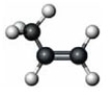
(Multiple Choice)
4.8/5 (89)
(89) When the following substance reacts with water in the presence of an acid, which of the following describes the reaction? 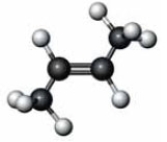
(Multiple Choice)
5.0/5 (87)
(87) In alkenes there are four groups bonded to the carbons which constitute the carbon-carbon double bond. Which of the following situations produces cis-trans isomerism?
(Multiple Choice)
4.9/5 (79)
(79) Which of the following is the starting material derived from natural gas that is used for the production of ethylene?
(Multiple Choice)
4.7/5 (78)
(78) Markovnikov's rule is useful to predict the outcome of the reaction of hydrogen chloride with which of the following alkenes?
(Multiple Choice)
5.0/5 (77)
(77) Which of the following is true in the IUPAC system for naming alkenes?
(Multiple Choice)
4.9/5 (87)
(87) 
Filters
- Essay(0)
- Multiple Choice(0)
- Short Answer(0)
- True False(0)
- Matching(0)