



 Chat with AI
Exam 12: Alkenes and Alkynes

Exam 1: Matter, Energy, and Measurement143 Questions
Exam 2: Atoms133 Questions
Exam 3: Chemical Bonds140 Questions
Exam 4: Chemical Reactions140 Questions
Exam 5: Gases, Liquids, and Solids132 Questions
Exam 6: Solutions and Colloids153 Questions
Exam 7: Reaction Rates and Chemical Equilibrium103 Questions
Exam 8: Acids and Bases197 Questions
Exam 9: Nuclear Chemistry155 Questions
Exam 10: Organic Chemistry70 Questions
Exam 11: Alkanes142 Questions
Exam 12: Alkenes and Alkynes123 Questions
Exam 13: Benzene and Its Derivatives60 Questions
Exam 14: Alcohols, Ethers, and Thiols122 Questions
Exam 15: Chirality: the Handedness of Molecules92 Questions
Exam 16: Amines89 Questions
Exam 17: Aldehydes and Ketones101 Questions
Exam 18: Carboxylic Acids115 Questions
Exam 19: Carboxylic Anhydrides, Esters, and Amides117 Questions
Exam 20: Carbohydrates103 Questions
Exam 21: Lipids132 Questions
Exam 22: Proteins128 Questions
Exam 23: Enzymes62 Questions
Exam 24: Chemical Communications: Neurotransmitters and Hormones89 Questions
Exam 25: Nucleotides, Nucleic Acids, and Heredity121 Questions
Exam 26: Gene Expression and Protein Synthesis129 Questions
Exam 27: Bioenergetics: How the Body Converts Food to Energy140 Questions
Exam 28: Specific Catabolic Pathways: Carbohydrate, Lipid, and Protein Metabolism104 Questions
Exam 29: Biosynthetic Pathways67 Questions
Exam 30: Nutrition73 Questions
Exam 31: Immunochemistry142 Questions
Exam 32: Body Fluids72 Questions
Select questions type


Which of the following compounds will not produce methylcyclopentane after catalytic hydrogenation?
(Multiple Choice)
4.7/5  (80)
(80) A student wanted to use the branched groups, isobutyl, sec-butyl, and tert-butyl when naming alkenes, but was told not to. What is the correct IUPAC name for the compound the student called sec-butylethene?
(Multiple Choice)
4.8/5 (92)
(92) Which of the following is true of the non-cyclic portion of vitamin A?
(Multiple Choice)
4.9/5 (77)
(77) Which product is formed by the chlorination of 2-methyl-1-butene?
(Multiple Choice)
4.8/5 (88)
(88) Which of the listed products will be formed in the following reaction? 
(Multiple Choice)
4.9/5 (78)
(78) Which of the following compounds, all of which have the molecular formula C6H12, has cis and trans isomers?
(Multiple Choice)
4.7/5 (75)
(75) Which of the following is true of the six atoms of ethylene?
(Multiple Choice)
4.7/5 (74)
(74) A student named a particular compound 2-ethyl-3-methyl-2-butene. Assuming that the student's choice actually corresponded to the correct distribution of the double bond and the substituents, what is the correct IUPAC name for this compound?
(Multiple Choice)
5.0/5 (86)
(86) Which of the following occurs when rhodopsin absorbs light?
(Multiple Choice)
4.8/5 (85)
(85) Which product is formed by the bromination of cyclohexene?
(Multiple Choice)
4.9/5 (79)
(79) Which of the listed products will be formed in the following reaction? 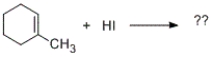
(Multiple Choice)
4.9/5 (82)
(82) What is the name of the lightest hydrocarbon which has cis and trans isomers?
(Multiple Choice)
4.8/5 (81)
(81) Which of the following compounds is a natural ripening agent for fruits?
(Multiple Choice)
4.9/5 (81)
(81) What is the configuration of each of the alkenes shown below? 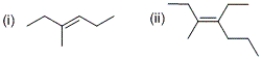
(Multiple Choice)
4.9/5 (63)
(63) What type of alcohol is formed by the hydration of 2-butene?
(Multiple Choice)
4.8/5 (81)
(81) Chloroprene, which is the monomer used to make neoprene rubber, is one of several monochloro derivatives of 1,3-butadiene. How many monochloro derivatives of 1,3-butadiene are there? (Be sure to account for cis-trans isomers.)
(Multiple Choice)
5.0/5 (81)
(81) Consider the substance represented by the following model. 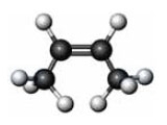 The physical properties of this substance would most closely represent the corresponding member of which functional group class?
 (Multiple Choice)
4.8/5 (83)
(83) Four patterns can be noted for certain organic reactions;
Pattern 1: Add a proton.
Pattern 2: Take a proton away.
Pattern 3: Reaction between an electrophile and nucleophile to form a new covalent bond.
Pattern 4: Reaction of proton donor with a carbon to carbon double bond to from a new covalent bond.
-To which pattern does the following reaction belong? 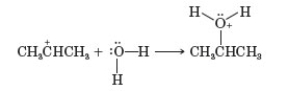
(Multiple Choice)
4.9/5 (90)
(90) Consider the alkyne counterpart of the following compound. 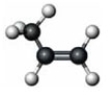 Which of the following would characterize this alkyne?
 (Multiple Choice)
4.8/5 (83)
(83) 
Filters
- Essay(0)
- Multiple Choice(0)
- Short Answer(0)
- True False(0)
- Matching(0)