



 Chat with AI
Exam 11: Biological Membranes and Transport

Exam 1: The Foundations of Biochemistry109 Questions
Exam 2: Water87 Questions
Exam 3: Amino Acids, Peptides, and Proteins112 Questions
Exam 4: The Three-Dimensional Structure of Proteins100 Questions
Exam 5: Protein Function101 Questions
Exam 6: Enzymes106 Questions
Exam 7: Carbohydrates and Glycobiology109 Questions
Exam 8: Nucleotides and Nucleic Acids98 Questions
Exam 9: DNA-Based Information Technologies102 Questions
Exam 10: Lipids102 Questions
Exam 11: Biological Membranes and Transport105 Questions
Exam 12: Biosignaling98 Questions
Exam 13: Bioenergetics and Biochemical Reaction Types105 Questions
Exam 14: Glycolysis, Gluconeogenesis, and the Pentose Phosphate Pathway112 Questions
Exam 15: Principles of Metabolic Regulation101 Questions
Exam 16: The Citric Acid Cycle105 Questions
Exam 17: Fatty Acid Catabolism97 Questions
Exam 18: Amino Acid Oxidation and the Production of Urea98 Questions
Exam 19: Oxidative Phosphorylation and Photophosphorylation96 Questions
Exam 20: Carbohydrate Biosynthesis in Plants and Bacteria94 Questions
Exam 21: Lipid Biosynthesis100 Questions
Exam 22: Biosynthesis of Amino Acids, Nucleotides, and Related Molecules98 Questions
Exam 23: Hormonal Regulation and Integration of Mammalian Metabolism100 Questions
Exam 24: Genes and Chromosomes99 Questions
Exam 25: DNA Metabolism101 Questions
Exam 26: RNA Metabolism101 Questions
Exam 27: Protein Metabolism99 Questions
Exam 28: Regulation of Gene Expression99 Questions
Select questions type


The shortest helix segment in a protein that will span a membrane bilayer has about _____ amino acid residues.
(Multiple Choice)
5.0/5  (74)
(74) The plasma membrane of an animal cell consists of 45% by weight of phospholipid and 55% protein. What is the mole ratio (moles of lipid/moles of protein) if the average molecular weight of phospholipids is 750 and the average molecular weight of membrane proteins is 50,000?
(Short Answer)
4.9/5 (87)
(87) You are trying to isolate an enzyme that catalyzes the conversion of A B, and you have a sensitive assay for this enzyme. After lysing open the cells, you find that the activity is associated with the membrane fraction, not the soluble fraction (which you throw away). You then follow the procedure shown below. Explain the sudden re-occurrence of activity at the end of your protocol. 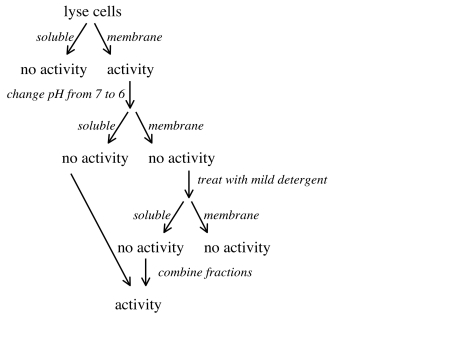
(Not Answered)
This question doesn't have any answer yet
(a) Explain why phosphoglycerides are capable of spontaneously assembling into the bilayer structure found in biological membranes but triacylglycerols are not. (b) What are the forces that drive bilayer formation?
(Essay)
4.9/5 (90)
(90) Describe the structure of a biological membrane as proposed by the fluid mosaic model. Indicate the positions and orientations of phospholipids, cholesterol, integral and peripheral membrane proteins, and the carbohydrate moieties of glycoproteins and glycolipids.
(Essay)
4.8/5 (82)
(82) If a monovalent cation is being imported into a cell in the absence of a concentration gradient (i.e., the concentration for the transported cation is equal on both sides of the membrane), what could you predict about Gt? Assume the transmembrane potential is 50mV (inside negative).
(Multiple Choice)
4.9/5 (75)
(75) What is an amphipathic compound? Explain how such compounds contribute to the structure of biological membranes.
(Essay)
4.9/5 (84)
(84) Which statement is FALSE regarding the major facilitator superfamily of transporters?
(Multiple Choice)
4.8/5 (83)
(83) What kind of bond can link a palmitoyl anchor to a polypeptide?
(Multiple Choice)
4.9/5 (70)
(70) What kind of bond can link a prenyl anchor to a polypeptide?
(Multiple Choice)
4.9/5 (74)
(74) What are the principle features of the fluid mosaic model of membranes?
(Short Answer)
4.8/5 (66)
(66) Which step is NOT involved in neurotransmitter release at a synapse?
(Multiple Choice)
4.9/5 (88)
(88) Distinguish between simple diffusion (SD), facilitated diffusion (FD), and active transport (AT) across a membrane for the following questions. (More than one may be true.)
(a) Which processes are energy dependent?
(b) Which processes need some kind of carrier protein(s)?
(c) Which processes can be saturated by substrate?
(d) Which processes can establish a concentration gradient?
(e) How much energy does it take to transport an uncharged substrate in, if its starting inside concentration is 10-fold greater than outside?
(Short Answer)
4.9/5 (70)
(70) The type of membrane transport that uses ion gradients as the energy source is:
(Multiple Choice)
4.8/5 (73)
(73) Movement of water across membranes is facilitated by proteins called:
(Multiple Choice)
4.8/5 (85)
(85) Syndecans are proteoglycans that have glycosaminoglycans attached to the N-terminal domain, a single transmembrane helix and a C-terminal domain that can be phosphorylated. What type of membrane proteins are these?
(Multiple Choice)
4.8/5 (72)
(72) 
Filters
- Essay(0)
- Multiple Choice(0)
- Short Answer(0)
- True False(0)
- Matching(0)