



 Chat with AI
Exam 19: Oxidative Phosphorylation and Photophosphorylation

Exam 1: The Foundations of Biochemistry109 Questions
Exam 2: Water87 Questions
Exam 3: Amino Acids, Peptides, and Proteins112 Questions
Exam 4: The Three-Dimensional Structure of Proteins100 Questions
Exam 5: Protein Function101 Questions
Exam 6: Enzymes106 Questions
Exam 7: Carbohydrates and Glycobiology109 Questions
Exam 8: Nucleotides and Nucleic Acids98 Questions
Exam 9: DNA-Based Information Technologies102 Questions
Exam 10: Lipids102 Questions
Exam 11: Biological Membranes and Transport105 Questions
Exam 12: Biosignaling98 Questions
Exam 13: Bioenergetics and Biochemical Reaction Types105 Questions
Exam 14: Glycolysis, Gluconeogenesis, and the Pentose Phosphate Pathway112 Questions
Exam 15: Principles of Metabolic Regulation101 Questions
Exam 16: The Citric Acid Cycle105 Questions
Exam 17: Fatty Acid Catabolism97 Questions
Exam 18: Amino Acid Oxidation and the Production of Urea98 Questions
Exam 19: Oxidative Phosphorylation and Photophosphorylation96 Questions
Exam 20: Carbohydrate Biosynthesis in Plants and Bacteria94 Questions
Exam 21: Lipid Biosynthesis100 Questions
Exam 22: Biosynthesis of Amino Acids, Nucleotides, and Related Molecules98 Questions
Exam 23: Hormonal Regulation and Integration of Mammalian Metabolism100 Questions
Exam 24: Genes and Chromosomes99 Questions
Exam 25: DNA Metabolism101 Questions
Exam 26: RNA Metabolism101 Questions
Exam 27: Protein Metabolism99 Questions
Exam 28: Regulation of Gene Expression99 Questions
Select questions type


A recently discovered bacterium carries out ATP synthesis coupled to the flow of electrons through a chain of carriers to some electron acceptor. The components of its electron transfer chain differ from those found in mitochondria; they are listed below with their standard reduction potentials. 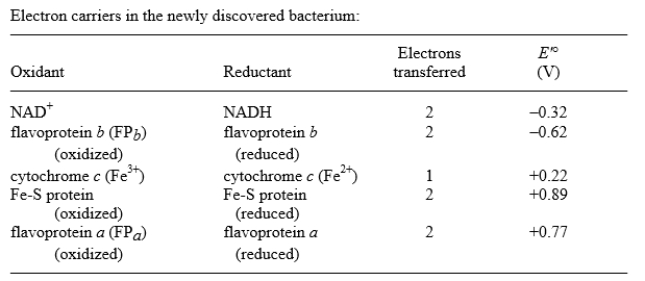 (a) Place the electron carriers in the order in which they are most likely to act in carrying electrons. (b) Is it likely that O2 (for which E'° = 0.82 V) is the final electron acceptor in this organism? Why or why not? (c) How would you calculate the maximum number of ATP molecules that could theoretically be synthesized, under standard conditions, per pair of electrons transfered through this chain of carriers? (The Faraday constant,
 , is 96.48 kJ/V · mol.) G'° for ATP synthesis is +30.5 kJ/mol.
(a) Place the electron carriers in the order in which they are most likely to act in carrying electrons. (b) Is it likely that O2 (for which E'° = 0.82 V) is the final electron acceptor in this organism? Why or why not? (c) How would you calculate the maximum number of ATP molecules that could theoretically be synthesized, under standard conditions, per pair of electrons transfered through this chain of carriers? (The Faraday constant, , is 96.48 kJ/V · mol.) G'° for ATP synthesis is +30.5 kJ/mol. (Not Answered)
This question doesn't have any answer yet
The compound 2,4-dinitrophenol (DNP), an uncoupler, was briefly used as a weight-loss drug. Some of its effects in people who took the drug included weight loss and higher than normal body temperature. Some people even died. Explain the first two effects of the compound in biochemical terms.
(Essay)
4.9/5  (79)
(79) How many molecules of water are produced by the electron-transport chain during the complete aerobic oxidation of one molecule of pyruvate?
(Multiple Choice)
4.8/5 (91)
(91) Which statement explains why the [ATP]/[ADP][Pi] ratio is relatively stable in a cell?
(Multiple Choice)
4.9/5 (72)
(72) During the operation of the malate-aspartate shuttle, what process does NOT occur?
(Multiple Choice)
4.8/5 (81)
(81) Bovine ATP synthase contains 8 c subunits while yeast ATP synthase contains 10 c subunits. How many protons would be needed for each ATP in these two synthases, and how would it impact the P:O ratio?
(Essay)
4.8/5 (79)
(79) Diagram the path of electron flow from NADH to the final electron acceptor during electron transport in mitochondria. For each electron carrier, indicate whether only electrons, or both electrons and protons, are accepted/donated by that carrier. Also, indicate where electrons from succinate oxidation enter the chain of carriers.
(Essay)
4.7/5 (80)
(80) During oxidative phosphorylation, the proton motive force (electrochemical gradient) that is generated by electron transport is used to:
(Multiple Choice)
4.9/5 (69)
(69) Mammals produce heat by using which endogenous uncoupling agent?
(Multiple Choice)
4.9/5 (82)
(82) During oxidative phosphorylation, the proton motive force that is generated by electron transport is used to:
(Multiple Choice)
5.0/5 (75)
(75) Almost all of the oxygen (O2) one consumes in breathing is converted to:
(Multiple Choice)
4.7/5 (82)
(82) Under standard conditions, NADH reoxidation by the electron-transport chain has a free-energy change equal to -220 kJ/mol. With 100% efficiency, how many ATP could be synthesized under standard conditions? What is the "actual" efficiency given these numbers?
(Short Answer)
4.8/5 (78)
(78) Cyanide, oligomycin, and 2,4-dinitrophenol (DNP) are inhibitors of mitochondrial aerobic phosphorylation. Which statement CORRECTLY describes the mode of action of the three inhibitors?
(Multiple Choice)
4.9/5 (75)
(75) Mutations in mitochondrial genes frequently produce diseases that affect the brain and skeletal muscle (mitochondrial encephalomyopathies). Why are these two tissues particularly sensitive to mitochondrial mutations?
(Short Answer)
4.9/5 (99)
(99) If a drug that specifically prevented the interaction of cytochrome c with other proteins was added to respiring mitochondria in a test tube, what effects would be observed?
(Multiple Choice)
4.7/5 (82)
(82) 
Filters
- Essay(0)
- Multiple Choice(0)
- Short Answer(0)
- True False(0)
- Matching(0)