



 Chat with AI
Exam 20: Income Inequality and Poverty

Exam 1: Ten Principles of Economics439 Questions
Exam 2: Thinking Like an Economist617 Questions
Exam 3: Interdependence and the Gains From Trade527 Questions
Exam 4: The Market Forces of Supply and Demand697 Questions
Exam 5: Elasticity and Its Application594 Questions
Exam 6: Supply, Demand, and Government Policies645 Questions
Exam 7: Consumers, Producers, and the Efficiency of Markets549 Questions
Exam 8: Application: the Costs of Taxation513 Questions
Exam 9: Application: International Trade492 Questions
Exam 10: Externalities524 Questions
Exam 11: Public Goods and Common Resources433 Questions
Exam 12: The Design of the Tax System549 Questions
Exam 13: The Costs of Production420 Questions
Exam 14: Firms in Competitive Markets543 Questions
Exam 15: Monopoly637 Questions
Exam 16: Monopolistic Competition580 Questions
Exam 17: Oligopoly488 Questions
Exam 18: The Markets for the Factors of Production564 Questions
Exam 19: Earnings and Discrimination490 Questions
Exam 20: Income Inequality and Poverty455 Questions
Exam 21: The Theory of Consumer Choice431 Questions
Exam 22: Frontiers of Microeconomics440 Questions
Exam 23: Measuring a Nations Income520 Questions
Exam 24: Measuring the Cost of Living529 Questions
Exam 25: Production and Growth505 Questions
Exam 26: Saving, Investment, and the Financial System564 Questions
Exam 27: The Basic Tools of Finance500 Questions
Exam 28: Unemployment678 Questions
Exam 29: The Monetary System515 Questions
Exam 30: Money Growth and Inflation481 Questions
Exam 31: Open-Economy Macroeconomics: Basic Concepts522 Questions
Exam 32: A Macroeconomic Theory of the Open Economy475 Questions
Exam 33: Aggregate Demand and Aggregate Supply562 Questions
Exam 34: The Influence of Monetary and Fiscal Policy on Aggregate Demand508 Questions
Exam 35: The Short-Run Trade-Off Between Inflation and Unemployment491 Questions
Exam 36: Six Debates Over Macroeconomic Policy372 Questions
Select questions type


Figure 20-3  -Refer to Figure 20-3. Which of the following best describes the poverty rates by age from 1965 to 2011?
 (Multiple Choice)
4.9/5  (82)
(82) Figure 20-4 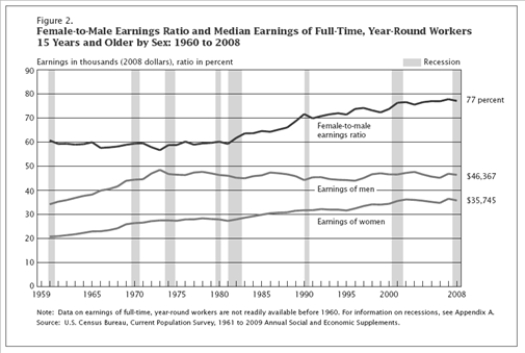 -Refer to Figure 20-4. The ratio of female-to-male earnings has increased steadily from about 1980 to 2008 because the earnings of men
 (Multiple Choice)
4.9/5 (85)
(85) Table 20-1
The following table shows the distribution of income in Marysville.  -Refer to Table 20-1. Seventy-five percent of all families have incomes below what level?
 (Multiple Choice)
4.9/5 (79)
(79) What is the primary problem in comparing income inequality in the US with income inequality in other countries?
(Short Answer)
4.9/5 (67)
(67) In general, which of the following would libertarians argue is more important than equal outcomes?
(Multiple Choice)
4.8/5 (71)
(71) Given the table shown, which country has a more equal income distribution? Explain your answer. 
(Essay)
4.9/5 (84)
(84) According to the maximin criterion, income should be transferred from the rich to the poor as long as it
(Multiple Choice)
4.8/5 (80)
(80) Government vouchers to purchase food, also known as food stamps, are an example of
(Multiple Choice)
4.8/5 (80)
(80) Libertarians believe that in considering economic fairness, one should primarily consider the
(Multiple Choice)
4.9/5 (82)
(82) Scenario 20-7
Zooey is a single mother of two young children whose husband died in a tragic car accident. She earns $20,000 per year working as a cashier at a grocery store. The government uses a negative income tax system in which Taxes owed = (1/4 of income) - $15,000.
-Refer to Scenario 20-7. Zooey's brother Zander owes $10,000 in taxes. How much does he earn?
(Short Answer)
4.7/5 (79)
(79) Measuring poverty using an absolute income scale like the poverty line can be misleading because
(Multiple Choice)
4.8/5 (90)
(90) Table 20-14
Income Inequality in the United States
The values in the table reflect the percentages of pre-tax-and transfer income.  Source: US Census Bureau
-Refer to Table 20-14. In 2010, how many more percentage points of total income did the top fifth of the population earn compared to if the income distribution were completely equal?
Source: US Census Bureau
-Refer to Table 20-14. In 2010, how many more percentage points of total income did the top fifth of the population earn compared to if the income distribution were completely equal? (Short Answer)
4.9/5 (92)
(92) Table 20-3
The Distribution of Income in Edgerton  -Refer to Table 20-3. According to the table, what percent of families in Edgerton have income levels below $44,000?
 (Multiple Choice)
4.9/5 (71)
(71) 
Filters
- Essay(0)
- Multiple Choice(0)
- Short Answer(0)
- True False(0)
- Matching(0)