



 Chat with AI
Exam 20: Income Inequality and Poverty

Exam 1: Ten Principles of Economics439 Questions
Exam 2: Thinking Like an Economist617 Questions
Exam 3: Interdependence and the Gains From Trade527 Questions
Exam 4: The Market Forces of Supply and Demand697 Questions
Exam 5: Elasticity and Its Application594 Questions
Exam 6: Supply, Demand, and Government Policies645 Questions
Exam 7: Consumers, Producers, and the Efficiency of Markets549 Questions
Exam 8: Application: the Costs of Taxation513 Questions
Exam 9: Application: International Trade492 Questions
Exam 10: Externalities524 Questions
Exam 11: Public Goods and Common Resources433 Questions
Exam 12: The Design of the Tax System549 Questions
Exam 13: The Costs of Production420 Questions
Exam 14: Firms in Competitive Markets543 Questions
Exam 15: Monopoly637 Questions
Exam 16: Monopolistic Competition580 Questions
Exam 17: Oligopoly488 Questions
Exam 18: The Markets for the Factors of Production564 Questions
Exam 19: Earnings and Discrimination490 Questions
Exam 20: Income Inequality and Poverty455 Questions
Exam 21: The Theory of Consumer Choice431 Questions
Exam 22: Frontiers of Microeconomics440 Questions
Exam 23: Measuring a Nations Income520 Questions
Exam 24: Measuring the Cost of Living529 Questions
Exam 25: Production and Growth505 Questions
Exam 26: Saving, Investment, and the Financial System564 Questions
Exam 27: The Basic Tools of Finance500 Questions
Exam 28: Unemployment678 Questions
Exam 29: The Monetary System515 Questions
Exam 30: Money Growth and Inflation481 Questions
Exam 31: Open-Economy Macroeconomics: Basic Concepts522 Questions
Exam 32: A Macroeconomic Theory of the Open Economy475 Questions
Exam 33: Aggregate Demand and Aggregate Supply562 Questions
Exam 34: The Influence of Monetary and Fiscal Policy on Aggregate Demand508 Questions
Exam 35: The Short-Run Trade-Off Between Inflation and Unemployment491 Questions
Exam 36: Six Debates Over Macroeconomic Policy372 Questions
Select questions type


The Hicks family owns a blueberry farm in Maine. The Ward family owns a blueberry farm in Massachusetts. A drought in Massachusetts destroys half of the Ward family's harvest for one year. For the Ward family, their
(Multiple Choice)
4.9/5  (78)
(78) Which of the following groups has the lowest poverty rate?
(Multiple Choice)
4.8/5 (90)
(90) Which of the three political philosophies discussed in the textbook, if any, think the government should not take from some individuals and give to others to achieve any particular distribution of income?
(Short Answer)
4.9/5 (83)
(83) What is one argument made by proponents of in-kind transfers over cash payments to the needy?
(Essay)
4.9/5 (74)
(74) Table 20-6 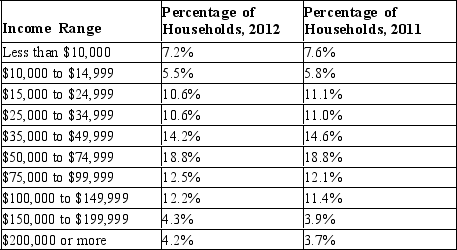 -Refer to Table 20-6. In both 2011 and 2012, approximately 25% of the population earned less than
 (Multiple Choice)
4.9/5 (77)
(77) Suppose that Family A borrows money when its car breaks down and saves money when the wife receives a holiday bonus from her employer. Suppose that Family B borrows money to buy elaborate birthday presents for the children and spends the husband's holiday bonus on a vacation to Florida. Which of the following is correct?
(Multiple Choice)
4.9/5 (70)
(70) One existing government program that works much like a negative income tax is Medicaid.
(True/False)
4.7/5 (77)
(77) Liberalism aims to raise the welfare of the worst-off person in society. This rule is called the
(Multiple Choice)
4.8/5 (85)
(85) The distribution of income for Abbyville is as follows: Number of Families Income 
 300 less than $15,000
500 between $15,000 and $20,000
900 between $20,000 and $25,000
600 between $25,000 and $30,000
200 over $30,000
 If the poverty rate in Abbyville is 12 percent, what is the poverty line in Abbyville?
300 less than $15,000
500 between $15,000 and $20,000
900 between $20,000 and $25,000
600 between $25,000 and $30,000
200 over $30,000 If the poverty rate in Abbyville is 12 percent, what is the poverty line in Abbyville? (Multiple Choice)
4.9/5 (84)
(84) The poverty line in the country of Abbyville is $15,000. The distribution of income for Abbyville is as follows: Number of Families Income 
 300 less than $15,000
500 between $15,000 and $20,000
900 between $20,000 and $25,000
600 between $25,000 and $30,000
200 over $30,000
 The poverty rate in Abbyville is
300 less than $15,000
500 between $15,000 and $20,000
900 between $20,000 and $25,000
600 between $25,000 and $30,000
200 over $30,000 The poverty rate in Abbyville is (Multiple Choice)
4.9/5 (87)
(87) Assume that the government proposes a negative income tax that calculates the taxes owed as follows: taxes owed equal 30% of income less $12,000. A family that earns an income of $40,000 will
(Multiple Choice)
4.8/5 (81)
(81) Figure 20-3  -Refer to Figure 20-3. In 2011, the percent of elderly aged 65 and over in poverty is
 (Multiple Choice)
4.9/5 (62)
(62) Despite continued growth in average income since the early 1970s, the poverty rate has not declined below the level reached in 1973.
(True/False)
4.8/5 (65)
(65) "Only individual members of society earn income, not society itself." This statement is most closely associated with the political philosophy of a
(Multiple Choice)
4.8/5 (77)
(77) 
Filters
- Essay(0)
- Multiple Choice(0)
- Short Answer(0)
- True False(0)
- Matching(0)