



 Chat with AI
Exam 20: Income Inequality and Poverty

Exam 1: Ten Principles of Economics439 Questions
Exam 2: Thinking Like an Economist617 Questions
Exam 3: Interdependence and the Gains From Trade527 Questions
Exam 4: The Market Forces of Supply and Demand697 Questions
Exam 5: Elasticity and Its Application594 Questions
Exam 6: Supply, Demand, and Government Policies645 Questions
Exam 7: Consumers, Producers, and the Efficiency of Markets549 Questions
Exam 8: Application: the Costs of Taxation513 Questions
Exam 9: Application: International Trade492 Questions
Exam 10: Externalities524 Questions
Exam 11: Public Goods and Common Resources433 Questions
Exam 12: The Design of the Tax System549 Questions
Exam 13: The Costs of Production420 Questions
Exam 14: Firms in Competitive Markets543 Questions
Exam 15: Monopoly637 Questions
Exam 16: Monopolistic Competition580 Questions
Exam 17: Oligopoly488 Questions
Exam 18: The Markets for the Factors of Production564 Questions
Exam 19: Earnings and Discrimination490 Questions
Exam 20: Income Inequality and Poverty455 Questions
Exam 21: The Theory of Consumer Choice431 Questions
Exam 22: Frontiers of Microeconomics440 Questions
Exam 23: Measuring a Nations Income520 Questions
Exam 24: Measuring the Cost of Living529 Questions
Exam 25: Production and Growth505 Questions
Exam 26: Saving, Investment, and the Financial System564 Questions
Exam 27: The Basic Tools of Finance500 Questions
Exam 28: Unemployment678 Questions
Exam 29: The Monetary System515 Questions
Exam 30: Money Growth and Inflation481 Questions
Exam 31: Open-Economy Macroeconomics: Basic Concepts522 Questions
Exam 32: A Macroeconomic Theory of the Open Economy475 Questions
Exam 33: Aggregate Demand and Aggregate Supply562 Questions
Exam 34: The Influence of Monetary and Fiscal Policy on Aggregate Demand508 Questions
Exam 35: The Short-Run Trade-Off Between Inflation and Unemployment491 Questions
Exam 36: Six Debates Over Macroeconomic Policy372 Questions
Select questions type


A disadvantage of the Earned Income Tax Credit (EITC) program is that it does not help alleviate poverty due to unemployment, sickness, or other inability to work.
(True/False)
4.9/5  (91)
(91) Scenario 20-5
Suppose the government implemented a negative income tax and used the following formula to compute a family's
tax liability:
Taxes owed = (1/4 of income) - $10,000
-Refer to Scenario 20-5. A family earning $110,000 before taxes would have how much after-tax income?
(Multiple Choice)
4.9/5 (73)
(73) Whether or not policymakers should try to make our society more egalitarian is largely a matter of
(Multiple Choice)
4.9/5 (92)
(92) Table 20-10 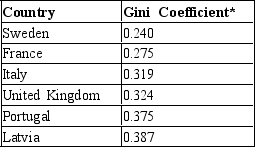 *A Gini coefficient is a commonly used measure of income inequality, with values between 0 and 1 (0 corresponds to perfect equality whereby everyone has exactly the same income, and 1 corresponds to perfect inequality where one person has all the income, while everyone else has zero income).
Source: The World Bank
-Refer to Table 20-10. Which country has the most equal income distribution?
*A Gini coefficient is a commonly used measure of income inequality, with values between 0 and 1 (0 corresponds to perfect equality whereby everyone has exactly the same income, and 1 corresponds to perfect inequality where one person has all the income, while everyone else has zero income).
Source: The World Bank
-Refer to Table 20-10. Which country has the most equal income distribution? (Multiple Choice)
4.9/5 (73)
(73) The regular pattern of income variation over a person's life is called the
(Multiple Choice)
4.8/5 (84)
(84) The maximin criterion for government policies is associated with
(Multiple Choice)
5.0/5 (90)
(90) Table 20-5
Distribution of Income in Umakastan  -Refer to Table 20-5. Where would the government of Umakastan have to set the poverty line to have a poverty rate of about 28%?
 (Multiple Choice)
4.9/5 (81)
(81) In the Temporary Assistance for Needy Families program, most families
(Multiple Choice)
4.7/5 (94)
(94) Which of the following does not explain why data on income distribution and the poverty rate give an incomplete picture of inequality?
(Multiple Choice)
4.8/5 (84)
(84) Which of the following will not occur when government policies are enacted to make the distribution of income more equitable?
(Multiple Choice)
4.9/5 (69)
(69) The only qualification to receive government assistance under a negative income tax is
(Multiple Choice)
4.7/5 (78)
(78) The economic life cycle describes how young people usually have higher savings rates than middle-aged people.
(True/False)
4.8/5 (77)
(77) In 2011 the top 5 percent of income earners accounted for over 50% of all income received by United States' families.
(True/False)
4.9/5 (85)
(85) The typical economic life cycle illustrates how people tend to
(Multiple Choice)
4.8/5 (79)
(79) A common criticism of government programs that are designed to assist the poor is that
(Multiple Choice)
4.9/5 (86)
(86) When considering a person's standard of living, data on the income distribution and the poverty rate may provide an incomplete picture because the poor may
(Multiple Choice)
4.8/5 (82)
(82) 
Filters
- Essay(0)
- Multiple Choice(0)
- Short Answer(0)
- True False(0)
- Matching(0)