



 Chat with AI
Exam 20: Income Inequality and Poverty

Exam 1: Ten Principles of Economics439 Questions
Exam 2: Thinking Like an Economist617 Questions
Exam 3: Interdependence and the Gains From Trade527 Questions
Exam 4: The Market Forces of Supply and Demand697 Questions
Exam 5: Elasticity and Its Application594 Questions
Exam 6: Supply, Demand, and Government Policies645 Questions
Exam 7: Consumers, Producers, and the Efficiency of Markets549 Questions
Exam 8: Application: the Costs of Taxation513 Questions
Exam 9: Application: International Trade492 Questions
Exam 10: Externalities524 Questions
Exam 11: Public Goods and Common Resources433 Questions
Exam 12: The Design of the Tax System549 Questions
Exam 13: The Costs of Production420 Questions
Exam 14: Firms in Competitive Markets543 Questions
Exam 15: Monopoly637 Questions
Exam 16: Monopolistic Competition580 Questions
Exam 17: Oligopoly488 Questions
Exam 18: The Markets for the Factors of Production564 Questions
Exam 19: Earnings and Discrimination490 Questions
Exam 20: Income Inequality and Poverty455 Questions
Exam 21: The Theory of Consumer Choice431 Questions
Exam 22: Frontiers of Microeconomics440 Questions
Exam 23: Measuring a Nations Income520 Questions
Exam 24: Measuring the Cost of Living529 Questions
Exam 25: Production and Growth505 Questions
Exam 26: Saving, Investment, and the Financial System564 Questions
Exam 27: The Basic Tools of Finance500 Questions
Exam 28: Unemployment678 Questions
Exam 29: The Monetary System515 Questions
Exam 30: Money Growth and Inflation481 Questions
Exam 31: Open-Economy Macroeconomics: Basic Concepts522 Questions
Exam 32: A Macroeconomic Theory of the Open Economy475 Questions
Exam 33: Aggregate Demand and Aggregate Supply562 Questions
Exam 34: The Influence of Monetary and Fiscal Policy on Aggregate Demand508 Questions
Exam 35: The Short-Run Trade-Off Between Inflation and Unemployment491 Questions
Exam 36: Six Debates Over Macroeconomic Policy372 Questions
Select questions type


If the government decided that each family needs a minimum income of $25,000 and promised to make up the difference between whatever a family earned and $25,000, which of the following is correct?
(Multiple Choice)
4.9/5  (74)
(74) Table 20-1
The following table shows the distribution of income in Marysville.  -Refer to Table 20-1. Seventy-five percent of all families have incomes above what level?
 (Multiple Choice)
4.9/5 (73)
(73) According to libertarians, the government should redistribute income from rich individuals to poor individuals to achieve a more equal distribution of income.
(True/False)
4.9/5 (80)
(80) Table 20-15
Income Inequality in 2010 in the United States by Race
The values in the table reflect the percentages of pre-tax-and-transfer income.  Source: US Census Bureau
-Refer to Table 20-15. In percentage point terms, how much more did the top 5% of the Asian population earn than it would have if income were distributed equally?
Source: US Census Bureau
-Refer to Table 20-15. In percentage point terms, how much more did the top 5% of the Asian population earn than it would have if income were distributed equally? (Short Answer)
4.9/5 (98)
(98) Table 20-11
Poverty Thresholds in 2011, by Size of Family and Number of Related Children Under 18 Years [Dollars]  Source: U. S. Bureau of the Census, Current Population Survey.
-Refer to Table 20-11. What is the poverty line for a family with one 35-year-old adult and one child?
Source: U. S. Bureau of the Census, Current Population Survey.
-Refer to Table 20-11. What is the poverty line for a family with one 35-year-old adult and one child? (Multiple Choice)
4.8/5 (79)
(79) The United States has more income inequality than Brazil and South Africa.
(True/False)
5.0/5 (77)
(77) Explain what is meant by "in-kind transfer" programs. Briefly outline the advantages and disadvantages of an in-kind transfer program.
(Essay)
4.9/5 (79)
(79) The poverty line in the country of Dismal is $20,000. The distribution of income for Dismal is as follows: Number of Families Income 
 1,000 less than $10,000
2,000 between $10,000 and $20,000
2,000 between $20,000 and $30,000
800 between $30,000 and $40,000
200 over $40,000
 The poverty rate in Dismal is
1,000 less than $10,000
2,000 between $10,000 and $20,000
2,000 between $20,000 and $30,000
800 between $30,000 and $40,000
200 over $40,000 The poverty rate in Dismal is (Multiple Choice)
4.7/5 (76)
(76) The income level below which families are said to be poor is known as the
(Multiple Choice)
4.8/5 (79)
(79) In the United States from 1935 to 2011 the share of total income earned by the bottom fifth of income earners rose and then fell.
(True/False)
4.8/5 (69)
(69) A tax provision that works much like a negative income tax is the
(Multiple Choice)
4.8/5 (80)
(80) Table 20-13
Distribution of Income in Imagination  -Refer to Table 20-13. If the poverty line in Imagination is $18,000, what is the poverty rate?
 (Short Answer)
4.9/5 (84)
(84) Figure 20-5 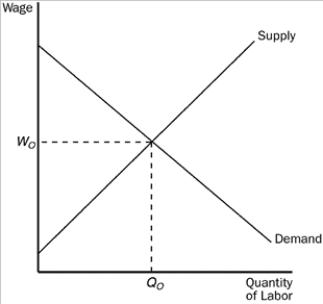 -Refer to Figure 20-5. If the government imposes a minimum wage above Wo, it is likely to
 (Multiple Choice)
4.7/5 (85)
(85) If the value of in-kind transfers are taken into account, the number of families living in poverty in the United States would
(Multiple Choice)
4.9/5 (78)
(78) Table 20-11
Poverty Thresholds in 2011, by Size of Family and Number of Related Children Under 18 Years [Dollars] Source: U. S. Bureau of the Census, Current Population Survey.
-Refer to Table 20-11. What is the poverty line for a family of eight with two children?
Source: U. S. Bureau of the Census, Current Population Survey.
-Refer to Table 20-11. What is the poverty line for a family of eight with two children? (Multiple Choice)
4.8/5 (84)
(84) The 2011 U.S. distribution of income shows that the top 5 percent of families earn approximately how much income per year?
(Multiple Choice)
4.9/5 (81)
(81) "The government should choose policies deemed to be just, as evaluated by an impartial observer behind a 'veil of ignorance.'" This statement is most closely associated with which political philosophy?
(Multiple Choice)
4.8/5 (83)
(83) Figure 20-3  -Refer to Figure 20-3. In 2011, the percent of adults between ages 18 and 64 in poverty is
 (Multiple Choice)
4.7/5 (82)
(82) Explain how a "leaky bucket" can be used to illustrate the utilitarian argument that governments should not attempt to completely equalize individual incomes.
(Essay)
4.9/5 (83)
(83) 
Filters
- Essay(0)
- Multiple Choice(0)
- Short Answer(0)
- True False(0)
- Matching(0)