



 Chat with AI
Exam 20: Income Inequality and Poverty

Exam 1: Ten Principles of Economics439 Questions
Exam 2: Thinking Like an Economist617 Questions
Exam 3: Interdependence and the Gains From Trade527 Questions
Exam 4: The Market Forces of Supply and Demand697 Questions
Exam 5: Elasticity and Its Application594 Questions
Exam 6: Supply, Demand, and Government Policies645 Questions
Exam 7: Consumers, Producers, and the Efficiency of Markets549 Questions
Exam 8: Application: the Costs of Taxation513 Questions
Exam 9: Application: International Trade492 Questions
Exam 10: Externalities524 Questions
Exam 11: Public Goods and Common Resources433 Questions
Exam 12: The Design of the Tax System549 Questions
Exam 13: The Costs of Production420 Questions
Exam 14: Firms in Competitive Markets543 Questions
Exam 15: Monopoly637 Questions
Exam 16: Monopolistic Competition580 Questions
Exam 17: Oligopoly488 Questions
Exam 18: The Markets for the Factors of Production564 Questions
Exam 19: Earnings and Discrimination490 Questions
Exam 20: Income Inequality and Poverty455 Questions
Exam 21: The Theory of Consumer Choice431 Questions
Exam 22: Frontiers of Microeconomics440 Questions
Exam 23: Measuring a Nations Income520 Questions
Exam 24: Measuring the Cost of Living529 Questions
Exam 25: Production and Growth505 Questions
Exam 26: Saving, Investment, and the Financial System564 Questions
Exam 27: The Basic Tools of Finance500 Questions
Exam 28: Unemployment678 Questions
Exam 29: The Monetary System515 Questions
Exam 30: Money Growth and Inflation481 Questions
Exam 31: Open-Economy Macroeconomics: Basic Concepts522 Questions
Exam 32: A Macroeconomic Theory of the Open Economy475 Questions
Exam 33: Aggregate Demand and Aggregate Supply562 Questions
Exam 34: The Influence of Monetary and Fiscal Policy on Aggregate Demand508 Questions
Exam 35: The Short-Run Trade-Off Between Inflation and Unemployment491 Questions
Exam 36: Six Debates Over Macroeconomic Policy372 Questions
Select questions type


A follower of liberalism would not support a redistribution of income but rather would focus on equalizing opportunities.
(True/False)
5.0/5  (93)
(93) When the government redistributes income to achieve greater equality, it
(Multiple Choice)
4.8/5 (70)
(70) Scenario 20-3
Suppose that a society is made up of five families whose incomes are as follows:
$120,000; $90,000; $30,000; $30,000; and $18,000.
The federal government is considering two potential income tax plans:
Plan A is a negative income tax plan where the taxes owed equal 1/3 of income minus $20,000.
Plan B is a two-tiered plan where families earning less than $35,000 pay no income tax and families earning more than $35,000 pay 10% of their income in taxes. The income tax revenue collected from those families earning over
$35,000 is then redistributed equally to those families earning less than $35,000.
-Refer to Scenario 20-3. Assuming that utility is directly proportional to the cash value of after-tax income, which government policy would an advocate of libertarianism prefer?
(Multiple Choice)
4.8/5 (85)
(85) Table 20-1
The following table shows the distribution of income in Marysville.  -Refer to Table 20-1. If the poverty line was $31,852, what would be the poverty rate?
 (Multiple Choice)
4.8/5 (69)
(69) Scenario 20-5
Suppose the government implemented a negative income tax and used the following formula to compute a family's
tax liability:
Taxes owed = (1/4 of income) - $10,000
-Refer to Scenario 20-5. A family earning $70,000 before taxes would have how much after-tax income?
(Multiple Choice)
4.8/5 (74)
(74) Suppose the government used the following formula to compute a family's tax liability: Taxes owed = 28% of income - $8,000. How much would a family that earned $150,000 owe?
(Multiple Choice)
4.9/5 (82)
(82) The poverty line is an absolute standard and is based on the cost of providing an adequate diet.
(True/False)
4.9/5 (83)
(83) Suppose a society consists of only two people, John and Jane. A utilitarian would say that the proper role of government in this society is to
(Multiple Choice)
4.9/5 (77)
(77) Figure 20-3  -Refer to Figure 20-3. In 1968, the percent of adults aged 18 to 64 years in poverty is
 (Multiple Choice)
4.8/5 (77)
(77) The 2011 U.S. distribution of income shows that the top 20 percent of families have approximately what share of income?
(Multiple Choice)
4.9/5 (83)
(83) The percentage of the population whose family income falls below an absolute level is call the
(Short Answer)
4.8/5 (86)
(86) Table 20-8 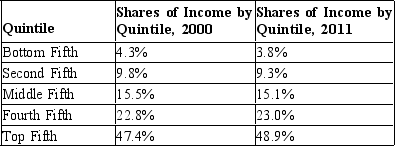 Source: U.S. Bureau of Census
-Refer to Table 20-8. In 2011, the bottom 40% of families has
Source: U.S. Bureau of Census
-Refer to Table 20-8. In 2011, the bottom 40% of families has (Multiple Choice)
4.8/5 (93)
(93) Table 20-1
The following table shows the distribution of income in Marysville.
-Refer to Table 20-1. If the poverty line were $23,021, what would be the poverty rate?
-Refer to Table 20-1. If the poverty line were $23,021, what would be the poverty rate? (Multiple Choice)
4.9/5 (82)
(82) Many Democrats support raising the U.S. minimum wage. Critics of raising the minimum wage argue that minimum-wage laws are
(Multiple Choice)
4.8/5 (73)
(73) The maximin criterion is the idea that the government should aim to maximize the well-being of the worst-off person in society.
(True/False)
4.9/5 (72)
(72) Table 20-14
Income Inequality in the United States
The values in the table reflect the percentages of pre-tax-and transfer income.  Source: US Census Bureau
-Refer to Table 20-14. The trend in income inequality from 1980 to 2010 is .
Source: US Census Bureau
-Refer to Table 20-14. The trend in income inequality from 1980 to 2010 is . (Short Answer)
4.8/5 (84)
(84) The poverty rate is the percentage of the population whose family income falls below the poverty line.
(True/False)
4.8/5 (82)
(82) Robert Nozick criticizes Rawls's concept of justice by using an example of
(Multiple Choice)
4.8/5 (77)
(77) 
Filters
- Essay(0)
- Multiple Choice(0)
- Short Answer(0)
- True False(0)
- Matching(0)