



 Chat with AI
Exam 20: Income Inequality and Poverty

Exam 1: Ten Principles of Economics439 Questions
Exam 2: Thinking Like an Economist617 Questions
Exam 3: Interdependence and the Gains From Trade527 Questions
Exam 4: The Market Forces of Supply and Demand697 Questions
Exam 5: Elasticity and Its Application594 Questions
Exam 6: Supply, Demand, and Government Policies645 Questions
Exam 7: Consumers, Producers, and the Efficiency of Markets549 Questions
Exam 8: Application: the Costs of Taxation513 Questions
Exam 9: Application: International Trade492 Questions
Exam 10: Externalities524 Questions
Exam 11: Public Goods and Common Resources433 Questions
Exam 12: The Design of the Tax System549 Questions
Exam 13: The Costs of Production420 Questions
Exam 14: Firms in Competitive Markets543 Questions
Exam 15: Monopoly637 Questions
Exam 16: Monopolistic Competition580 Questions
Exam 17: Oligopoly488 Questions
Exam 18: The Markets for the Factors of Production564 Questions
Exam 19: Earnings and Discrimination490 Questions
Exam 20: Income Inequality and Poverty455 Questions
Exam 21: The Theory of Consumer Choice431 Questions
Exam 22: Frontiers of Microeconomics440 Questions
Exam 23: Measuring a Nations Income520 Questions
Exam 24: Measuring the Cost of Living529 Questions
Exam 25: Production and Growth505 Questions
Exam 26: Saving, Investment, and the Financial System564 Questions
Exam 27: The Basic Tools of Finance500 Questions
Exam 28: Unemployment678 Questions
Exam 29: The Monetary System515 Questions
Exam 30: Money Growth and Inflation481 Questions
Exam 31: Open-Economy Macroeconomics: Basic Concepts522 Questions
Exam 32: A Macroeconomic Theory of the Open Economy475 Questions
Exam 33: Aggregate Demand and Aggregate Supply562 Questions
Exam 34: The Influence of Monetary and Fiscal Policy on Aggregate Demand508 Questions
Exam 35: The Short-Run Trade-Off Between Inflation and Unemployment491 Questions
Exam 36: Six Debates Over Macroeconomic Policy372 Questions
Select questions type


In the United States, a typical worker's income peaks around age
(Multiple Choice)
4.9/5  (85)
(85) Table 20-10 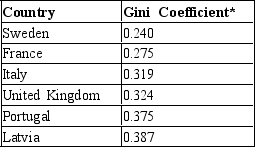 *A Gini coefficient is a commonly used measure of income inequality, with values between 0 and 1 (0 corresponds to perfect equality whereby everyone has exactly the same income, and 1 corresponds to perfect inequality where one person has all the income, while everyone else has zero income).
Source: The World Bank
-Refer to Table 20-10. Which country has the most unequal income distribution?
*A Gini coefficient is a commonly used measure of income inequality, with values between 0 and 1 (0 corresponds to perfect equality whereby everyone has exactly the same income, and 1 corresponds to perfect inequality where one person has all the income, while everyone else has zero income).
Source: The World Bank
-Refer to Table 20-10. Which country has the most unequal income distribution? (Multiple Choice)
4.9/5 (63)
(63) Table 20-9
Income Inequality in the United States
The values in the table reflect the percentages of pre-tax-and transfer income. 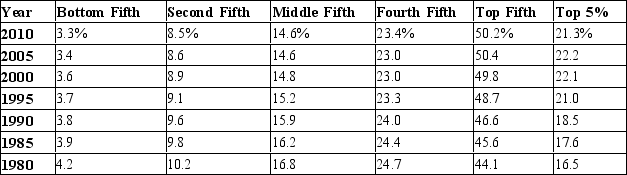 Source: US Census Bureau
-Refer to Table 20-9. Which of the following statements best describes the trends in the table?
Source: US Census Bureau
-Refer to Table 20-9. Which of the following statements best describes the trends in the table? (Multiple Choice)
4.9/5 (81)
(81) Which of the following represents a problem in measuring inequality?
(Multiple Choice)
4.7/5 (79)
(79) In the United States, labor earnings are about what percent of total income?
(Multiple Choice)
4.7/5 (66)
(66) Which two of the Ten Principles of Economics are illustrated in this chapter?
(Multiple Choice)
4.8/5 (95)
(95) Table 20-9
Income Inequality in the United States
The values in the table reflect the percentages of pre-tax-and transfer income. Source: US Census Bureau
-Refer to Table 20-9. In 2010, the top fifth of the US population had
Source: US Census Bureau
-Refer to Table 20-9. In 2010, the top fifth of the US population had (Multiple Choice)
4.9/5 (78)
(78) The concept of diminishing marginal utility is embedded in the utilitarian rationale for
(Multiple Choice)
4.8/5 (77)
(77) The Callaway family owns a small bait and tackle shop in a resort town in Wisconsin. An economic recession reduces the number of tourists for one summer, which reduces the family's income for that year. For the Callaway family, their
(Multiple Choice)
4.9/5 (78)
(78) Would the maximin criterion achieve perfect income equality?
(Multiple Choice)
4.8/5 (77)
(77) Figure 20-1 Number of Poor  -Refer to Figure 20-1. The absolute number of people in poverty
 (Multiple Choice)
4.8/5 (83)
(83) Suppose the government used the following formula to compute a family's tax liability:
Taxes owed = 28% of income - $8,000. How much would a family that earned $75,000 owe?
(Short Answer)
4.9/5 (77)
(77) Raising the welfare of the worst-off person in society is an important goal of which political philosophy?
(Multiple Choice)
4.9/5 (80)
(80) According to utilitarians, the ultimate objective of public actions should be to
(Multiple Choice)
4.8/5 (97)
(97) 
Filters
- Essay(0)
- Multiple Choice(0)
- Short Answer(0)
- True False(0)
- Matching(0)