



 Chat with AI
Exam 19: Earnings and Discrimination

Exam 1: Ten Principles of Economics439 Questions
Exam 2: Thinking Like an Economist617 Questions
Exam 3: Interdependence and the Gains From Trade527 Questions
Exam 4: The Market Forces of Supply and Demand697 Questions
Exam 5: Elasticity and Its Application594 Questions
Exam 6: Supply, Demand, and Government Policies645 Questions
Exam 7: Consumers, Producers, and the Efficiency of Markets549 Questions
Exam 8: Application: the Costs of Taxation513 Questions
Exam 9: Application: International Trade492 Questions
Exam 10: Externalities524 Questions
Exam 11: Public Goods and Common Resources433 Questions
Exam 12: The Design of the Tax System549 Questions
Exam 13: The Costs of Production420 Questions
Exam 14: Firms in Competitive Markets543 Questions
Exam 15: Monopoly637 Questions
Exam 16: Monopolistic Competition580 Questions
Exam 17: Oligopoly488 Questions
Exam 18: The Markets for the Factors of Production564 Questions
Exam 19: Earnings and Discrimination490 Questions
Exam 20: Income Inequality and Poverty455 Questions
Exam 21: The Theory of Consumer Choice431 Questions
Exam 22: Frontiers of Microeconomics440 Questions
Exam 23: Measuring a Nations Income520 Questions
Exam 24: Measuring the Cost of Living529 Questions
Exam 25: Production and Growth505 Questions
Exam 26: Saving, Investment, and the Financial System564 Questions
Exam 27: The Basic Tools of Finance500 Questions
Exam 28: Unemployment678 Questions
Exam 29: The Monetary System515 Questions
Exam 30: Money Growth and Inflation481 Questions
Exam 31: Open-Economy Macroeconomics: Basic Concepts522 Questions
Exam 32: A Macroeconomic Theory of the Open Economy475 Questions
Exam 33: Aggregate Demand and Aggregate Supply562 Questions
Exam 34: The Influence of Monetary and Fiscal Policy on Aggregate Demand508 Questions
Exam 35: The Short-Run Trade-Off Between Inflation and Unemployment491 Questions
Exam 36: Six Debates Over Macroeconomic Policy372 Questions
Select questions type


A difference in wages between a highly-educated worker and a less-educated worker
(Multiple Choice)
4.8/5  (84)
(84) Figure 19-1 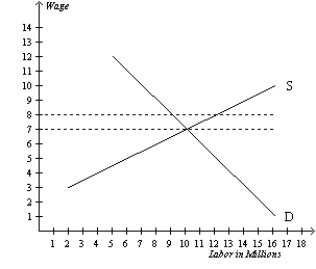 -Refer to Figure 19-1. What is the change in employment of having the minimum wage at $8 instead of $7?
 (Multiple Choice)
4.8/5 (84)
(84) Over the past several years, the earnings gap between high-skilled and low-skilled workers has
(Multiple Choice)
4.8/5 (88)
(88) Daryn earns a higher salary than his friend Nick because Daryn is willing to work on the loading dock, whereas Nick prefers to work in an air-conditioned office. The difference in salary could illustrate a compensating differential.
(True/False)
4.8/5 (81)
(81) Evidence from a study of the market for baseball players using 1960s data
(Multiple Choice)
4.8/5 (84)
(84) A signaling theory of education suggests that educational attainment
(Multiple Choice)
4.7/5 (72)
(72) Scenario 19-2
Travis, a student at a community college, is considering what he should do for summer employment. Two recruiters show up at his school in search of summer workers. Recruiter A is looking for workers to help a disaster relief agency distribute food aid in Africa. Recruiter B is looking for custodial help to clean motel rooms in a motel located near the entrance to a famous national park.
-Refer to Scenario 19-2. Travis is carefully considering the options that each recruiter presents. On the basis of knowledge obtained in his economics class, Travis concludes that
(Multiple Choice)
4.8/5 (77)
(77) Cheryl is a professor at a local university. She hired a student from the university to babysit for her children and paid the student a wage higher than the typical wage paid to babysitters in her area to ensure the babysitter's reliability and that attention is paid to her children. What is the name for this above-equilibrium wage?
(Short Answer)
4.7/5 (83)
(83) Figure 19-6  -Refer to Figure 19-6. Given demand, D1, and supply, S1, what is the quantity of labor demanded if a minimum wage of $8 per hour is imposed on this market?
 (Short Answer)
4.9/5 (95)
(95) A compensating differential is a difference in wages due to higher levels of education or other forms of human capital.
(True/False)
4.8/5 (70)
(70) Which of the following could explain the changing gap in income between unskilled and skilled workers in the United States?
(Multiple Choice)
4.8/5 (83)
(83) Discrimination occurs when the marketplace offers different opportunities to similar individuals who differ only by
(Multiple Choice)
4.8/5 (77)
(77) Which of the following factors does not affect the value of a worker's marginal product?
(Multiple Choice)
4.8/5 (70)
(70) The signaling theory of education maintains that workers who complete specific levels of education enhance their productivity through education.
(True/False)
4.8/5 (75)
(75) Workers whose skills become obsolete as a result of technological change are often paid a lower wage as a result of
(Multiple Choice)
4.9/5 (95)
(95) Which of the following variables related to a worker's wage are the most difficult to measure?
(Multiple Choice)
4.8/5 (84)
(84) 
Filters
- Essay(0)
- Multiple Choice(0)
- Short Answer(0)
- True False(0)
- Matching(0)