



 Chat with AI
Exam 19: Earnings and Discrimination

Exam 1: Ten Principles of Economics439 Questions
Exam 2: Thinking Like an Economist617 Questions
Exam 3: Interdependence and the Gains From Trade527 Questions
Exam 4: The Market Forces of Supply and Demand697 Questions
Exam 5: Elasticity and Its Application594 Questions
Exam 6: Supply, Demand, and Government Policies645 Questions
Exam 7: Consumers, Producers, and the Efficiency of Markets549 Questions
Exam 8: Application: the Costs of Taxation513 Questions
Exam 9: Application: International Trade492 Questions
Exam 10: Externalities524 Questions
Exam 11: Public Goods and Common Resources433 Questions
Exam 12: The Design of the Tax System549 Questions
Exam 13: The Costs of Production420 Questions
Exam 14: Firms in Competitive Markets543 Questions
Exam 15: Monopoly637 Questions
Exam 16: Monopolistic Competition580 Questions
Exam 17: Oligopoly488 Questions
Exam 18: The Markets for the Factors of Production564 Questions
Exam 19: Earnings and Discrimination490 Questions
Exam 20: Income Inequality and Poverty455 Questions
Exam 21: The Theory of Consumer Choice431 Questions
Exam 22: Frontiers of Microeconomics440 Questions
Exam 23: Measuring a Nations Income520 Questions
Exam 24: Measuring the Cost of Living529 Questions
Exam 25: Production and Growth505 Questions
Exam 26: Saving, Investment, and the Financial System564 Questions
Exam 27: The Basic Tools of Finance500 Questions
Exam 28: Unemployment678 Questions
Exam 29: The Monetary System515 Questions
Exam 30: Money Growth and Inflation481 Questions
Exam 31: Open-Economy Macroeconomics: Basic Concepts522 Questions
Exam 32: A Macroeconomic Theory of the Open Economy475 Questions
Exam 33: Aggregate Demand and Aggregate Supply562 Questions
Exam 34: The Influence of Monetary and Fiscal Policy on Aggregate Demand508 Questions
Exam 35: The Short-Run Trade-Off Between Inflation and Unemployment491 Questions
Exam 36: Six Debates Over Macroeconomic Policy372 Questions
Select questions type


If unskilled labor is relatively plentiful and cheap in many foreign countries, then as the United States expands its trade with these foreign countries, the domestic demand for
(Multiple Choice)
4.7/5  (78)
(78) Jake and Zach are identical twins who attended grammar school through college together. Jake took a job as an engineer who does not have to travel out of the state. Zach took a job as an engineer who must travel out of state once a week. Jake earns $125,000 a year, and Zach earns $155,000 a year. Select the best explanation for this wage difference.
(Multiple Choice)
4.9/5 (67)
(67) Tom, the manager and owner of a small company, believes in the signaling theory of education, not the human capital theory. As such, Tom would be most likely to agree with which of the following quotes?
(Multiple Choice)
4.9/5 (90)
(90) How does the theory of efficiency wages explain above-equilibrium wages?
(Multiple Choice)
4.8/5 (64)
(64) Which of the following explains why soccer players make millions of dollars in Europe but do not in the United States?
(Multiple Choice)
4.9/5 (73)
(73) Dr. Benson is regarded as, by far, the best dentist in his part of the country, yet his income is not significantly higher than the average income for a dentist in his area. In contrast, Bo Johnson, the best baseball player in that region, earns five times the average salary of all baseball players. The most likely explanation is that
(Multiple Choice)
4.9/5 (71)
(71) When discrimination occurs as a result of employer prejudice, discriminating firms do not maximize profits.
(True/False)
4.9/5 (89)
(89) The theory of efficiency wages suggests that firms may pay above-equilibrium wages
(Multiple Choice)
4.8/5 (76)
(76) Which of the following is not an example of efficiency wages?
(Multiple Choice)
4.9/5 (80)
(80) If we were to observe above-equilibrium wages in a particular labor market, then a possible explanation might be that
(Multiple Choice)
4.7/5 (70)
(70) Figure 19-5  -Refer to Figure 19-5. Given demand for labor, D1, and supply of labor, S1, what is the quantity demanded of labor if a minimum wage of $8 per hour is imposed on this market?
 (Multiple Choice)
4.8/5 (72)
(72) Figure 19-3
The manufacturing labor market. 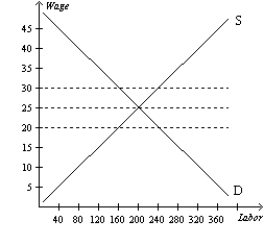 -Refer to Figure 19-3. Suppose the manufacturing labor market, which is non-unionized, is in equilibrium at a wage equal to $25. Suppose now that the AFL-CIO (a labor organization) organizes the workers in the manufacturing market and negotiates a wage of $30 per hour. Because of the union,
 (Multiple Choice)
4.8/5 (81)
(81) Explain why the following situation is likely to persist: soccer players in Europe are the highest paid athletes and in the US they are among the lowest paid athletes.
(Essay)
4.8/5 (83)
(83) Daryn and Nick work for two different companies, but each performs the same job working on a loading dock.
Daryn, however, earns a higher salary than his friend Nick The difference in salary could illustrate union wages if
Daryn's annual salary is covered by a collective bargaining agreement and Nick's is not.
(True/False)
4.7/5 (80)
(80) Why do college graduates earn more in wages than workers with only a high school diploma?
(Short Answer)
4.8/5 (74)
(74) 
Filters
- Essay(0)
- Multiple Choice(0)
- Short Answer(0)
- True False(0)
- Matching(0)