



 Chat with AI
Exam 19: Earnings and Discrimination

Exam 1: Ten Principles of Economics439 Questions
Exam 2: Thinking Like an Economist617 Questions
Exam 3: Interdependence and the Gains From Trade527 Questions
Exam 4: The Market Forces of Supply and Demand697 Questions
Exam 5: Elasticity and Its Application594 Questions
Exam 6: Supply, Demand, and Government Policies645 Questions
Exam 7: Consumers, Producers, and the Efficiency of Markets549 Questions
Exam 8: Application: the Costs of Taxation513 Questions
Exam 9: Application: International Trade492 Questions
Exam 10: Externalities524 Questions
Exam 11: Public Goods and Common Resources433 Questions
Exam 12: The Design of the Tax System549 Questions
Exam 13: The Costs of Production420 Questions
Exam 14: Firms in Competitive Markets543 Questions
Exam 15: Monopoly637 Questions
Exam 16: Monopolistic Competition580 Questions
Exam 17: Oligopoly488 Questions
Exam 18: The Markets for the Factors of Production564 Questions
Exam 19: Earnings and Discrimination490 Questions
Exam 20: Income Inequality and Poverty455 Questions
Exam 21: The Theory of Consumer Choice431 Questions
Exam 22: Frontiers of Microeconomics440 Questions
Exam 23: Measuring a Nations Income520 Questions
Exam 24: Measuring the Cost of Living529 Questions
Exam 25: Production and Growth505 Questions
Exam 26: Saving, Investment, and the Financial System564 Questions
Exam 27: The Basic Tools of Finance500 Questions
Exam 28: Unemployment678 Questions
Exam 29: The Monetary System515 Questions
Exam 30: Money Growth and Inflation481 Questions
Exam 31: Open-Economy Macroeconomics: Basic Concepts522 Questions
Exam 32: A Macroeconomic Theory of the Open Economy475 Questions
Exam 33: Aggregate Demand and Aggregate Supply562 Questions
Exam 34: The Influence of Monetary and Fiscal Policy on Aggregate Demand508 Questions
Exam 35: The Short-Run Trade-Off Between Inflation and Unemployment491 Questions
Exam 36: Six Debates Over Macroeconomic Policy372 Questions
Select questions type


In a labor market free from discrimination, wages for workers that are employed by the same company will still differ.
(True/False)
4.8/5  (82)
(82) A compensating differential refers to a difference in wages that arises from nonmonetary characteristics.
(True/False)
4.9/5 (84)
(84) Suppose that a company hires recent college graduates for two types of jobs, sales people and credit analysts. The hours worked and skill levels are the same for both positions. The sales people get to travel to several desirable locations, whereas the credit analysts do not leave the home office. When comparing the salaries of the two positions, it is likely that the company pays the
(Multiple Choice)
4.8/5 (93)
(93) The wage difference between jobs that require education and those that don't
(Multiple Choice)
4.8/5 (69)
(69) Discrimination is an emotionally charged issue that is impossible to study objectively.
(True/False)
4.9/5 (80)
(80) Which of the following explains the "beauty premium" differences in wages?
(Multiple Choice)
4.8/5 (75)
(75) Profit-maximizing, competitive firms will not discriminate in the hiring of workers unless consumers exercise a preference for discrimination in product markets or governments mandate discrimination.
(True/False)
4.8/5 (83)
(83) In the early 20th century, streetcars in many southern cities required that white passengers sit in the front of the car while black passengers sat in the back. The firms that ran the streetcars were
(Multiple Choice)
4.9/5 (77)
(77) The signaling theory of education maintains that workers who complete specific levels of education signal their high productivity to potential employers.
(True/False)
4.9/5 (84)
(84) Which of these instances would constitute labor-market discrimination? Henry receives a higher wage than Ryan. Henry and Ryan are identical in all of their labor-market characteristics except that
(Multiple Choice)
4.9/5 (69)
(69) Evidence from a 1988 study of the market for professional basketball players
(Multiple Choice)
4.8/5 (80)
(80) Which of the following factors affects the marginal productivity of a worker?
(Multiple Choice)
4.7/5 (79)
(79) Table 19-1 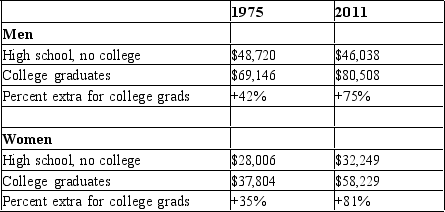 Source: US Census Bureau and Mankiw's calculations
-Refer to Table 19-1. From 1975 to 2011, the salary gap among women who graduate from college compared to those who complete only high school
Source: US Census Bureau and Mankiw's calculations
-Refer to Table 19-1. From 1975 to 2011, the salary gap among women who graduate from college compared to those who complete only high school (Multiple Choice)
4.8/5 (72)
(72) Politicians often point to wage differentials as evidence of labor-market discrimination against ethnic minorities and women; however, economists argue against this approach because people differ in the amount of human capital they have and the kinds of work they are willing and able to do.
(True/False)
4.8/5 (84)
(84) Explain the role of job experience in explaining the differences between the average wages of men and women.
(Essay)
4.8/5 (77)
(77) Which of the following would be considered an investment in human capital?
(Multiple Choice)
4.8/5 (83)
(83) Which of the following theories would suggest that attending school does not improve productivity but that high- ability people are more likely to stay in school?
(Multiple Choice)
4.8/5 (90)
(90) Which of the following is the most likely outcome of raising the minimum wage?
(Multiple Choice)
4.9/5 (80)
(80) 
Filters
- Essay(0)
- Multiple Choice(0)
- Short Answer(0)
- True False(0)
- Matching(0)