



 Chat with AI
Exam 19: Earnings and Discrimination

Exam 1: Ten Principles of Economics439 Questions
Exam 2: Thinking Like an Economist617 Questions
Exam 3: Interdependence and the Gains From Trade527 Questions
Exam 4: The Market Forces of Supply and Demand697 Questions
Exam 5: Elasticity and Its Application594 Questions
Exam 6: Supply, Demand, and Government Policies645 Questions
Exam 7: Consumers, Producers, and the Efficiency of Markets549 Questions
Exam 8: Application: the Costs of Taxation513 Questions
Exam 9: Application: International Trade492 Questions
Exam 10: Externalities524 Questions
Exam 11: Public Goods and Common Resources433 Questions
Exam 12: The Design of the Tax System549 Questions
Exam 13: The Costs of Production420 Questions
Exam 14: Firms in Competitive Markets543 Questions
Exam 15: Monopoly637 Questions
Exam 16: Monopolistic Competition580 Questions
Exam 17: Oligopoly488 Questions
Exam 18: The Markets for the Factors of Production564 Questions
Exam 19: Earnings and Discrimination490 Questions
Exam 20: Income Inequality and Poverty455 Questions
Exam 21: The Theory of Consumer Choice431 Questions
Exam 22: Frontiers of Microeconomics440 Questions
Exam 23: Measuring a Nations Income520 Questions
Exam 24: Measuring the Cost of Living529 Questions
Exam 25: Production and Growth505 Questions
Exam 26: Saving, Investment, and the Financial System564 Questions
Exam 27: The Basic Tools of Finance500 Questions
Exam 28: Unemployment678 Questions
Exam 29: The Monetary System515 Questions
Exam 30: Money Growth and Inflation481 Questions
Exam 31: Open-Economy Macroeconomics: Basic Concepts522 Questions
Exam 32: A Macroeconomic Theory of the Open Economy475 Questions
Exam 33: Aggregate Demand and Aggregate Supply562 Questions
Exam 34: The Influence of Monetary and Fiscal Policy on Aggregate Demand508 Questions
Exam 35: The Short-Run Trade-Off Between Inflation and Unemployment491 Questions
Exam 36: Six Debates Over Macroeconomic Policy372 Questions
Select questions type


Table 19-1 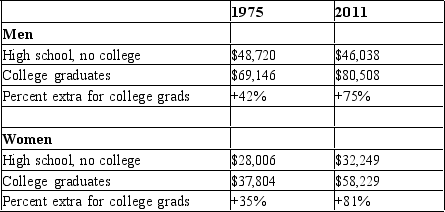 Source: US Census Bureau and Mankiw's calculations
-Refer to Table 19-1. Economists suspect that the increase in the earnings gap between skilled and unskilled workers is likely due to
Source: US Census Bureau and Mankiw's calculations
-Refer to Table 19-1. Economists suspect that the increase in the earnings gap between skilled and unskilled workers is likely due to (Multiple Choice)
4.8/5  (74)
(74) Sometimes wages are set above the equilibrium level when firms pay
(Multiple Choice)
4.9/5 (77)
(77) As a result of an increase in the earnings gap between skilled and unskilled jobs, the incentive to get a college education has been declining.
(True/False)
4.9/5 (69)
(69) White women earn an average of 25% less than white men. A labor economist who wants to investigate whether the differences in earnings indicate labor-market discrimination against women should consider whether white men and women have similar
(Multiple Choice)
5.0/5 (88)
(88) Which of the following represents an example of labor-market discrimination?
(Multiple Choice)
4.9/5 (71)
(71) Scenario 19-6
Suppose that in the competitive market for auto repair, firms prefer to hire men rather than women. Assume that the women applying for positions have the same skills, experience, and work ethic as the men. As a result of this discrimination, the demand for women is lower than it otherwise would be.
-Refer to Scenario 19-6. Suppose that consumers prefer to have men work on their auto repairs and are willing to pay higher prices to accommodate these preferences. What will happen to the wage differential between men and women?
(Short Answer)
4.9/5 (82)
(82) When robots are used to replace workers on a factory production line, the wage gap between skilled and unskilled workers
(Multiple Choice)
4.9/5 (82)
(82) Scenario 19-5
Jason works part-time at a grocery store after school. Jason has worked at the store for two years but still hasn't received a wage increase, even though newer employees have received raises. Jason has threatened his employer with a lawsuit if he doesn't get a raise in the next few weeks. Jason believes he is a victim of labor-market discrimination.
-Refer to Scenario 19-5. In a competitive market for grocery store employees, why might Jason's wage differential persist?
(Multiple Choice)
4.8/5 (88)
(88) Al and Steve are both reporters at the same newspaper. Al is black and Steve is white. Al earns less than Steve. Which of the following can explain why Al earns less?
(Multiple Choice)
4.9/5 (68)
(68) According to a study of the "beauty premium," how do the wages of people with average looks compare to those of people considered less attractive than average?
(Short Answer)
4.7/5 (76)
(76) Certain factors that are probably important in determining wages are nevertheless difficult to measure. Consequently, labor economists find those factors difficult to incorporate into their studies of labor markets and wages. Those factors include
(Multiple Choice)
4.9/5 (91)
(91) Some economists are skeptical of the argument that employers are responsible for discriminatory wage differences. They argue that market economies provide a natural remedy to employer discrimination, and that remedy is
(Multiple Choice)
4.8/5 (70)
(70) Which of the following moves the wage above its equilibrium value?
(Multiple Choice)
4.9/5 (83)
(83) Offering different opportunities to similar individuals who differ only by race, ethnic group, sex, age, or other personal characteristics is called
(Multiple Choice)
4.9/5 (65)
(65) One example of labor-market discrimination is that firms may be less likely to interview job-market candidates whose names suggest that they are members of a racial minority.
(True/False)
4.9/5 (83)
(83) Figure 19-7  -Refer to Figure 19-7. The figure shows labor demand and labor supply in a non-unionized labor market. Suppose the current labor demand is D1 and the current labor supply is S1. If a firm in this market decided to pay its workers $18 per hour to increase the productivity of its workers, this firm would be paying a(n)
 (Short Answer)
4.7/5 (69)
(69) Which of the following would both make a worker's wage higher than otherwise?
(Multiple Choice)
4.8/5 (74)
(74) That some schools direct females away from science and math courses is evidence of
(Multiple Choice)
4.9/5 (83)
(83) Figure 19-6  -Refer to Figure 19-6. Given demand, D1, and supply, S1, how much more do workers earn per hour if the supply curve shifts to S2?
 (Short Answer)
5.0/5 (92)
(92) 
Filters
- Essay(0)
- Multiple Choice(0)
- Short Answer(0)
- True False(0)
- Matching(0)