



 Chat with AI
Exam 19: Earnings and Discrimination

Exam 1: Ten Principles of Economics439 Questions
Exam 2: Thinking Like an Economist617 Questions
Exam 3: Interdependence and the Gains From Trade527 Questions
Exam 4: The Market Forces of Supply and Demand697 Questions
Exam 5: Elasticity and Its Application594 Questions
Exam 6: Supply, Demand, and Government Policies645 Questions
Exam 7: Consumers, Producers, and the Efficiency of Markets549 Questions
Exam 8: Application: the Costs of Taxation513 Questions
Exam 9: Application: International Trade492 Questions
Exam 10: Externalities524 Questions
Exam 11: Public Goods and Common Resources433 Questions
Exam 12: The Design of the Tax System549 Questions
Exam 13: The Costs of Production420 Questions
Exam 14: Firms in Competitive Markets543 Questions
Exam 15: Monopoly637 Questions
Exam 16: Monopolistic Competition580 Questions
Exam 17: Oligopoly488 Questions
Exam 18: The Markets for the Factors of Production564 Questions
Exam 19: Earnings and Discrimination490 Questions
Exam 20: Income Inequality and Poverty455 Questions
Exam 21: The Theory of Consumer Choice431 Questions
Exam 22: Frontiers of Microeconomics440 Questions
Exam 23: Measuring a Nations Income520 Questions
Exam 24: Measuring the Cost of Living529 Questions
Exam 25: Production and Growth505 Questions
Exam 26: Saving, Investment, and the Financial System564 Questions
Exam 27: The Basic Tools of Finance500 Questions
Exam 28: Unemployment678 Questions
Exam 29: The Monetary System515 Questions
Exam 30: Money Growth and Inflation481 Questions
Exam 31: Open-Economy Macroeconomics: Basic Concepts522 Questions
Exam 32: A Macroeconomic Theory of the Open Economy475 Questions
Exam 33: Aggregate Demand and Aggregate Supply562 Questions
Exam 34: The Influence of Monetary and Fiscal Policy on Aggregate Demand508 Questions
Exam 35: The Short-Run Trade-Off Between Inflation and Unemployment491 Questions
Exam 36: Six Debates Over Macroeconomic Policy372 Questions
Select questions type


Which theory is supportive of the idea that increasing educational levels for all workers would raise all workers' productivity and therefore their wages?
(Multiple Choice)
4.9/5  (96)
(96) Other things the same, we'd expect that a job with less pleasant working conditions pays
(Multiple Choice)
4.7/5 (82)
(82) Which of the following is not an example of a compensating differential?
(Multiple Choice)
4.8/5 (69)
(69) In recent years, the amount of international trade in which the United States engages has
(Multiple Choice)
4.9/5 (82)
(82) What is the term for offering different opportunities to similar individuals who differ only by race, ethnic group, sex, age, or other personal characteristics?
(Short Answer)
4.8/5 (77)
(77) Black men earn an average of 21% less than white men. A labor economist who wants to investigate whether the differences in earnings indicate labor-market discrimination against black men should consider whether black and white men have similar
(Multiple Choice)
4.9/5 (76)
(76) Experimental evidence indicates women choose less competitive environments than men.
(True/False)
4.7/5 (69)
(69) Scenario 19-2
Travis, a student at a community college, is considering what he should do for summer employment. Two recruiters show up at his school in search of summer workers. Recruiter A is looking for workers to help a disaster relief agency distribute food aid in Africa. Recruiter B is looking for custodial help to clean motel rooms in a motel located near the entrance to a famous national park.
-Refer to Scenario 19-2. Travis is carefully considering the options that each recruiter presents. On the basis of knowledge obtained in his economics class, Travis concludes that
(Multiple Choice)
4.8/5 (72)
(72) Figure 19-3
The manufacturing labor market. 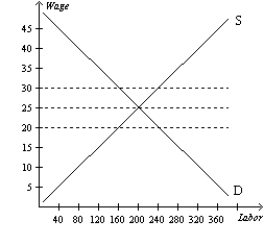 -Refer to Figure 19-3. Suppose the manufacturing labor market, which is non-unionized, is in equilibrium at a wage equal to $20. Suppose now that the AFL-CIO (a labor organization) organizes the workers in the manufacturing market and negotiates a wage of $30 per hour. After the workers become unionized, how many workers do manufacturing firms collectively hire?
 (Multiple Choice)
4.7/5 (72)
(72) When an employer pays the cost of educating a worker, it is likely that the employer
(Multiple Choice)
4.8/5 (80)
(80) Scenario 19-4
Assume that the labor market for barbers is competitive and that it is differentiated into two groups: barbers who are bald (or going bald) and those who have a full head of hair. Assume that the barbers in this market have identical hair-cutting ability, regardless of whether they are bald or not. Currently the equilibrium wage in the bald barber market is lower than that in the nonbald market. Further assume that the market for haircuts is competitive.
-Refer to Scenario 19-4. If consumers do not discriminate between bald barbers and barbers with hair, then
(Multiple Choice)
4.8/5 (90)
(90) Chris just completed his college degree from a prestigious university. He did not go to school to become more productive. Rather, he went to school and completed his degree to convey his innate productivity to employers. To which theory of education does he subscribe?
(Short Answer)
4.8/5 (75)
(75) The statement that "night shift workers make a higher wage than day shift workers" is likely to reflect the fact that
(Multiple Choice)
4.9/5 (81)
(81) A manager of a small firm who believes in the signaling theory of education would encourage her employees to obtain additional education to raise their on-the-job productivity.
(True/False)
4.9/5 (83)
(83) Mary and Mike are twins who attended grammar school through college together. Both twins got jobs in the same department of an accounting firm. They both work equally hard and have received similar performance reviews. Mary earns $62,000 a year, and Mike earns $80,000 a year. Select the best explanation for this wage difference.
(Multiple Choice)
4.8/5 (80)
(80) One reason why better-looking workers may have higher earnings is that physical attractiveness is correlated with intelligence.
(True/False)
4.8/5 (85)
(85) Higher levels of human capital are correlated with higher earnings because firms are willing to pay more for better- educated workers who have higher marginal productivities.
(True/False)
4.9/5 (77)
(77) On average, truck drivers who drive on dangerous ice-covered roads earn more per mile driven than similarly skilled truck drivers who drive on normal roads. The difference in pay can be attributed to
(Multiple Choice)
4.9/5 (92)
(92) Which of the following is an example of customer discrimination?
(Multiple Choice)
4.9/5 (84)
(84) Table 19-2  Source: US Census Bureau and Mankiw's calculations
-Refer to Table 19-2. What are two possible hypotheses to explain the changes in relative demand for high-skilled workers and low-skilled workers in recent years?
Source: US Census Bureau and Mankiw's calculations
-Refer to Table 19-2. What are two possible hypotheses to explain the changes in relative demand for high-skilled workers and low-skilled workers in recent years? (Essay)
4.9/5 (74)
(74) 
Filters
- Essay(0)
- Multiple Choice(0)
- Short Answer(0)
- True False(0)
- Matching(0)