



 Chat with AI
Exam 19: Earnings and Discrimination

Exam 1: Ten Principles of Economics439 Questions
Exam 2: Thinking Like an Economist617 Questions
Exam 3: Interdependence and the Gains From Trade527 Questions
Exam 4: The Market Forces of Supply and Demand697 Questions
Exam 5: Elasticity and Its Application594 Questions
Exam 6: Supply, Demand, and Government Policies645 Questions
Exam 7: Consumers, Producers, and the Efficiency of Markets549 Questions
Exam 8: Application: the Costs of Taxation513 Questions
Exam 9: Application: International Trade492 Questions
Exam 10: Externalities524 Questions
Exam 11: Public Goods and Common Resources433 Questions
Exam 12: The Design of the Tax System549 Questions
Exam 13: The Costs of Production420 Questions
Exam 14: Firms in Competitive Markets543 Questions
Exam 15: Monopoly637 Questions
Exam 16: Monopolistic Competition580 Questions
Exam 17: Oligopoly488 Questions
Exam 18: The Markets for the Factors of Production564 Questions
Exam 19: Earnings and Discrimination490 Questions
Exam 20: Income Inequality and Poverty455 Questions
Exam 21: The Theory of Consumer Choice431 Questions
Exam 22: Frontiers of Microeconomics440 Questions
Exam 23: Measuring a Nations Income520 Questions
Exam 24: Measuring the Cost of Living529 Questions
Exam 25: Production and Growth505 Questions
Exam 26: Saving, Investment, and the Financial System564 Questions
Exam 27: The Basic Tools of Finance500 Questions
Exam 28: Unemployment678 Questions
Exam 29: The Monetary System515 Questions
Exam 30: Money Growth and Inflation481 Questions
Exam 31: Open-Economy Macroeconomics: Basic Concepts522 Questions
Exam 32: A Macroeconomic Theory of the Open Economy475 Questions
Exam 33: Aggregate Demand and Aggregate Supply562 Questions
Exam 34: The Influence of Monetary and Fiscal Policy on Aggregate Demand508 Questions
Exam 35: The Short-Run Trade-Off Between Inflation and Unemployment491 Questions
Exam 36: Six Debates Over Macroeconomic Policy372 Questions
Select questions type


Discrimination occurs when the marketplace offers different opportunities to similar individuals who differ only by
(Multiple Choice)
4.8/5  (79)
(79) A competitive market may be consistent with a discriminatory wage differential if
(Multiple Choice)
4.7/5 (90)
(90) The example of segregated streetcars in the southern United States in the early twentieth century is one example of
(Multiple Choice)
4.8/5 (86)
(86) Figure 19-1 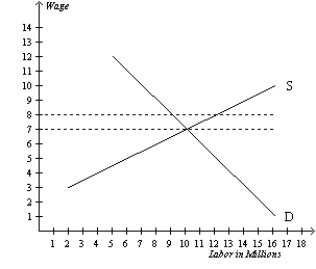 -Refer to Figure 19-1. If the minimum wage in this market is $8, then
 (Multiple Choice)
4.8/5 (82)
(82) Scenario 19-4
Assume that the labor market for barbers is competitive and that it is differentiated into two groups: barbers who are bald (or going bald) and those who have a full head of hair. Assume that the barbers in this market have identical hair-cutting ability, regardless of whether they are bald or not. Currently the equilibrium wage in the bald barber market is lower than that in the nonbald market. Further assume that the market for haircuts is competitive.
-Refer to Scenario 19-4. If consumers do not discriminate between bald barbers and barbers with hair, then
(Multiple Choice)
4.9/5 (76)
(76) Scenario 19-2
Travis, a student at a community college, is considering what he should do for summer employment. Two recruiters show up at his school in search of summer workers. Recruiter A is looking for workers to help a disaster relief agency distribute food aid in Africa. Recruiter B is looking for custodial help to clean motel rooms in a motel located near the entrance to a famous national park.
-Refer to Scenario 19-2. Travis is carefully considering the options that each recruiter presents. On the basis of knowledge obtained in his economics class, Travis concludes that
(Multiple Choice)
4.9/5 (86)
(86) Cory has just graduated from veterinary school. He can earn $40,000 working at a small animal clinic or $50,000 working with farm animals and horses where the risks of getting injured by an animal are higher. The higher salary to work with larger animals is an example of
(Multiple Choice)
4.9/5 (71)
(71) When employers pay an efficiency wage above the market equilibrium wage, this will likely result in
(Multiple Choice)
4.8/5 (90)
(90) Explain the theory that education acts as a signaling device. How does this contrast with the theory of education as an investment in human capital?
(Essay)
4.9/5 (88)
(88) Economists who attempt to explain the increasing earnings gap between skilled and unskilled workers in the United States offer two main hypotheses. Both hypotheses
(Multiple Choice)
4.9/5 (83)
(83) Economists are skeptical that discrimination is employer driven because
(Multiple Choice)
4.8/5 (81)
(81) If firms are competitive, then labor-market discrimination
(Multiple Choice)
4.8/5 (89)
(89) Scenario 19-1
Ferris B., a student at a community college, is considering what he should do for summer employment. Two recruiters show up at his school in search of summer workers. Recruiter A is looking for lifeguards to patrol the beach at an exclusive island resort in the Caribbean. Recruiter B is looking for workers to staff positions at a summer youth camp.
-Refer to Scenario 19-1. Ferris is carefully considering the options that each recruiter presents. On the basis of knowledge obtained in his economics class, Ferris concludes that
(Multiple Choice)
4.8/5 (87)
(87) John is an Asian 23-year-old male, and Ken is an Asian 43-year-old male. Both John and Ken are economics majors, and they graduated from the same college with the same GPA - John in 2006 and Ken in 1986. John and Ken are both financial advisers at the same brokerage firm. John earns $52,000 a year, and Ken earns $88,000 a year. Select the best explanation for this wage difference.
(Multiple Choice)
4.7/5 (78)
(78) Given that the median male is better paid than the median female, which of the following is a valid explanation for wage differences?
(Multiple Choice)
4.7/5 (68)
(68) Which of the following is not an explanation for why better educated workers earn more, on average, than less educated workers?
(Multiple Choice)
4.8/5 (64)
(64) Labor-market discrimination based solely on age is illegal in the United States.
(True/False)
5.0/5 (87)
(87) Economists have found evidence that differences in wages can be explained by
(Multiple Choice)
4.8/5 (85)
(85) 
Filters
- Essay(0)
- Multiple Choice(0)
- Short Answer(0)
- True False(0)
- Matching(0)