



 Chat with AI
Exam 15: Monopoly

Exam 1: Ten Principles of Economics439 Questions
Exam 2: Thinking Like an Economist617 Questions
Exam 3: Interdependence and the Gains From Trade527 Questions
Exam 4: The Market Forces of Supply and Demand697 Questions
Exam 5: Elasticity and Its Application594 Questions
Exam 6: Supply, Demand, and Government Policies645 Questions
Exam 7: Consumers, Producers, and the Efficiency of Markets549 Questions
Exam 8: Application: the Costs of Taxation513 Questions
Exam 9: Application: International Trade492 Questions
Exam 10: Externalities524 Questions
Exam 11: Public Goods and Common Resources433 Questions
Exam 12: The Design of the Tax System549 Questions
Exam 13: The Costs of Production420 Questions
Exam 14: Firms in Competitive Markets543 Questions
Exam 15: Monopoly637 Questions
Exam 16: Monopolistic Competition580 Questions
Exam 17: Oligopoly488 Questions
Exam 18: The Markets for the Factors of Production564 Questions
Exam 19: Earnings and Discrimination490 Questions
Exam 20: Income Inequality and Poverty455 Questions
Exam 21: The Theory of Consumer Choice431 Questions
Exam 22: Frontiers of Microeconomics440 Questions
Exam 23: Measuring a Nations Income520 Questions
Exam 24: Measuring the Cost of Living529 Questions
Exam 25: Production and Growth505 Questions
Exam 26: Saving, Investment, and the Financial System564 Questions
Exam 27: The Basic Tools of Finance500 Questions
Exam 28: Unemployment678 Questions
Exam 29: The Monetary System515 Questions
Exam 30: Money Growth and Inflation481 Questions
Exam 31: Open-Economy Macroeconomics: Basic Concepts522 Questions
Exam 32: A Macroeconomic Theory of the Open Economy475 Questions
Exam 33: Aggregate Demand and Aggregate Supply562 Questions
Exam 34: The Influence of Monetary and Fiscal Policy on Aggregate Demand508 Questions
Exam 35: The Short-Run Trade-Off Between Inflation and Unemployment491 Questions
Exam 36: Six Debates Over Macroeconomic Policy372 Questions
Select questions type


Table 15-7
Sally owns the only shoe store in town. She has the following cost and revenue information.  -Refer to Table 15-7. What is the marginal revenue from selling the 2nd pair of shoes?
 (Multiple Choice)
4.8/5  (85)
(85) Which of the following is not an example of price discrimination?
(Multiple Choice)
4.8/5 (85)
(85) Which of the following statements is correct for a monopolist?
(Multiple Choice)
4.8/5 (74)
(74) Suppose that a professional photographer takes a prize-winning digital photo. She can sell a 5"x7" color print of the photo for $10. She can also sell the digital file for $20. There are 500 people willing to buy the color print and 2,000 people willing to buy the digital file. Assume the costs to the photographer are zero and that the people who purchase the digital file cannot resell the file itself or any prints made from it. What should she do in order to maximize her profits?
(Multiple Choice)
4.9/5 (95)
(95) Which of the following statements is correct? Monopolies are socially inefficient because they
(Multiple Choice)
4.7/5 (73)
(73) Scenario 15-2
Consider a local, privately-owned electrical cooperative named Poweshiek Power Company (PPCo). PPCo has just completed a clean-coal-burning electrical power plant in Iowa. Currently, PPCo can meet the electricity needs of all residents in the county. In fact, its capacity far exceeds the needs of the county. After just a few years of operation, the shareholders of PPCo experienced incredibly high rates of return on their investment due to the profitability of the corporation.
-Refer to Scenario 15-2. Which of the following statements is most likely to be true?
(Multiple Choice)
4.9/5 (78)
(78) Which of the following statements comparing monopoly with competition is correct?
(Multiple Choice)
4.9/5 (80)
(80) Figure 15-1 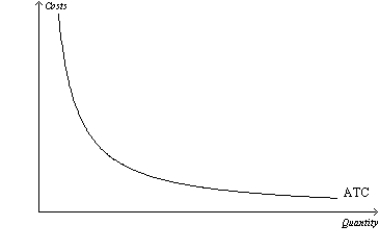 -Refer to Figure 15-1. Considering the relationship between average total cost and marginal cost, the marginal cost curve for this firm
 (Multiple Choice)
4.9/5 (78)
(78) Which of the following is not an example of a barrier to entry?
(Multiple Choice)
4.7/5 (88)
(88) For a monopolist, when the output effect is greater than the price effect, marginal revenue is
(Multiple Choice)
4.9/5 (80)
(80) State one benefit of government-granted monopolies like patents and copyrights.
(Short Answer)
4.8/5 (83)
(83) Figure 15-7  -Refer to Figure 15-7. In order to maximize profits, the monopolist should produce
 (Multiple Choice)
4.7/5 (83)
(83) Figure 15-22  -Refer to Figure 15-22. How much consumer surplus results if this single-price monopolist profit-maximizes?
 (Short Answer)
4.9/5 (83)
(83) Authors are allowed to be monopolists in the sale of their books in order to
(Multiple Choice)
4.8/5 (92)
(92) Because a monopolist must lower its price in order to sell another unit of output,
(Multiple Choice)
5.0/5 (80)
(80) Deadweight loss measures the loss in society's welfare that occurs because a monopolist can earn profits without the concern of new firms entering its industry.
(True/False)
4.9/5 (73)
(73) The amount that producers receive for a good minus their costs of producing it equals
(Multiple Choice)
4.9/5 (81)
(81) 
Filters
- Essay(0)
- Multiple Choice(0)
- Short Answer(0)
- True False(0)
- Matching(0)