



 Chat with AI
Exam 15: Monopoly

Exam 1: Ten Principles of Economics439 Questions
Exam 2: Thinking Like an Economist617 Questions
Exam 3: Interdependence and the Gains From Trade527 Questions
Exam 4: The Market Forces of Supply and Demand697 Questions
Exam 5: Elasticity and Its Application594 Questions
Exam 6: Supply, Demand, and Government Policies645 Questions
Exam 7: Consumers, Producers, and the Efficiency of Markets549 Questions
Exam 8: Application: the Costs of Taxation513 Questions
Exam 9: Application: International Trade492 Questions
Exam 10: Externalities524 Questions
Exam 11: Public Goods and Common Resources433 Questions
Exam 12: The Design of the Tax System549 Questions
Exam 13: The Costs of Production420 Questions
Exam 14: Firms in Competitive Markets543 Questions
Exam 15: Monopoly637 Questions
Exam 16: Monopolistic Competition580 Questions
Exam 17: Oligopoly488 Questions
Exam 18: The Markets for the Factors of Production564 Questions
Exam 19: Earnings and Discrimination490 Questions
Exam 20: Income Inequality and Poverty455 Questions
Exam 21: The Theory of Consumer Choice431 Questions
Exam 22: Frontiers of Microeconomics440 Questions
Exam 23: Measuring a Nations Income520 Questions
Exam 24: Measuring the Cost of Living529 Questions
Exam 25: Production and Growth505 Questions
Exam 26: Saving, Investment, and the Financial System564 Questions
Exam 27: The Basic Tools of Finance500 Questions
Exam 28: Unemployment678 Questions
Exam 29: The Monetary System515 Questions
Exam 30: Money Growth and Inflation481 Questions
Exam 31: Open-Economy Macroeconomics: Basic Concepts522 Questions
Exam 32: A Macroeconomic Theory of the Open Economy475 Questions
Exam 33: Aggregate Demand and Aggregate Supply562 Questions
Exam 34: The Influence of Monetary and Fiscal Policy on Aggregate Demand508 Questions
Exam 35: The Short-Run Trade-Off Between Inflation and Unemployment491 Questions
Exam 36: Six Debates Over Macroeconomic Policy372 Questions
Select questions type


Monopoly pricing prevents some mutually beneficial trades from taking place. These unrealized, mutually beneficial trades are
(Multiple Choice)
4.7/5  (64)
(64) Table 15-21
Tommy's Tie Company, a monopolist, has the following cost and revenue information. Assume that Tommy's is
able to engage in perfect price discrimination.  -Refer to Table 15-21. If the monopolist can engage in perfect price discrimination, what is the total revenue when 3 ties are sold?
 (Multiple Choice)
4.8/5 (71)
(71) Antitrust laws have economic benefits that outweigh the costs if they
(Multiple Choice)
4.8/5 (85)
(85) Table 15-18
A monopolist faces the following demand curve:  Suppose marginal cost is constant at $8 per unit.
-Refer to Table 15-18. The monopolist's marginal revenue is
Suppose marginal cost is constant at $8 per unit.
-Refer to Table 15-18. The monopolist's marginal revenue is (Multiple Choice)
4.9/5 (69)
(69) Which of the following is a characteristic of a natural monopoly?
(Multiple Choice)
4.8/5 (79)
(79) Table 15-11
The following table shows quantity, price, and marginal cost information for a monopoly: 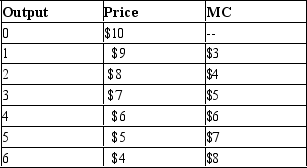 -Refer to Table 15-11. What price should the firm charge to maximize its profit?
 (Multiple Choice)
5.0/5 (84)
(84) Table 15-12
The following table provides information on the price, quantity, and average total cost for a monopoly. 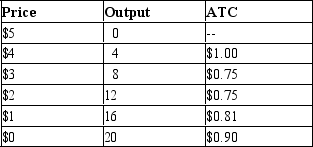 -Refer to Table 15-12. In order to maximize profits, the firm should produce
 (Multiple Choice)
4.9/5 (93)
(93) The socially efficient quantity is found where the demand curve intersects the marginal cost curve.
(True/False)
4.7/5 (76)
(76) Scenario 15-11
Vincent operates a scenic tour business in Boston. He has one bus which can fit 50 people per tour and each tour lasts 2 hours. His total cost of operating one tour is fixed at $450. Vincent's cost is not reduced if he runs a tour with a partially full bus. While his cost is the same for all tours, Vincent charges each passenger his/her willingness to pay: adults $18 per trip, children $10 per trip, and senior citizens $12 per trip. At those rates, on a typical day Vincent's demand is:  Assume that Vincent's customers are always available for the tour; therefore, he can fill his bus for each tour as long as there is sufficient total demand for the day.
-Refer to Scenario 15-11. Vincent uses a pricing practice called
Assume that Vincent's customers are always available for the tour; therefore, he can fill his bus for each tour as long as there is sufficient total demand for the day.
-Refer to Scenario 15-11. Vincent uses a pricing practice called (Short Answer)
4.8/5 (79)
(79) The deadweight loss that arises from a monopoly is a consequence of the fact that the monopoly
(Multiple Choice)
4.8/5 (74)
(74) Figure 15-18  -Refer to Figure 15-18. If the monopoly firm is not allowed to price discriminate, then the deadweight loss amounts to
 (Multiple Choice)
4.9/5 (77)
(77) One example of price discrimination occurs in the publishing industry when a publisher initially releases an expensive hardcover edition of a popular novel and later releases a cheaper paperback edition. Use this example to demonstrate the benefits and potential pitfalls of a price discrimination pricing strategy.
(Essay)
4.9/5 (87)
(87) Figure 15-5  -Refer to Figure 15-5. Profit on a typical unit sold for a profit-maximizing monopoly would equal
 (Multiple Choice)
4.8/5 (79)
(79) Policymakers are discussing various proposals regarding how to deal with natural monopolies. Senator Huff wants to regulate natural monopolies by equating price with average total cost. Huff contends that such a policy will ensure that monopolies make every effort to reduce costs. Senator Puff wants the government to own natural monopolies. Puff argues that government-owned monopolies usually do a better job of holding down costs than privately owned monopolies. Which senator's argument is correct?
(Multiple Choice)
4.9/5 (84)
(84) To maximize total surplus with a monopoly firm, a benevolent social planner would choose the level of output where
(Multiple Choice)
4.9/5 (73)
(73) Figure 15-8  -Refer to Figure 15-8. What is the monopoly price and quantity?
 (Multiple Choice)
4.9/5 (81)
(81) Table 15-5
A monopolist faces the following demand curve: 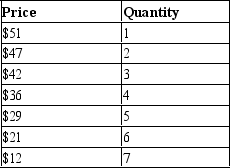 -Refer to Table 15-5. The monopolist has total fixed costs of $60 and has a constant marginal cost of $15. What is the profit-maximizing price?
 (Multiple Choice)
4.8/5 (85)
(85) Suppose when a monopolist produces 75 units its average revenue is $10 per unit, its marginal revenue is $5 per unit, its marginal cost is $6 per unit, and its average total cost is $5 per unit. What can we conclude about this monopolist?
(Multiple Choice)
4.9/5 (82)
(82) 
Filters
- Essay(0)
- Multiple Choice(0)
- Short Answer(0)
- True False(0)
- Matching(0)