



 Chat with AI
Exam 15: Monopoly

Exam 1: Ten Principles of Economics439 Questions
Exam 2: Thinking Like an Economist617 Questions
Exam 3: Interdependence and the Gains From Trade527 Questions
Exam 4: The Market Forces of Supply and Demand697 Questions
Exam 5: Elasticity and Its Application594 Questions
Exam 6: Supply, Demand, and Government Policies645 Questions
Exam 7: Consumers, Producers, and the Efficiency of Markets549 Questions
Exam 8: Application: the Costs of Taxation513 Questions
Exam 9: Application: International Trade492 Questions
Exam 10: Externalities524 Questions
Exam 11: Public Goods and Common Resources433 Questions
Exam 12: The Design of the Tax System549 Questions
Exam 13: The Costs of Production420 Questions
Exam 14: Firms in Competitive Markets543 Questions
Exam 15: Monopoly637 Questions
Exam 16: Monopolistic Competition580 Questions
Exam 17: Oligopoly488 Questions
Exam 18: The Markets for the Factors of Production564 Questions
Exam 19: Earnings and Discrimination490 Questions
Exam 20: Income Inequality and Poverty455 Questions
Exam 21: The Theory of Consumer Choice431 Questions
Exam 22: Frontiers of Microeconomics440 Questions
Exam 23: Measuring a Nations Income520 Questions
Exam 24: Measuring the Cost of Living529 Questions
Exam 25: Production and Growth505 Questions
Exam 26: Saving, Investment, and the Financial System564 Questions
Exam 27: The Basic Tools of Finance500 Questions
Exam 28: Unemployment678 Questions
Exam 29: The Monetary System515 Questions
Exam 30: Money Growth and Inflation481 Questions
Exam 31: Open-Economy Macroeconomics: Basic Concepts522 Questions
Exam 32: A Macroeconomic Theory of the Open Economy475 Questions
Exam 33: Aggregate Demand and Aggregate Supply562 Questions
Exam 34: The Influence of Monetary and Fiscal Policy on Aggregate Demand508 Questions
Exam 35: The Short-Run Trade-Off Between Inflation and Unemployment491 Questions
Exam 36: Six Debates Over Macroeconomic Policy372 Questions
Select questions type


Figure 15-4  -Refer to Figure 15-4. The marginal cost curve for a monopoly firm is depicted by curve
 (Multiple Choice)
4.7/5  (84)
(84) Figure 15-4
-Refer to Figure 15-4. The average total cost curve for a monopoly firm is depicted by curve
-Refer to Figure 15-4. The average total cost curve for a monopoly firm is depicted by curve (Multiple Choice)
4.8/5 (95)
(95) Figure 15-19  -Refer to Figure 15-19. If the monopoly firm is not allowed to price discriminate, then consumer surplus amounts to
 (Multiple Choice)
4.8/5 (84)
(84) Figure 15-21  -Refer to Figure 15-21. What is the price and quantity for this natural monopolist under fair return pricing?
 (Multiple Choice)
4.9/5 (89)
(89) Scenario 15-6
The concert promoters of a heavy-metal band, WeR2Loud, know that there are two types of concert-goers: die- hard fans and casual fans. For a particular WeR2Loud concert, there are 1,000 die-hard fans who will pay $150 for a ticket and 500 casual fans who will pay $50 for a ticket. There are 1,500 seats available at the concert venue. Suppose the cost of putting on the concert is $50,000, which includes the cost of the band, lighting, security, etc.
-Refer to Scenario 15-6. How much profit will the concert promoters earn if they set the price of each ticket at $50?
(Multiple Choice)
4.7/5 (80)
(80) Scenario 15-8
Mega Media Cable TV is able to purchase an exclusive right to sell a premium sports channel in its market area. Let's assume that Mega Media pays $100,000 a year for the exclusive marketing rights to the sports channel. Since Mega Media has already installed cable to all of the homes in its market area, the marginal cost of delivering the sports channel to subscribers is zero. The manager of Mega Media needs to know what price to charge for the sports channel service to maximize her profit. Before setting price, she hires an economist to estimate demand for the sports channel. The economist discovers that there are two types of subscribers who value premium sporting channels. First are the 3,000 die-hard sports fans who will pay as much as $150 a year for the new channel. Second, the premium sports channel will appeal to 20,000 occasional sports viewers who will pay as much as $25 a year for a subscription to it.
-Refer to Scenario 15-8. If Mega Media Cable TV is able to price discriminate, what would be the maximum amount of profit it could generate?
(Multiple Choice)
4.8/5 (79)
(79) Figure 15-3  -Refer to Figure 15-3. Which panel could represent the demand curve facing the soybean industry?
 (Multiple Choice)
4.8/5 (71)
(71) Table 15-12
The following table provides information on the price, quantity, and average total cost for a monopoly. 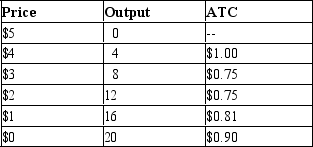 -Refer to Table 15-12. At what price will the firm maximize its profit?
 (Multiple Choice)
4.9/5 (85)
(85) Figure 15-19
-Refer to Figure 15-19. If the monopoly firm perfectly price discriminates, then the deadweight loss amounts to
-Refer to Figure 15-19. If the monopoly firm perfectly price discriminates, then the deadweight loss amounts to (Multiple Choice)
5.0/5 (72)
(72) The De Beers Diamond company advertises heavily to promote the sale of all diamonds, not just its own. This is evidence that it has a monopoly position to some degree.
(True/False)
4.8/5 (81)
(81) Encouraging firms to invest in research and development and individuals to engage in creative endeavors such as writing novels is one justification for
(Multiple Choice)
4.7/5 (82)
(82) For a long while, electricity producers were thought to be a classic example of a natural monopoly. People held this view because
(Multiple Choice)
4.8/5 (77)
(77) Which of the following would be most likely to have monopoly power?
(Multiple Choice)
4.8/5 (87)
(87) In many countries, the government chooses to "internalize" the monopoly by owning monopoly providers of goods and services. (In some cases these firms are "nationalized," and the government actually buys or confiscates firms that operate in monopoly markets). What would be the advantages and disadvantages of such an approach to ensure that the "best interest of society" is promoted in these markets? Explain your answer.
(Essay)
4.8/5 (67)
(67) Suppose when a monopolist produces 50 units its average revenue is $8 per unit, its marginal revenue is $4 per unit, its marginal cost is $4 per unit, and its average total cost is $3 per unit. What can we conclude about this monopolist?
(Multiple Choice)
5.0/5 (86)
(86) Which of the following is not a reason for the existence of a monopoly?
(Multiple Choice)
4.9/5 (74)
(74) After the patent runs out on a brand name drug, generic drugs enter the market. What happens next in the market?
(Multiple Choice)
4.7/5 (73)
(73) Comparing firms in perfectly competitive markets to monopoly firms, which can earn economic profits in the long run?
(Short Answer)
4.9/5 (81)
(81) For a monopoly firm, which of the following equalities is always true?
(Multiple Choice)
4.8/5 (83)
(83) 
Filters
- Essay(0)
- Multiple Choice(0)
- Short Answer(0)
- True False(0)
- Matching(0)