



 Chat with AI
Exam 15: Monopoly

Exam 1: Ten Principles of Economics439 Questions
Exam 2: Thinking Like an Economist617 Questions
Exam 3: Interdependence and the Gains From Trade527 Questions
Exam 4: The Market Forces of Supply and Demand697 Questions
Exam 5: Elasticity and Its Application594 Questions
Exam 6: Supply, Demand, and Government Policies645 Questions
Exam 7: Consumers, Producers, and the Efficiency of Markets549 Questions
Exam 8: Application: the Costs of Taxation513 Questions
Exam 9: Application: International Trade492 Questions
Exam 10: Externalities524 Questions
Exam 11: Public Goods and Common Resources433 Questions
Exam 12: The Design of the Tax System549 Questions
Exam 13: The Costs of Production420 Questions
Exam 14: Firms in Competitive Markets543 Questions
Exam 15: Monopoly637 Questions
Exam 16: Monopolistic Competition580 Questions
Exam 17: Oligopoly488 Questions
Exam 18: The Markets for the Factors of Production564 Questions
Exam 19: Earnings and Discrimination490 Questions
Exam 20: Income Inequality and Poverty455 Questions
Exam 21: The Theory of Consumer Choice431 Questions
Exam 22: Frontiers of Microeconomics440 Questions
Exam 23: Measuring a Nations Income520 Questions
Exam 24: Measuring the Cost of Living529 Questions
Exam 25: Production and Growth505 Questions
Exam 26: Saving, Investment, and the Financial System564 Questions
Exam 27: The Basic Tools of Finance500 Questions
Exam 28: Unemployment678 Questions
Exam 29: The Monetary System515 Questions
Exam 30: Money Growth and Inflation481 Questions
Exam 31: Open-Economy Macroeconomics: Basic Concepts522 Questions
Exam 32: A Macroeconomic Theory of the Open Economy475 Questions
Exam 33: Aggregate Demand and Aggregate Supply562 Questions
Exam 34: The Influence of Monetary and Fiscal Policy on Aggregate Demand508 Questions
Exam 35: The Short-Run Trade-Off Between Inflation and Unemployment491 Questions
Exam 36: Six Debates Over Macroeconomic Policy372 Questions
Select questions type


The collection of statutes aimed at curbing monopoly power is called
(Multiple Choice)
4.7/5  (73)
(73) Describe how government is involved in creating a monopoly. Why might the government create one? Give an example.
(Essay)
4.8/5 (60)
(60) Table 15-4
A monopolist faces the following demand curve:  -Refer to Table 15-4. In order to maximize total revenues, the monopolist should produce
 (Multiple Choice)
4.7/5 (94)
(94) When we compare economic welfare in a monopoly market to a competitive market, the profits earned by the monopolist represent
(Multiple Choice)
4.8/5 (73)
(73) Scenario 15-7
Black Box Cable TV is able to purchase an exclusive right to sell a premium movie channel (PMC) in its market area. Let's assume that Black Box Cable pays $150,000 a year for the exclusive marketing rights to PMC. Since Black Box has already installed cable to all of the homes in its market area, the marginal cost of delivering PMC to subscribers is zero. The manager of Black Box needs to know what price to charge for the PMC service to maximize her profit. Before setting price, she hires an economist to estimate demand for the PMC service. The economist discovers that there are two types of subscribers who value premium movie channels. First are the 4,000 die-hard TV viewers who will pay as much as $150 a year for the new PMC premium channel. Second, the PMC channel will appeal to 20,000 occasional TV viewers who will pay as much as $20 a year for a subscription to PMC.
-Refer to Scenario 15-7. What is the deadweight loss associated with the nondiscriminating pricing policy compared to the price discriminating policy?
(Multiple Choice)
4.7/5 (73)
(73) A common solution to monopoly in European countries is public ownership.
(True/False)
4.9/5 (70)
(70) Deadweight loss measures the loss in society's welfare that occurs because a monopolist does not produce the socially efficient level of output.
(True/False)
5.0/5 (81)
(81) Figure 15-1 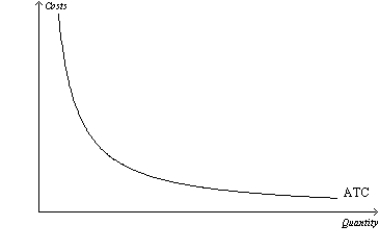 -Refer to Figure 15-1. The shape of the average total cost curve reveals information about the nature of the barrier to entry that might exist in a monopoly market. Which of the following monopoly types best coincides with the figure?
 (Multiple Choice)
4.9/5 (68)
(68) When a certain monopoly sets its price at $8 it sells 64 units. When the monopoly sets its price at $10 it sells 62 units. The marginal revenue for the firm over this range is
(Multiple Choice)
4.8/5 (83)
(83) Figure 15-24  -Refer to Figure 15-24. Use the letters in the figure to identify the area of deadweight loss for the single price monopolist.
 (Short Answer)
4.8/5 (75)
(75) Drug companies are allowed to be monopolists in the drugs they discover in order to
(Multiple Choice)
4.8/5 (87)
(87) Figure 15-3  -Refer to Figure 15-3. Which panel could represent the demand curve facing a local cable television provider if that firm in a monopolist?
 (Multiple Choice)
4.8/5 (87)
(87) Scenario 15-5
An airline knows that there are two types of travelers: business travelers and vacationers. For a particular flight, there are 100 business travelers who will pay $600 for a ticket while there are 50 vacationers who will pay $300 for a ticket. There are 150 seats available on the plane. Suppose the cost to the airline of providing the flight is $20,000, which includes the cost of the pilots, flight attendants, fuel, etc.
-Refer to Scenario 15-5. How much profit will the airline earn if it sets the price of each ticket at $600?
(Multiple Choice)
4.9/5 (79)
(79) The three main sources of barriers to entry are monopoly resources, government regulation, and the firm's production process.
(True/False)
4.8/5 (69)
(69) In a competitive market, a firm's supply curve dictates the amount it will supply. In a monopoly market the
(Multiple Choice)
4.8/5 (72)
(72) Like competitive firms, monopolies choose to produce a quantity in which marginal revenue equals marginal cost.
(True/False)
4.9/5 (78)
(78) 
Filters
- Essay(0)
- Multiple Choice(0)
- Short Answer(0)
- True False(0)
- Matching(0)