



 Chat with AI
Exam 15: Monopoly

Exam 1: Ten Principles of Economics439 Questions
Exam 2: Thinking Like an Economist617 Questions
Exam 3: Interdependence and the Gains From Trade527 Questions
Exam 4: The Market Forces of Supply and Demand697 Questions
Exam 5: Elasticity and Its Application594 Questions
Exam 6: Supply, Demand, and Government Policies645 Questions
Exam 7: Consumers, Producers, and the Efficiency of Markets549 Questions
Exam 8: Application: the Costs of Taxation513 Questions
Exam 9: Application: International Trade492 Questions
Exam 10: Externalities524 Questions
Exam 11: Public Goods and Common Resources433 Questions
Exam 12: The Design of the Tax System549 Questions
Exam 13: The Costs of Production420 Questions
Exam 14: Firms in Competitive Markets543 Questions
Exam 15: Monopoly637 Questions
Exam 16: Monopolistic Competition580 Questions
Exam 17: Oligopoly488 Questions
Exam 18: The Markets for the Factors of Production564 Questions
Exam 19: Earnings and Discrimination490 Questions
Exam 20: Income Inequality and Poverty455 Questions
Exam 21: The Theory of Consumer Choice431 Questions
Exam 22: Frontiers of Microeconomics440 Questions
Exam 23: Measuring a Nations Income520 Questions
Exam 24: Measuring the Cost of Living529 Questions
Exam 25: Production and Growth505 Questions
Exam 26: Saving, Investment, and the Financial System564 Questions
Exam 27: The Basic Tools of Finance500 Questions
Exam 28: Unemployment678 Questions
Exam 29: The Monetary System515 Questions
Exam 30: Money Growth and Inflation481 Questions
Exam 31: Open-Economy Macroeconomics: Basic Concepts522 Questions
Exam 32: A Macroeconomic Theory of the Open Economy475 Questions
Exam 33: Aggregate Demand and Aggregate Supply562 Questions
Exam 34: The Influence of Monetary and Fiscal Policy on Aggregate Demand508 Questions
Exam 35: The Short-Run Trade-Off Between Inflation and Unemployment491 Questions
Exam 36: Six Debates Over Macroeconomic Policy372 Questions
Select questions type


In a monopoly market, the socially efficient quantity of output is typically higher than the profit-maximizing quantity of output for the monopolist.
(True/False)
4.8/5  (84)
(84) Table 15-7
Sally owns the only shoe store in town. She has the following cost and revenue information.  -Refer to Table 15-7. What is total profit at the profit-maximizing quantity?
 (Multiple Choice)
5.0/5 (89)
(89) Comparing firms in perfectly competitive markets to monopoly firms, which results in a deadweight loss?
(Short Answer)
4.9/5 (76)
(76) Figure 15-23  -Refer to Figure 15-23. If a regulator requires the firm to charge a marginal cost price, what is the amount of profit or loss earned by the firm?
 (Short Answer)
4.9/5 (86)
(86) Figure 15-23
-Refer to Figure 15-23. If a regulator requires the firm to charge a marginal cost price, what price will the firm charge?
-Refer to Figure 15-23. If a regulator requires the firm to charge a marginal cost price, what price will the firm charge? (Short Answer)
4.9/5 (69)
(69) As a monopolist increases the quantity of output it sells, the price consumers are willing to pay for the good
(Multiple Choice)
4.9/5 (74)
(74) The DeBeers Company faces very little competition from other firms in the wholesale diamond market. Why isn't the price of the wholesale diamonds $10,000 per carat?
(Multiple Choice)
4.8/5 (90)
(90) Table 15-18
A monopolist faces the following demand curve:  Suppose marginal cost is constant at $8 per unit.
-Refer to Table 15-18. When the price effect on revenue is greater than the output effect, marginal revenue is
Suppose marginal cost is constant at $8 per unit.
-Refer to Table 15-18. When the price effect on revenue is greater than the output effect, marginal revenue is (Multiple Choice)
4.9/5 (79)
(79) Figure 15-5  -Refer to Figure 15-5. A profit-maximizing monopoly's total cost is equal to
 (Multiple Choice)
4.8/5 (98)
(98) Table 15-12
The following table provides information on the price, quantity, and average total cost for a monopoly. 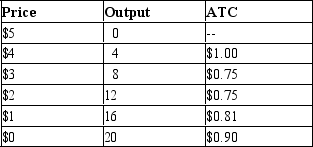 -Refer to Table 15-12. If the firm produces the profit-maximizing level of output, it will earn profits of
(Multiple Choice)
4.8/5 (83)
(83) Figure 15-17  -Refer to Figure 15-17. Which of the following statements best describes the changes that would occur if this firm were to switch from operating as a single price profit-maximizing monopolist to perfect price discrimination?
 (Multiple Choice)
4.8/5 (89)
(89) Consumers' willingness to pay for a good minus the amount they actually pay for it equals
(Multiple Choice)
4.7/5 (77)
(77) When a certain monopoly sets its price at $8 it sells 64 units. When the monopoly sets its price at $9 it sells 62 units. The marginal revenue for the firm over this range is
(Multiple Choice)
4.9/5 (74)
(74) The legislation passed by Congress in 1914 to strengthen the government's powers and authorize private lawsuits was the
(Multiple Choice)
5.0/5 (87)
(87) A monopolist earns higher profits by charging one price than by practicing price discrimination.
(True/False)
4.9/5 (80)
(80) 
Filters
- Essay(0)
- Multiple Choice(0)
- Short Answer(0)
- True False(0)
- Matching(0)