



 Chat with AI
Exam 15: Monopoly

Exam 1: Ten Principles of Economics439 Questions
Exam 2: Thinking Like an Economist617 Questions
Exam 3: Interdependence and the Gains From Trade527 Questions
Exam 4: The Market Forces of Supply and Demand697 Questions
Exam 5: Elasticity and Its Application594 Questions
Exam 6: Supply, Demand, and Government Policies645 Questions
Exam 7: Consumers, Producers, and the Efficiency of Markets549 Questions
Exam 8: Application: the Costs of Taxation513 Questions
Exam 9: Application: International Trade492 Questions
Exam 10: Externalities524 Questions
Exam 11: Public Goods and Common Resources433 Questions
Exam 12: The Design of the Tax System549 Questions
Exam 13: The Costs of Production420 Questions
Exam 14: Firms in Competitive Markets543 Questions
Exam 15: Monopoly637 Questions
Exam 16: Monopolistic Competition580 Questions
Exam 17: Oligopoly488 Questions
Exam 18: The Markets for the Factors of Production564 Questions
Exam 19: Earnings and Discrimination490 Questions
Exam 20: Income Inequality and Poverty455 Questions
Exam 21: The Theory of Consumer Choice431 Questions
Exam 22: Frontiers of Microeconomics440 Questions
Exam 23: Measuring a Nations Income520 Questions
Exam 24: Measuring the Cost of Living529 Questions
Exam 25: Production and Growth505 Questions
Exam 26: Saving, Investment, and the Financial System564 Questions
Exam 27: The Basic Tools of Finance500 Questions
Exam 28: Unemployment678 Questions
Exam 29: The Monetary System515 Questions
Exam 30: Money Growth and Inflation481 Questions
Exam 31: Open-Economy Macroeconomics: Basic Concepts522 Questions
Exam 32: A Macroeconomic Theory of the Open Economy475 Questions
Exam 33: Aggregate Demand and Aggregate Supply562 Questions
Exam 34: The Influence of Monetary and Fiscal Policy on Aggregate Demand508 Questions
Exam 35: The Short-Run Trade-Off Between Inflation and Unemployment491 Questions
Exam 36: Six Debates Over Macroeconomic Policy372 Questions
Select questions type


Splitting up a monopoly is often justified on the grounds that
(Multiple Choice)
4.9/5  (83)
(83) By selling hardcover books to die-hard fans and paperback books to less enthusiastic readers, the publisher is able to price discriminate and raise its profits.
(True/False)
5.0/5 (68)
(68) The profit-maximization problem for a monopolist differs from that of a competitive firm in which of the following ways?
(Multiple Choice)
4.9/5 (82)
(82) Scenario 15-1
Consider a transportation corporation named Reading's that has just completed the development of a new light rail system in Minneapolis. Currently, there are plenty of seats on the train, and it is never crowded. Its capacity far exceeds the needs of the city. After just a few years of operation, the shareholders of Reading's experienced incredibly high rates of return on their investment due to the profitability of the corporation.
-Refer to Scenario 15-1. Which of the following statements is most likely to be true? currently has.
(Multiple Choice)
4.8/5 (80)
(80) The practice of selling the same goods to different customers at different prices, but with the same marginal cost, is known as
(Multiple Choice)
4.8/5 (82)
(82) The simplest way for a monopoly to arise is for a single firm to
(Multiple Choice)
4.8/5 (65)
(65) Figure 15-20 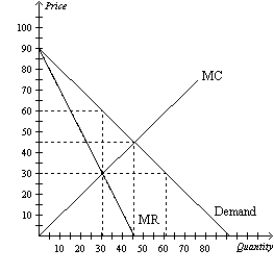 -Refer to Figure 15-20. The deadweight loss caused by a profit-maximizing monopoly amounts to
 (Multiple Choice)
4.9/5 (75)
(75) Figure 15-4  -Refer to Figure 15-4. If the monopoly firm is currently producing Q4 units of output, then a decrease in output will necessarily cause profit to
 (Multiple Choice)
4.9/5 (87)
(87) Figure 15-22  -Refer to Figure 15-22. If the monopolist uses perfect price discrimination, how much output does the firm produce?
 (Short Answer)
4.9/5 (94)
(94) The economic inefficiency of a monopolist can be measured by the
(Multiple Choice)
4.8/5 (87)
(87) Because a monopolist does not face competition from other firms, the outcome in a market with a monopoly
(Multiple Choice)
4.8/5 (85)
(85) Figure 15-9  -Refer to Figure 15-9. The deadweight loss caused by a profit-maximizing monopoly amounts to
 (Multiple Choice)
4.9/5 (71)
(71) Table 15-17
A monopolist faces the following demand curve: 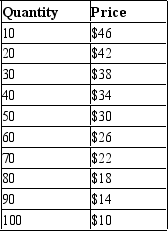 -Refer to Table 15-17. If the marginal cost of production is constant at $18 per unit, this profit-maximizing monopolist will choose to produce
 (Multiple Choice)
4.9/5 (92)
(92) Scenario 15-8
Mega Media Cable TV is able to purchase an exclusive right to sell a premium sports channel in its market area. Let's assume that Mega Media pays $100,000 a year for the exclusive marketing rights to the sports channel. Since Mega Media has already installed cable to all of the homes in its market area, the marginal cost of delivering the sports channel to subscribers is zero. The manager of Mega Media needs to know what price to charge for the sports channel service to maximize her profit. Before setting price, she hires an economist to estimate demand for the sports channel. The economist discovers that there are two types of subscribers who value premium sporting channels. First are the 3,000 die-hard sports fans who will pay as much as $150 a year for the new channel. Second, the premium sports channel will appeal to 20,000 occasional sports viewers who will pay as much as $25 a year for a subscription to it.
-Refer to Scenario 15-8. How much profit will Mega Media Cable TV earn if it sets the price at $25?
(Multiple Choice)
4.9/5 (81)
(81) 
Filters
- Essay(0)
- Multiple Choice(0)
- Short Answer(0)
- True False(0)
- Matching(0)