



 Chat with AI
Exam 22: Long-Run Economic Growth: Sources and Policies

Exam 1: Economics: Foundations and Models447 Questions
Exam 2: Trade-Offs, comparative Advantage, and the Market System492 Questions
Exam 3: Where Prices Come From: the Interaction of Demand and Supply476 Questions
Exam 4: Economic Efficiency, government Price Setting, and Taxes420 Questions
Exam 5: Externalities, environmental Policy, and Public Goods263 Questions
Exam 6: Elasticity: the Responsiveness of Demand and Supply294 Questions
Exam 7: The Economics of Health Care338 Questions
Exam 8: Firms,the Stock Market,and Corporate Governance522 Questions
Exam 9: Comparative Advantage and the Gains From International Trade377 Questions
Exam 10: Consumer Choice and Behavioral Economics300 Questions
Exam 11: Technology,production,and Costs327 Questions
Exam 12: Firms in Perfectly Competitive Markets296 Questions
Exam 13: Monopolistic Competition: the Competitive Model in a More Realistic Setting272 Questions
Exam 14: Oligopoly: Firms in Less Competitive Markets258 Questions
Exam 15: Monopoly and Antitrust Policy279 Questions
Exam 16: Pricing Strategy261 Questions
Exam 17: The Markets for Labor and Other Factors of Production281 Questions
Exam 18: Public Choice, taxes, and the Distribution of Income258 Questions
Exam 19: Gdp: Measuring Total Production and Income261 Questions
Exam 20: Unemployment and Inflation291 Questions
Exam 21: Economic Growth, the Financial System, and Business Cycles253 Questions
Exam 22: Long-Run Economic Growth: Sources and Policies262 Questions
Exam 23: Aggregate Expenditure and Output in the Short Run301 Questions
Exam 24: Aggregate Demand and Aggregate Supply Analysis286 Questions
Exam 25: Money,banks,and the Federal Reserve System281 Questions
Exam 26: Monetary Policy275 Questions
Exam 27: Fiscal Policy306 Questions
Exam 28: Inflation, unemployment, and Federal Reserve Policy257 Questions
Exam 29: Macroeconomics in an Open Economy278 Questions
Exam 30: The International Financial System258 Questions
Select questions type


Which of the following is a true statement regarding the economic growth model's predictions and how it actually affects the real world?
(Multiple Choice)
4.8/5  (78)
(78) Because knowledge capital is nonexcludable and nonrival,firms have an incentive to ________ the research and development of other firms.
(Multiple Choice)
4.7/5 (88)
(88) Does globalization promote economic growth,and how does globalization affect the welfare of a given country's citizens?
(Essay)
4.9/5 (70)
(70) The rapid growth of China's economy relative to the United States has benefitted U.S.consumers because
(Multiple Choice)
4.7/5 (83)
(83) What are some of the reasons used to explain improvements in health,education,democracy,and political stability in many low-income countries?
(Essay)
4.8/5 (86)
(86) Robert Lucas,a Nobel laureate in economics,argues that there are ________ returns to human capital.
(Multiple Choice)
4.9/5 (80)
(80) As predicted by the economic growth model,countries that start with lower levels of GDP per capita always grow faster than countries that start with higher levels of GDP per capita.
(True/False)
4.8/5 (70)
(70) Most of the countries of Africa are considered newly industrializing countries.
(True/False)
4.9/5 (75)
(75) Figure 22-3 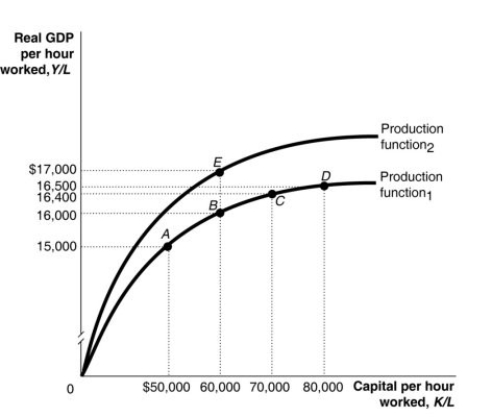 -Refer to Figure 22-3.Technological change is shown in the figure above by the movement from
 (Multiple Choice)
4.7/5 (81)
(81) One reason why many low-income countries experience low rates of growth is because of poor public education and health.
(True/False)
4.9/5 (81)
(81) Suppose that in 2016,real GDP grew in Estonia by 3% and the population increased by 5%.Therefore,in 2016,Estonia experienced
(Multiple Choice)
4.7/5 (68)
(68) Robert Lucas,a Nobel laureate in economics,argues that there are increasing returns to
(Multiple Choice)
4.9/5 (91)
(91) List two ways the labor force experience is different between workers in Europe and in the United States.How do these differences influence productivity?
(Essay)
4.8/5 (73)
(73) Which of the following advances contributed to the "new economy" of the mid-1990s?
(Multiple Choice)
4.8/5 (82)
(82) Economists who believe that real GDP may grow slowly because of insufficient demand for investment spending cite three main reasons for the low demand for loanable funds.Which of the following is not one of those reasons?
(Multiple Choice)
5.0/5 (72)
(72) The growth rate of real GDP per capita in Mexico was negative in which of the following time periods?
(Multiple Choice)
4.8/5 (80)
(80) 
Filters
- Essay(0)
- Multiple Choice(0)
- Short Answer(0)
- True False(0)
- Matching(0)